00018198482025FYfalsehttp://www.jobyaviation.com/20251231#GainLossFromChangeInTheFairValueOfWarrantsEarnoutSharesAndContingentConsiderationhttp://www.jobyaviation.com/20251231#GainLossFromChangeInTheFairValueOfWarrantsEarnoutSharesAndContingentConsiderationhttp://www.jobyaviation.com/20251231#GainLossFromChangeInTheFairValueOfWarrantsEarnoutSharesAndContingentConsiderationhttp://fasb.org/us-gaap/2025#PropertyPlantAndEquipmentAndFinanceLeaseRightOfUseAssetAfterAccumulatedDepreciationAndAmortizationhttp://fasb.org/us-gaap/2025#PropertyPlantAndEquipmentAndFinanceLeaseRightOfUseAssetAfterAccumulatedDepreciationAndAmortizationhttp://fasb.org/us-gaap/2025#OtherLiabilitiesCurrenthttp://fasb.org/us-gaap/2025#OtherLiabilitiesCurrenthttp://fasb.org/us-gaap/2025#OtherLiabilitiesNoncurrenthttp://fasb.org/us-gaap/2025#OtherLiabilitiesNoncurrent.3333.0704846142143360iso4217:USDxbrli:sharesiso4217:USDxbrli:sharesjoby:segmentxbrli:purejoby:tranchejoby:tradingDayutr:Yjoby:votejoby:goaljoby:installment00018198482025-01-012025-12-310001819848us-gaap:CommonStockMember2025-01-012025-12-310001819848us-gaap:WarrantMember2025-01-012025-12-3100018198482025-06-3000018198482026-02-2300018198482025-12-3100018198482024-12-3100018198482024-01-012024-12-3100018198482023-01-012023-12-310001819848us-gaap:CommonStockMember2022-12-310001819848us-gaap:AdditionalPaidInCapitalMember2022-12-310001819848us-gaap:RetainedEarningsMember2022-12-310001819848us-gaap:AccumulatedOtherComprehensiveIncomeMember2022-12-3100018198482022-12-310001819848us-gaap:RetainedEarningsMember2023-01-012023-12-310001819848us-gaap:AccumulatedOtherComprehensiveIncomeMember2023-01-012023-12-310001819848us-gaap:CommonStockMember2023-01-012023-12-310001819848us-gaap:AdditionalPaidInCapitalMember2023-01-012023-12-310001819848us-gaap:CommonStockMember2023-12-310001819848us-gaap:AdditionalPaidInCapitalMember2023-12-310001819848us-gaap:RetainedEarningsMember2023-12-310001819848us-gaap:AccumulatedOtherComprehensiveIncomeMember2023-12-3100018198482023-12-310001819848us-gaap:RetainedEarningsMember2024-01-012024-12-310001819848us-gaap:AccumulatedOtherComprehensiveIncomeMember2024-01-012024-12-310001819848us-gaap:CommonStockMember2024-01-012024-12-310001819848us-gaap:AdditionalPaidInCapitalMember2024-01-012024-12-310001819848joby:AtTheMarketPublicOfferingMember2024-01-012024-12-310001819848joby:AtTheMarketPublicOfferingMemberus-gaap:CommonStockMember2024-01-012024-12-310001819848joby:AtTheMarketPublicOfferingMemberus-gaap:AdditionalPaidInCapitalMember2024-01-012024-12-310001819848joby:UnderwrittenPublicOfferingMember2024-01-012024-12-310001819848joby:UnderwrittenPublicOfferingMemberus-gaap:CommonStockMember2024-01-012024-12-310001819848joby:UnderwrittenPublicOfferingMemberus-gaap:AdditionalPaidInCapitalMember2024-01-012024-12-310001819848us-gaap:CommonStockMember2024-12-310001819848us-gaap:AdditionalPaidInCapitalMember2024-12-310001819848us-gaap:RetainedEarningsMember2024-12-310001819848us-gaap:AccumulatedOtherComprehensiveIncomeMember2024-12-310001819848us-gaap:RetainedEarningsMember2025-01-012025-12-310001819848us-gaap:AccumulatedOtherComprehensiveIncomeMember2025-01-012025-12-310001819848us-gaap:CommonStockMember2025-01-012025-12-310001819848us-gaap:AdditionalPaidInCapitalMember2025-01-012025-12-310001819848joby:AtTheMarketPublicOfferingMember2025-01-012025-12-310001819848joby:AtTheMarketPublicOfferingMemberus-gaap:CommonStockMember2025-01-012025-12-310001819848joby:AtTheMarketPublicOfferingMemberus-gaap:AdditionalPaidInCapitalMember2025-01-012025-12-310001819848joby:UnderwrittenPublicOfferingMember2025-01-012025-12-310001819848joby:UnderwrittenPublicOfferingMemberus-gaap:CommonStockMember2025-01-012025-12-310001819848joby:UnderwrittenPublicOfferingMemberus-gaap:AdditionalPaidInCapitalMember2025-01-012025-12-310001819848us-gaap:PrivatePlacementMember2025-01-012025-12-310001819848us-gaap:PrivatePlacementMemberus-gaap:CommonStockMember2025-01-012025-12-310001819848us-gaap:PrivatePlacementMemberus-gaap:AdditionalPaidInCapitalMember2025-01-012025-12-310001819848joby:PrivatePlacementWarrantsMemberus-gaap:CommonStockMember2025-01-012025-12-310001819848joby:PrivatePlacementWarrantsMemberus-gaap:AdditionalPaidInCapitalMember2025-01-012025-12-310001819848joby:PrivatePlacementWarrantsMember2025-01-012025-12-310001819848joby:PublicWarrantsMemberus-gaap:CommonStockMember2025-01-012025-12-310001819848joby:PublicWarrantsMemberus-gaap:AdditionalPaidInCapitalMember2025-01-012025-12-310001819848joby:PublicWarrantsMember2025-01-012025-12-310001819848us-gaap:CommonStockMember2025-12-310001819848us-gaap:AdditionalPaidInCapitalMember2025-12-310001819848us-gaap:RetainedEarningsMember2025-12-310001819848us-gaap:AccumulatedOtherComprehensiveIncomeMember2025-12-310001819848joby:UnderwrittenPublicOfferingMember2023-01-012023-12-310001819848joby:AtTheMarketPublicOfferingMember2023-01-012023-12-310001819848us-gaap:CommonStockMember2021-02-232021-02-230001819848country:USus-gaap:CreditConcentrationRiskMemberus-gaap:AccountsReceivableMember2025-01-012025-12-310001819848country:USus-gaap:CreditConcentrationRiskMemberus-gaap:AccountsReceivableMember2024-01-012024-12-310001819848joby:LeaseObligationMember2025-12-310001819848joby:LeaseObligationMember2024-12-310001819848srt:MinimumMember2025-12-310001819848srt:MaximumMember2025-12-310001819848us-gaap:SellingGeneralAndAdministrativeExpensesMember2025-01-012025-12-310001819848us-gaap:SellingGeneralAndAdministrativeExpensesMember2024-01-012024-12-310001819848us-gaap:SellingGeneralAndAdministrativeExpensesMember2023-01-012023-12-310001819848joby:TwoCustomersMemberus-gaap:CustomerConcentrationRiskMemberus-gaap:RevenueFromContractWithCustomerMember2025-01-012025-12-310001819848joby:CustomerAMemberus-gaap:CustomerConcentrationRiskMemberus-gaap:RevenueFromContractWithCustomerMember2025-01-012025-12-310001819848joby:CustomerBMemberus-gaap:CustomerConcentrationRiskMemberus-gaap:RevenueFromContractWithCustomerMember2025-01-012025-12-310001819848joby:OneCustomerMemberus-gaap:CustomerConcentrationRiskMemberus-gaap:RevenueFromContractWithCustomerMember2024-01-012024-12-310001819848joby:OneCustomerMemberus-gaap:CustomerConcentrationRiskMemberus-gaap:RevenueFromContractWithCustomerMember2023-01-012023-12-310001819848joby:OneCustomerMemberus-gaap:CustomerConcentrationRiskMemberus-gaap:AccountsReceivableMember2025-01-012025-12-310001819848us-gaap:MoneyMarketFundsMemberus-gaap:FairValueInputsLevel1Member2025-12-310001819848us-gaap:MoneyMarketFundsMemberus-gaap:FairValueInputsLevel2Member2025-12-310001819848us-gaap:MoneyMarketFundsMemberus-gaap:FairValueInputsLevel3Member2025-12-310001819848us-gaap:MoneyMarketFundsMember2025-12-310001819848us-gaap:FairValueInputsLevel1Member2025-12-310001819848us-gaap:FairValueInputsLevel2Member2025-12-310001819848us-gaap:FairValueInputsLevel3Member2025-12-310001819848us-gaap:InterestBearingDepositsMemberus-gaap:FairValueInputsLevel1Member2025-12-310001819848us-gaap:InterestBearingDepositsMemberus-gaap:FairValueInputsLevel2Member2025-12-310001819848us-gaap:InterestBearingDepositsMemberus-gaap:FairValueInputsLevel3Member2025-12-310001819848us-gaap:InterestBearingDepositsMember2025-12-310001819848us-gaap:AssetBackedSecuritiesMemberus-gaap:FairValueInputsLevel1Member2025-12-310001819848us-gaap:AssetBackedSecuritiesMemberus-gaap:FairValueInputsLevel2Member2025-12-310001819848us-gaap:AssetBackedSecuritiesMemberus-gaap:FairValueInputsLevel3Member2025-12-310001819848us-gaap:AssetBackedSecuritiesMember2025-12-310001819848us-gaap:USGovernmentAgenciesDebtSecuritiesMemberus-gaap:FairValueInputsLevel1Member2025-12-310001819848us-gaap:USGovernmentAgenciesDebtSecuritiesMemberus-gaap:FairValueInputsLevel2Member2025-12-310001819848us-gaap:USGovernmentAgenciesDebtSecuritiesMemberus-gaap:FairValueInputsLevel3Member2025-12-310001819848us-gaap:USGovernmentAgenciesDebtSecuritiesMember2025-12-310001819848us-gaap:CorporateDebtSecuritiesMemberus-gaap:FairValueInputsLevel1Member2025-12-310001819848us-gaap:CorporateDebtSecuritiesMemberus-gaap:FairValueInputsLevel2Member2025-12-310001819848us-gaap:CorporateDebtSecuritiesMemberus-gaap:FairValueInputsLevel3Member2025-12-310001819848us-gaap:CorporateDebtSecuritiesMember2025-12-310001819848joby:CommonStockWarrantLiabilitiesPublicMemberus-gaap:FairValueInputsLevel1Member2025-12-310001819848joby:CommonStockWarrantLiabilitiesPublicMemberus-gaap:FairValueInputsLevel2Member2025-12-310001819848joby:CommonStockWarrantLiabilitiesPublicMemberus-gaap:FairValueInputsLevel3Member2025-12-310001819848joby:CommonStockWarrantLiabilitiesPublicMember2025-12-310001819848joby:CommonStockWarrantLiabilitiesDeltaMemberus-gaap:FairValueInputsLevel1Member2025-12-310001819848joby:CommonStockWarrantLiabilitiesDeltaMemberus-gaap:FairValueInputsLevel2Member2025-12-310001819848joby:CommonStockWarrantLiabilitiesDeltaMemberus-gaap:FairValueInputsLevel3Member2025-12-310001819848joby:CommonStockWarrantLiabilitiesDeltaMember2025-12-310001819848us-gaap:MoneyMarketFundsMemberus-gaap:FairValueInputsLevel1Member2024-12-310001819848us-gaap:MoneyMarketFundsMemberus-gaap:FairValueInputsLevel2Member2024-12-310001819848us-gaap:MoneyMarketFundsMemberus-gaap:FairValueInputsLevel3Member2024-12-310001819848us-gaap:MoneyMarketFundsMember2024-12-310001819848us-gaap:FairValueInputsLevel1Member2024-12-310001819848us-gaap:FairValueInputsLevel2Member2024-12-310001819848us-gaap:FairValueInputsLevel3Member2024-12-310001819848us-gaap:InterestBearingDepositsMemberus-gaap:FairValueInputsLevel1Member2024-12-310001819848us-gaap:InterestBearingDepositsMemberus-gaap:FairValueInputsLevel2Member2024-12-310001819848us-gaap:InterestBearingDepositsMemberus-gaap:FairValueInputsLevel3Member2024-12-310001819848us-gaap:InterestBearingDepositsMember2024-12-310001819848us-gaap:AssetBackedSecuritiesMemberus-gaap:FairValueInputsLevel1Member2024-12-310001819848us-gaap:AssetBackedSecuritiesMemberus-gaap:FairValueInputsLevel2Member2024-12-310001819848us-gaap:AssetBackedSecuritiesMemberus-gaap:FairValueInputsLevel3Member2024-12-310001819848us-gaap:AssetBackedSecuritiesMember2024-12-310001819848us-gaap:USGovernmentAgenciesDebtSecuritiesMemberus-gaap:FairValueInputsLevel1Member2024-12-310001819848us-gaap:USGovernmentAgenciesDebtSecuritiesMemberus-gaap:FairValueInputsLevel2Member2024-12-310001819848us-gaap:USGovernmentAgenciesDebtSecuritiesMemberus-gaap:FairValueInputsLevel3Member2024-12-310001819848us-gaap:USGovernmentAgenciesDebtSecuritiesMember2024-12-310001819848us-gaap:CorporateDebtSecuritiesMemberus-gaap:FairValueInputsLevel1Member2024-12-310001819848us-gaap:CorporateDebtSecuritiesMemberus-gaap:FairValueInputsLevel2Member2024-12-310001819848us-gaap:CorporateDebtSecuritiesMemberus-gaap:FairValueInputsLevel3Member2024-12-310001819848us-gaap:CorporateDebtSecuritiesMember2024-12-310001819848joby:CommonStockWarrantLiabilitiesPublicMemberus-gaap:FairValueInputsLevel1Member2024-12-310001819848joby:CommonStockWarrantLiabilitiesPublicMemberus-gaap:FairValueInputsLevel2Member2024-12-310001819848joby:CommonStockWarrantLiabilitiesPublicMemberus-gaap:FairValueInputsLevel3Member2024-12-310001819848joby:CommonStockWarrantLiabilitiesPublicMember2024-12-310001819848joby:CommonStockWarrantLiabilitiesPrivateMemberus-gaap:FairValueInputsLevel1Member2024-12-310001819848joby:CommonStockWarrantLiabilitiesPrivateMemberus-gaap:FairValueInputsLevel2Member2024-12-310001819848joby:CommonStockWarrantLiabilitiesPrivateMemberus-gaap:FairValueInputsLevel3Member2024-12-310001819848joby:CommonStockWarrantLiabilitiesPrivateMember2024-12-310001819848joby:CommonStockWarrantLiabilitiesDeltaMemberus-gaap:FairValueInputsLevel1Member2024-12-310001819848joby:CommonStockWarrantLiabilitiesDeltaMemberus-gaap:FairValueInputsLevel2Member2024-12-310001819848joby:CommonStockWarrantLiabilitiesDeltaMemberus-gaap:FairValueInputsLevel3Member2024-12-310001819848joby:CommonStockWarrantLiabilitiesDeltaMember2024-12-310001819848us-gaap:InterestBearingDepositsMember2025-01-012025-12-310001819848us-gaap:AssetBackedSecuritiesMember2025-01-012025-12-310001819848us-gaap:USGovernmentAgenciesDebtSecuritiesMember2025-01-012025-12-310001819848us-gaap:CorporateDebtSecuritiesMember2025-01-012025-12-310001819848us-gaap:InterestBearingDepositsMember2024-01-012024-12-310001819848us-gaap:AssetBackedSecuritiesMember2024-01-012024-12-310001819848us-gaap:USGovernmentAgenciesDebtSecuritiesMember2024-01-012024-12-310001819848us-gaap:CorporateDebtSecuritiesMember2024-01-012024-12-310001819848joby:EarnOutSharesMember2024-12-310001819848joby:CommonStockWarrantLiabilitiesDeltaMember2024-12-310001819848joby:EBITDAEarnoutLiabilityMember2024-12-310001819848joby:EarnOutSharesMember2025-01-012025-12-310001819848joby:CommonStockWarrantLiabilitiesDeltaMember2025-01-012025-12-310001819848joby:EBITDAEarnoutLiabilityMember2025-01-012025-12-310001819848joby:EarnOutSharesMember2025-12-310001819848joby:CommonStockWarrantLiabilitiesDeltaMember2025-12-310001819848joby:EBITDAEarnoutLiabilityMember2025-12-310001819848joby:AerospaceModularAutonomyTechnologyCompanyMember2024-05-312024-05-310001819848joby:HoldbackEquityMemberjoby:AerospaceModularAutonomyTechnologyCompanyMember2024-05-312024-05-310001819848joby:AerospaceModularAutonomyTechnologyCompanyMember2024-05-310001819848joby:AerospaceModularAutonomyTechnologyCompanyMemberus-gaap:DevelopedTechnologyRightsMember2024-05-310001819848joby:AerospaceModularAutonomyTechnologyCompanyMemberus-gaap:ContractBasedIntangibleAssetsMember2024-05-310001819848joby:BladeUrbanAirMobilityLLCAcquisitionMember2025-08-290001819848joby:BladeUrbanAirMobilityLLCAcquisitionMember2025-08-292025-08-290001819848joby:BladeUrbanAirMobilityLLCAcquisitionMemberjoby:RestrictedStockUnitsRSUsBeforeBusinessCombinationMember2025-08-292025-08-290001819848joby:BladeUrbanAirMobilityLLCAcquisitionMemberjoby:RestrictedStockUnitsRSUsAfterBusinessCombinationMember2025-08-292025-08-290001819848joby:BladeUrbanAirMobilityLLCAcquisitionMemberus-gaap:FairValueInputsLevel3Memberus-gaap:MeasurementInputDiscountRateMember2025-08-2900018198482025-10-012025-12-310001819848joby:BladeUrbanAirMobilityLLCAcquisitionMemberjoby:ExclusiveRightsToAirTransportationServicesMember2025-08-290001819848joby:BladeUrbanAirMobilityLLCAcquisitionMemberus-gaap:DevelopedTechnologyRightsMember2025-08-290001819848joby:BladeUrbanAirMobilityLLCAcquisitionMemberus-gaap:CustomerRelationshipsMember2025-08-290001819848joby:BladeUrbanAirMobilityLLCAcquisitionMemberus-gaap:TradeNamesMember2025-08-290001819848joby:BladeUrbanAirMobilityLLCAcquisitionMemberjoby:ExclusiveRightsToAirTransportationServicesMemberus-gaap:MeasurementInputDiscountRateMember2025-08-290001819848joby:BladeUrbanAirMobilityLLCAcquisitionMemberus-gaap:CustomerRelationshipsMemberus-gaap:MeasurementInputDiscountRateMember2025-08-290001819848joby:BladeUrbanAirMobilityLLCAcquisitionMemberus-gaap:TradeNamesMemberus-gaap:MeasurementInputDiscountRateMember2025-08-290001819848us-gaap:EquipmentMember2025-12-310001819848us-gaap:EquipmentMember2024-12-310001819848us-gaap:ToolsDiesAndMoldsMember2025-12-310001819848us-gaap:ToolsDiesAndMoldsMember2024-12-310001819848us-gaap:BuildingMember2025-12-310001819848us-gaap:BuildingMember2024-12-310001819848us-gaap:LeaseholdImprovementsMember2025-12-310001819848us-gaap:LeaseholdImprovementsMember2024-12-310001819848us-gaap:SoftwareDevelopmentMember2025-12-310001819848us-gaap:SoftwareDevelopmentMember2024-12-310001819848us-gaap:LandMember2025-12-310001819848us-gaap:LandMember2024-12-310001819848us-gaap:TransportationEquipmentMember2025-12-310001819848us-gaap:TransportationEquipmentMember2024-12-310001819848us-gaap:FurnitureAndFixturesMember2025-12-310001819848us-gaap:FurnitureAndFixturesMember2024-12-310001819848us-gaap:ConstructionInProgressMember2025-12-310001819848us-gaap:ConstructionInProgressMember2024-12-310001819848us-gaap:DevelopedTechnologyRightsMember2025-12-310001819848us-gaap:DevelopedTechnologyRightsMember2024-12-310001819848joby:ExclusiveRightsToAirTransportationServicesMember2025-12-310001819848joby:ExclusiveRightsToAirTransportationServicesMember2024-12-310001819848joby:AutomationPlatformSoftwareMember2025-12-310001819848joby:AutomationPlatformSoftwareMember2024-12-310001819848joby:SystemSimulationSoftwareTechnologyMember2025-12-310001819848joby:SystemSimulationSoftwareTechnologyMember2024-12-310001819848us-gaap:OtherIntangibleAssetsMember2025-12-310001819848us-gaap:OtherIntangibleAssetsMember2024-12-310001819848joby:FinanceLeaseMembersrt:MinimumMember2025-12-310001819848joby:FinanceLeaseMembersrt:MaximumMember2025-12-310001819848joby:BladeAirMobilityIncMemberus-gaap:TechnologyServiceMember2023-12-310001819848us-gaap:AirlineCapacityPurchaseArrangementsMember2025-12-310001819848joby:PublicWarrantsMember2021-08-102021-08-100001819848joby:PrivatePlacementWarrantsMember2021-08-102021-08-1000018198482021-08-100001819848joby:PublicWarrantsMemberus-gaap:CommonStockMember2021-08-100001819848joby:PrivatePlacementWarrantsMemberus-gaap:CommonStockMember2021-08-100001819848joby:PublicWarrantsMember2021-08-100001819848joby:PrivatePlacementWarrantsMember2021-08-100001819848joby:PrivatePlacementWarrantsMemberus-gaap:CommonStockMember2025-08-112025-08-110001819848joby:PrivatePlacementWarrantsMember2025-08-112025-08-110001819848joby:PrivatePlacementWarrantsMember2024-01-012024-12-310001819848joby:PrivatePlacementWarrantsMember2023-01-012023-12-310001819848joby:PublicWarrantsMember2024-01-012024-12-310001819848joby:PublicWarrantsMember2023-01-012023-12-310001819848us-gaap:CommonStockMember2021-08-102021-08-100001819848joby:EarnOutSharesMember2025-01-012025-12-310001819848joby:EarnOutSharesMemberjoby:TrancheOneMember2025-12-310001819848joby:EarnOutSharesMemberjoby:TrancheTwoMember2025-12-310001819848joby:EarnOutSharesMemberjoby:TrancheThreeMember2025-12-310001819848joby:EarnOutSharesMemberjoby:TrancheFourMember2025-12-310001819848joby:EarnOutSharesMemberjoby:TrancheFiveMember2025-12-310001819848joby:EarnOutSharesMembersrt:MinimumMember2025-01-012025-12-310001819848joby:EarnOutSharesMembersrt:MaximumMember2025-01-012025-12-310001819848joby:EarnOutSharesMember2025-12-3100018198482025-07-170001819848joby:EarnOutSharesMember2021-08-100001819848joby:EarnOutSharesMember2024-01-012024-12-310001819848joby:EarnOutSharesMember2023-01-012023-12-310001819848joby:EarnOutSharesMember2021-08-102021-08-100001819848us-gaap:CommonStockMember2022-10-072022-10-070001819848us-gaap:CommonStockMember2022-10-070001819848joby:DeltaWarrantsMemberus-gaap:CommonStockMember2022-10-0700018198482022-10-070001819848joby:DeltaWarrantsMemberjoby:TrancheOneMember2022-10-070001819848joby:DeltaWarrantsMemberjoby:TrancheTwoMember2022-10-070001819848joby:DeltaWarrantsMemberjoby:TrancheOneMemberus-gaap:CommonStockMember2022-10-070001819848joby:DeltaWarrantsMemberjoby:TrancheTwoMemberus-gaap:CommonStockMember2022-10-070001819848joby:DeltaWarrantsMember2022-10-070001819848joby:DeltaWarrantsMember2022-10-072022-10-070001819848joby:DeltaWarrantsMemberus-gaap:SubsequentEventMember2026-01-122026-01-120001819848joby:DeltaWarrantsMember2025-01-012025-12-310001819848joby:DeltaWarrantsMember2024-01-012024-12-310001819848joby:DeltaWarrantsMember2023-01-012023-12-310001819848joby:EBITDAEarnoutLiabilityMemberus-gaap:MeasurementInputPriceVolatilityMember2025-12-310001819848joby:EBITDAEarnoutLiabilityMemberus-gaap:MeasurementInputRiskFreeInterestRateMember2025-12-310001819848joby:EBITDAEarnoutLiabilityMemberus-gaap:MeasurementInputExpectedDividendRateMember2025-12-310001819848joby:EBITDAEarnoutLiabilityMemberus-gaap:MeasurementInputExpectedTermMember2025-12-310001819848joby:AmendedAndRestatedCertificateOfIncorporationMember2025-12-310001819848joby:StockOptionsOutstandingUnderTwoThousandAndSixteenStockPlanMember2025-12-310001819848joby:UnvestedRsusUnder2016StockPlanMember2025-12-310001819848joby:UnvestedRSUsUnder2021StockPlanMember2025-12-310001819848joby:RemainingSharesAvailableForFutureIssuanceUnderTheTwoThousandTwentyOnePlanMember2025-12-310001819848us-gaap:WarrantMember2025-12-310001819848joby:SharesAvailableForIssuanceUnder2021ESPPPlanMember2025-12-310001819848joby:StockOptionsOutstandingUnderTwoThousandAndSixteenStockPlanMember2024-12-310001819848joby:UnvestedRsusUnder2016StockPlanMember2024-12-310001819848joby:UnvestedRSUsUnder2021StockPlanMember2024-12-310001819848joby:RemainingSharesAvailableForFutureIssuanceUnderTheTwoThousandTwentyOnePlanMember2024-12-310001819848us-gaap:WarrantMember2024-12-310001819848us-gaap:CommonStockMember2023-05-052023-05-050001819848us-gaap:CommonStockMember2023-05-050001819848us-gaap:CommonStockMember2023-06-292023-06-290001819848us-gaap:CommonStockMember2023-06-290001819848joby:UnderwrittenPublicOfferingMember2024-10-282024-10-280001819848joby:UnderwrittenPublicOfferingMember2024-10-280001819848joby:AtTheMarketPublicOfferingMember2024-12-012024-12-310001819848joby:UnderwrittenPublicOfferingMember2025-10-092025-10-090001819848joby:UnderwrittenPublicOfferingMember2025-10-090001819848us-gaap:PrivatePlacementMember2024-10-012024-10-0100018198482024-10-010001819848us-gaap:PrivatePlacementMember2024-10-010001819848joby:PrivatePlacementTrancheTwoMember2024-10-012024-10-010001819848joby:PrivatePlacementTrancheOneMember2024-10-012024-10-010001819848us-gaap:PassengerMember2025-01-012025-12-310001819848us-gaap:PassengerMember2024-01-012024-12-310001819848us-gaap:PassengerMember2023-01-012023-12-310001819848us-gaap:ProductAndServiceOtherMember2025-01-012025-12-310001819848us-gaap:ProductAndServiceOtherMember2024-01-012024-12-310001819848us-gaap:ProductAndServiceOtherMember2023-01-012023-12-310001819848joby:TwoThousandAndSixteenStockOptionAndGrantPlanMemberjoby:IncentiveStockOptionsMember2016-11-012016-11-300001819848joby:TwoThousandAndSixteenStockOptionAndGrantPlanMemberjoby:IncentiveStockOptionsMember2025-01-012025-12-310001819848joby:IncentiveStockOptionsMemberjoby:TwoThousandAndSixteenStockOptionAndGrantPlanMemberjoby:GranteeOwnsTenPercentOfVotingRightsMember2025-01-012025-12-310001819848joby:TwoThousandAndSixteenStockOptionAndGrantPlanMemberus-gaap:RestrictedStockUnitsRSUMember2025-01-012025-12-310001819848joby:EquityIncentivePlanTwoThousandTwentyOnePlanMember2021-08-102021-08-100001819848us-gaap:RestrictedStockUnitsRSUMemberus-gaap:ShareBasedCompensationAwardTrancheOneMemberjoby:EquityIncentivePlanTwoThousandTwentyOnePlanMember2025-01-012025-12-310001819848us-gaap:RestrictedStockUnitsRSUMemberus-gaap:ShareBasedCompensationAwardTrancheTwoMemberjoby:EquityIncentivePlanTwoThousandTwentyOnePlanMember2025-01-012025-12-310001819848joby:EquityIncentivePlanTwoThousandTwentyOnePlanMember2025-12-310001819848joby:EquityIncentivePlanTwoThousandTwentyOnePlanMemberus-gaap:SubsequentEventMember2026-01-012026-01-010001819848joby:TwoThousandAndSixteenStockOptionAndGrantPlanMember2025-12-310001819848joby:TwoThousandAndSixteenStockOptionAndGrantPlanMember2024-12-310001819848joby:TwoThousandAndSixteenStockOptionAndGrantPlanMember2023-12-310001819848us-gaap:RestrictedStockUnitsRSUMember2024-12-310001819848us-gaap:RestrictedStockUnitsRSUMember2025-01-012025-12-310001819848us-gaap:RestrictedStockUnitsRSUMember2025-12-310001819848us-gaap:PerformanceSharesMember2023-02-270001819848us-gaap:PerformanceSharesMember2024-02-120001819848srt:MaximumMemberus-gaap:PerformanceSharesMember2024-02-122024-02-120001819848srt:MinimumMemberus-gaap:PerformanceSharesMember2024-02-122024-02-120001819848us-gaap:PerformanceSharesMember2024-02-122024-02-120001819848us-gaap:RestrictedStockUnitsRSUMember2025-02-040001819848us-gaap:RestrictedStockUnitsRSUMember2025-07-280001819848us-gaap:PerformanceSharesMember2025-01-012025-12-310001819848us-gaap:PerformanceSharesMember2024-01-012024-12-310001819848us-gaap:PerformanceSharesMember2023-01-012023-12-310001819848joby:TwoThousandTwentyOneEmployeeStockPurchasePlanMemberus-gaap:EmployeeStockMember2021-08-102021-08-100001819848joby:TwoThousandTwentyOneEmployeeStockPurchasePlanMember2021-08-102021-08-100001819848joby:TwoThousandTwentyOneEmployeeStockPurchasePlanMemberus-gaap:EmployeeStockMember2025-12-310001819848us-gaap:EmployeeStockMemberjoby:TwoThousandTwentyOneEmployeeStockPurchasePlanMemberus-gaap:SubsequentEventMember2026-01-012026-01-010001819848joby:TwoThousandTwentyOneEmployeeStockPurchasePlanMemberus-gaap:EmployeeStockMember2025-01-012025-12-310001819848joby:TwoThousandTwentyOneEmployeeStockPurchasePlanMemberus-gaap:EmployeeStockMember2024-01-012024-12-310001819848joby:TwoThousandTwentyOneEmployeeStockPurchasePlanMemberus-gaap:EmployeeStockMember2023-01-012023-12-310001819848us-gaap:EmployeeStockMember2025-01-012025-12-310001819848us-gaap:EmployeeStockMember2024-01-012024-12-310001819848srt:MinimumMemberus-gaap:EmployeeStockMember2025-01-012025-12-310001819848srt:MaximumMemberus-gaap:EmployeeStockMember2025-01-012025-12-310001819848srt:MinimumMemberus-gaap:EmployeeStockMember2024-01-012024-12-310001819848srt:MaximumMemberus-gaap:EmployeeStockMember2024-01-012024-12-310001819848us-gaap:ResearchAndDevelopmentExpenseMember2025-01-012025-12-310001819848us-gaap:ResearchAndDevelopmentExpenseMember2024-01-012024-12-310001819848us-gaap:ResearchAndDevelopmentExpenseMember2023-01-012023-12-310001819848srt:MaximumMemberus-gaap:EmployeeStockOptionMember2025-01-012025-12-310001819848srt:MaximumMemberus-gaap:EmployeeStockOptionMember2024-01-012024-12-310001819848us-gaap:EmployeeStockOptionMember2025-12-310001819848us-gaap:EmployeeStockOptionMember2024-12-310001819848srt:MaximumMemberus-gaap:EmployeeStockOptionMember2025-12-310001819848srt:MaximumMemberus-gaap:EmployeeStockOptionMember2024-12-310001819848joby:OtherStockBasedAwardsMemberjoby:LegacyJobyPreferredStockMember2025-01-012025-12-310001819848srt:MaximumMemberjoby:OtherStockBasedAwardsMember2025-01-012025-12-310001819848srt:MaximumMemberjoby:OtherStockBasedAwardsMember2024-01-012024-12-310001819848us-gaap:PerformanceSharesMember2023-02-272023-02-270001819848us-gaap:DomesticCountryMember2025-12-310001819848us-gaap:DomesticCountryMember2024-12-310001819848us-gaap:StateAndLocalJurisdictionMember2025-12-310001819848us-gaap:StateAndLocalJurisdictionMember2024-12-310001819848us-gaap:ForeignCountryMember2025-12-310001819848us-gaap:ForeignCountryMember2024-12-310001819848us-gaap:DomesticCountryMemberjoby:ResearchAndDevelopmentMember2025-12-310001819848stpr:CAjoby:ResearchAndDevelopmentMember2025-12-310001819848us-gaap:DomesticCountryMemberjoby:ResearchAndDevelopmentMember2024-12-310001819848stpr:CAjoby:ResearchAndDevelopmentMember2024-12-310001819848joby:OfficeSpaceAndCertainUtilitiesAndMaintenanceServicesMember2025-01-012025-12-310001819848joby:OfficeSpaceAndCertainUtilitiesAndMaintenanceServicesMember2024-01-012024-12-310001819848joby:OfficeSpaceAndCertainUtilitiesAndMaintenanceServicesMember2023-01-012023-12-310001819848joby:OfficeSpaceAndCertainUtilitiesAndMaintenanceServicesMember2025-12-310001819848joby:OfficeSpaceAndCertainUtilitiesAndMaintenanceServicesMember2024-12-310001819848srt:MinimumMemberus-gaap:OtherAffiliatesMember2025-12-310001819848joby:SubassemblyComponentsMemberus-gaap:OtherAffiliatesMember2025-01-012025-12-310001819848joby:SubassemblyComponentsMemberus-gaap:OtherAffiliatesMember2024-01-012024-12-310001819848joby:SubassemblyComponentsMemberus-gaap:OtherAffiliatesMember2023-01-012023-12-310001819848joby:DemonstrationFlightsAndSupportServicesMemberus-gaap:OtherAffiliatesMember2025-10-012025-12-310001819848joby:SubassemblyComponentsMemberus-gaap:OtherAffiliatesMember2025-12-310001819848joby:SubassemblyComponentsMemberus-gaap:OtherAffiliatesMember2024-12-310001819848joby:SubassemblyComponentsMemberus-gaap:OtherAffiliatesMember2023-12-310001819848joby:ToyotaStockPurchaseAgreementMemberus-gaap:OtherAffiliatesMember2024-10-012024-10-310001819848us-gaap:PrivatePlacementMemberus-gaap:OtherAffiliatesMember2025-05-012025-05-310001819848us-gaap:PrivatePlacementMemberus-gaap:OtherAffiliatesMember2025-05-310001819848joby:WarrantsMember2025-01-012025-12-310001819848joby:WarrantsMember2024-01-012024-12-310001819848joby:WarrantsMember2023-01-012023-12-310001819848joby:UnvestedRestrictedStockAwardsMember2025-01-012025-12-310001819848joby:UnvestedRestrictedStockAwardsMember2024-01-012024-12-310001819848joby:UnvestedRestrictedStockAwardsMember2023-01-012023-12-310001819848joby:UnvestedRestrictedStockUnitsMember2025-01-012025-12-310001819848joby:UnvestedRestrictedStockUnitsMember2024-01-012024-12-310001819848joby:UnvestedRestrictedStockUnitsMember2023-01-012023-12-310001819848joby:UnvestedExercisedCommonStockOptionsMember2025-01-012025-12-310001819848joby:UnvestedExercisedCommonStockOptionsMember2024-01-012024-12-310001819848joby:UnvestedExercisedCommonStockOptionsMember2023-01-012023-12-310001819848joby:OptionsToPurchaseCommonStockMember2025-01-012025-12-310001819848joby:OptionsToPurchaseCommonStockMember2024-01-012024-12-310001819848joby:OptionsToPurchaseCommonStockMember2023-01-012023-12-310001819848joby:FlightServicesMember2025-01-012025-12-310001819848joby:FlightServicesMember2024-01-012024-12-310001819848country:US2025-01-012025-12-310001819848country:US2024-01-012024-12-310001819848country:US2023-01-012023-12-310001819848country:JP2025-01-012025-12-310001819848country:JP2024-01-012024-12-310001819848country:JP2023-01-012023-12-310001819848srt:EuropeMember2025-01-012025-12-310001819848srt:EuropeMember2024-01-012024-12-310001819848srt:EuropeMember2023-01-012023-12-310001819848us-gaap:NonUsMember2025-01-012025-12-310001819848us-gaap:NonUsMember2024-01-012024-12-310001819848us-gaap:NonUsMember2023-01-012023-12-310001819848country:US2025-12-310001819848country:US2024-12-310001819848us-gaap:NonUsMember2025-12-310001819848us-gaap:NonUsMember2024-12-310001819848joby:DeltaWarrantsMemberus-gaap:SubsequentEventMember2026-01-120001819848joby:PublicStockOfferingMemberus-gaap:SubsequentEventMember2026-02-022026-02-020001819848joby:PublicStockOfferingMemberus-gaap:SubsequentEventMember2026-01-280001819848us-gaap:SubsequentEventMember2026-01-282026-01-280001819848us-gaap:OverAllotmentOptionMemberus-gaap:SubsequentEventMember2026-01-282026-01-280001819848joby:AdditionalPublicStockOfferingMemberus-gaap:SubsequentEventMember2026-01-282026-01-280001819848joby:ConvertibleSeniorNotesDue2032Memberus-gaap:ConvertibleDebtMemberus-gaap:SubsequentEventMember2026-02-020001819848joby:ConvertibleSeniorNotesDue2032Memberus-gaap:ConvertibleDebtMemberus-gaap:SubsequentEventMember2026-02-022026-02-020001819848joby:PaulSciarraMember2025-10-012025-12-310001819848joby:PaulSciarraMember2025-12-310001819848joby:JoeBenBevirtMember2025-10-012025-12-310001819848joby:JoeBenBevirtMemberjoby:JoeBenBevirtTradingArrangementCommonStockMember2025-12-310001819848joby:JoeBenBevirtMemberjoby:JoeBenBevirtTradingArrangementCommonStockHeldByJobyTrustMember2025-12-310001819848joby:JoeBenBevirtMemberjoby:JoeBenBevirtTradingArrangementCommonStockHeldByJoeBenBevirt2020DescendantsTrustMember2025-12-310001819848joby:EricAllisonMember2025-10-012025-12-310001819848joby:EricAllisonMember2025-12-31
UNITED STATES
SECURITIES AND EXCHANGE COMMISSION
Washington, D.C. 20549
____________________________
FORM 10-K
____________________________
(Mark One)
| | | | | |
| x | ANNUAL REPORT PURSUANT TO SECTION 13 OR 15(d) OF THE SECURITIES EXCHANGE ACT OF 1934 |
For the fiscal year ended December 31, 2025
OR
| | | | | |
| o | TRANSITION REPORT PURSUANT TO SECTION 13 OR 15(d) OF THE SECURITIES EXCHANGE ACT OF 1934 |
For the transition period from ___________ to __________
Commission file number 001-39463
____________________________
Joby Aviation, Inc.
(Exact name of registrant as specified in its charter)
____________________________
| | | | | |
| Delaware | 98-1548118 |
(State or other jurisdiction of incorporation or organization) | (I.R.S. Employer Identification No.) |
| |
333 Encinal Street, Santa Cruz, CA | 95060 |
| (Address of Principal Executive Offices) | (Zip Code) |
(831) 201-6700
Registrant's telephone number, including area code
Securities registered pursuant to Section 12(b) of the Act:
| | | | | | | | |
| Title of each class | Trading Symbol(s) | Name of each exchange on which registered |
| Common Stock, par value $0.0001 | JOBY | New York Stock Exchange |
| Warrants to purchase common stock | JOBY WS | New York Stock Exchange |
Securities registered pursuant to section 12(g) of the Act:
Indicate by check mark if the registrant is a well-known seasoned issuer, as defined in Rule 405 of the Securities Act. Yes x No o
Indicate by check mark if the registrant is not required to file reports pursuant to Section 13 or Section 15(d) of the Act. Yes o No x
Indicate by check mark whether the registrant: (1) has filed all reports required to be filed by Section 13 or 15(d) of the Securities Exchange Act of 1934 during the preceding 12 months (or for such shorter period that the registrant was required to file such reports); and (2) has been subject to such filing requirements for the past 90 days. Yes x No o
Indicate by check mark whether the registrant has submitted electronically every Interactive Data File required to be submitted pursuant to Rule 405 of Regulation S-T (§232.405 of this chapter) during the preceding 12 months (or for such shorter period that the registrant was required to submit such files). Yes x No o
Indicate by check mark whether the registrant is a large accelerated filer, an accelerated filer, a non-accelerated filer, a smaller reporting company, or an emerging growth company. See the definitions of “large accelerated filer,” “accelerated filer,” “smaller reporting company” and "emerging growth company" in Rule 12b-2 of the Exchange Act. (Check one):
| | | | | | | | | | | | | | |
| Large accelerated filer | x | | Accelerated filer | o |
| Non-accelerated filer | o | | Smaller reporting company | o |
| | | Emerging growth company | o |
If an emerging growth company, indicate by check mark if the registrant has elected not to use the extended transition period for complying with any new or revised financial accounting standards provided pursuant to Section 13(a) of the Exchange Act. o
Indicate by check mark whether the registrant has filed a report on and attestation to its management’s assessment of the effectiveness of its internal control over financial reporting under Section 404(b) of the Sarbanes-Oxley Act (15 U.S.C. 7262(b)) by the registered public accounting firm that prepared or issued its audit report. x
If securities are registered pursuant to Section 12(b) of the Act, indicate by check mark whether the financial statements of the registrant included in the filing reflect the correction of an error to previously issued financial statements. o
Indicate by check mark whether any of those error corrections are restatements that required a recovery analysis of incentive-based compensation received by any of the registrant’s executive officers during the relevant recovery period pursuant to §240.10D-1(b). o
Indicate by check mark whether the registrant is a shell company (as defined in Rule 12b-2 of the Act). Yes o No x
The aggregate market value of voting and non-voting common equity held by non-affiliates on June 30, 2025, the last business day of the registrant’s most recently completed second fiscal quarter, was approximately $5.63 billion, based upon the closing sales price of the common stock as reported on the New York Stock Exchange. Shares of common stock held by executive officers and directors have been excluded from this calculation because such persons may be deemed to be affiliates. This determination of affiliate status is not necessarily a conclusive determination for other purposes.
APPLICABLE ONLY TO REGISTRANTS INVOLVED IN BANKRUPTCY
PROCEEDINGS DURING THE PRECEDING FIVE YEARS:
Indicate by check mark whether the registrant has filed all documents and reports required to be filed by Section 12, 13 or 15(d) of the Securities Exchange Act of 1934 subsequent to the distribution of securities under a plan confirmed by a court. o Yes o No
APPLICABLE ONLY TO CORPORATE REGISTRANTS:
The registrant had outstanding 979,334,237 shares of common stock as of February 23, 2026.
DOCUMENTS INCORPORATED BY REFERENCE
Portions of the registrant’s Proxy Statement for the 2026 Annual Meeting of Stockholders are incorporated herein by reference in Part II and Part III of this Annual Report on Form 10-K to the extent stated herein. The registrant’s Proxy Statement will be filed with the Securities and Exchange Commission within 120 days of the registrant’s fiscal year ended December 31, 2025.
Table of Contents
Part I
Special Note Regarding Forward-Looking Statements
Statements contained in this Annual Report on Form 10-K (this “Annual Report”) which are not historical facts are forward-looking statements within the meaning of Section 21E of the Securities Exchange Act of 1934, as amended. Forward-looking statements include, without limitation, statements regarding the future financial position, business strategy and plans and objectives of management of Joby Aviation, Inc. (the “Company,” “we,” “us” or “our”). These statements constitute projections and forecasts and are not guarantees of performance. Such statements can be identified by the fact that they do not relate strictly to historical or current facts. When used in this Annual Report, words such as “anticipate,” “believe,” “continue,” “could,” “estimate,” “expect,” “intend,” “may,” “might,” “plan,” “possible,” “potential,” “predict,” “project,” “should,” “strive,” “would”, “look forward to” and similar expressions may identify forward-looking statements, but the absence of these words does not mean that a statement is not forward-looking.
These forward-looking statements are based on information available as of the date of this Annual Report and current expectations, forecasts and assumptions, and involve a number of judgments, risks and uncertainties including those set forth in Part I, Item 1A “Risk Factors” and elsewhere in this Annual Report and in other documents we file with the U.S. Securities and Exchange Commission. These risks and uncertainties may cause actual results or performance to differ materially from the expectations expressed or implied. Moreover, we operate in a very competitive and rapidly changing environment. New risks and uncertainties emerge from time to time and it is not possible for us to predict all risks and uncertainties or the extent to which any factor or combination of factors may cause actual results to differ materially from those contained in any forward-looking statements we may make in this Annual Report or the documents incorporated by reference herein. We cannot assure you that the results, events and circumstances reflected in the forward-looking statements will be achieved or occur. Actual results, events or circumstances could differ materially and adversely from those described or anticipated in the forward-looking statements. Accordingly, forward-looking statements should not be relied upon as representing our views as of any subsequent date, and we do not undertake any obligation to update forward-looking statements to reflect events or circumstances after the date they were made, whether as a result of new information, future events or otherwise, except as may be required under applicable securities laws.
Risk Factors Summary
Our business is subject to a number of risks and uncertainties, which are described in greater detail in Part I, Item 1A “Risk Factors” of this Annual Report, any of which could materially adversely affect our business, financial condition, results of operations, and brand. These risks include:
Risks Related to Our Business and Industry
Certification & Regulatory
•We may be unable to obtain relevant regulatory approvals for the commercialization of our aircraft.
•We may be unable to integrate into the National Airspace System, or it may be unable to accommodate the volume of flights we expect to operate at scale.
•Changes in government regulation could increase our operating costs or extend our certification timeline.
•We may be subject to security regulation that will increase our operating costs.
•We are subject to stringent U.S. export and import control laws and regulations.
•Global trade policies, including tariffs, could adversely affect our operations.
•Rapidly changing laws relating to privacy and data protection may be costly and difficult to comply with.
Market & Service
•The market for UAM may not achieve the growth potential we expect or may grow more slowly than expected.
•There may be reluctance by consumers to adopt this new form of mobility, or unwillingness to pay our prices.
•We may face delays in launching our commercial service.
•Errors or vulnerabilities in software code could harm our business.
•We may be unable to reduce end-user pricing at rates sufficient to drive growth for our service.
•Our competitors may commercialize their technology before us.
•If we are unable to integrate our service with ground transportation services it may limit customer adoption.
•Customers may not differentiate our services from our competitors.
•Our prospects may be affected by changes in consumer preferences that affect demand for our services.
•We may be unable to obtain or maintain adequate facilities and infrastructure.
•Our aircraft utilization may be lower than expected due to weather and other factors.
Aircraft and Production
•Our aircraft may fail to achieve performance expectations.
•We may not be able to produce aircraft in the volumes and on the timelines we project.
•Crashes, accidents or incidents of eVTOL and other aircraft could have a material adverse effect.
•We will initially rely on a single type of aircraft to support our commercial UAM business.
•We depend on suppliers and service partners for raw materials, parts and components.
•Our aircraft may require maintenance at frequencies or at costs which are unexpected.
U.S. Government Contracts and Pre-Certification Operations
•The U.S. government may modify or terminate one or more of our existing contracts.
•We may be unable to grow our relationship with the U.S. government and the Department of Defense.
•We conduct a portion of our business pursuant to U.S. government contracts, which are subject to unique risks.
Risks Related to our Blade Air Charter Operations
•We may not realize the anticipated benefits of our acquisition of Blade.
•We could suffer losses and adverse publicity stemming from accidents involving Blade charter flights.
•The markets for our Blade offerings are still in relatively early stages of growth, and may not continue to grow.
•We may be unable to offer our existing Blade flight schedule and to expand our route network in the future.
•We rely on our third-party operators to provide and operate aircraft.
•Illegal or improper operation of branded aircraft by our third-party operators, could harm our business.
Risks Related to Our Finances and Operations
•We have incurred significant losses since inception, we expect to incur losses in the future.
•We will need additional capital in the future.
•The Toyota Investment is subject to closing conditions.
•We have broad discretion in how we use our assets, and we may not use them effectively.
•Our ability to use our net operating loss carryforwards and certain other tax attributes may be limited.
•We are required to maintain disclosure controls and internal control over financial reporting.
•We may be unable to protect our intellectual property rights from unauthorized use by third parties.
•If conflicts arise between us and our strategic partners, our business could be adversely affected.
•We may invest significant resources in developing new offerings that may never materialize.
•Any material disruption in our information systems could adversely affect our business.
•We or our third-party service providers may experience a security breach.
•Our intended initial operations are concentrated in a small number of metropolitan areas.
•We currently have subsidiaries located outside of the United States and plans for international operations.
•We are subject to risks arising from natural disasters and severe weather conditions.
•We may not be able to secure adequate insurance policies, or secure insurance policies at reasonable prices.
•We are dependent on our senior management team and other highly skilled personnel.
•Our business may be adversely affected by union activities.
Additional Risks Related to Ownership of Our Common Stock
•The price of our common stock has been and may continue to be volatile.
•We do not intend to pay cash dividends for the foreseeable future.
•Analysts may not publish research about our business or may publish inaccurate or unfavorable research.
•We may be subject to securities litigation, activist investors and short-selling campaigns.
•Future resales of common stock may cause the market price of our securities to drop significantly.
•Our charter documents include provisions designed to ensure compliance with applicable aviation regulations.
•We could be deemed to be an investment company under the Investment Company Act of 1940.
Market and Industry Data
This Annual Report includes industry and market data obtained from periodic industry publications, third-party surveys and studies, including from Morgan Stanley and government and industry sources. Industry publications and surveys generally state that the information contained therein has been obtained from sources believed to be reliable. Although we believe the industry and market data to be reliable as of the date of this Annual Report, this information could prove to be inaccurate. Industry and market data could be wrong because of the method by which sources obtained their data and because information cannot always be verified with complete certainty due to the limits on the availability and reliability of raw data, the voluntary nature of the data gathering process and other limitations and uncertainties. Each publication, study and report speaks as of its original publication date (and not as of the date of this Annual Report). Certain of these publications, studies and reports were published before the COVID-19 pandemic and therefore do not reflect any impact of COVID-19 on any specific market. In addition, we do not know all of the assumptions regarding general economic conditions or growth that were used in preparing the forecasts from the sources relied upon or cited herein.
Item 1. Business
Overview
We have spent more than a decade designing and testing a piloted, all-electric, vertical take-off and landing (“eVTOL”) air taxi which we intend to operate in cities around the world. We intend to operate air taxi services both directly and through strategic partnerships, while also pursuing aircraft sales to distributors and expanding into defense and other specialized markets. Our mission is to help the world connect faster and more easily with the people and places that matter most by delivering a new form of clean, fast, quiet and convenient aerial transportation service. The Joby eVTOL is being designed to transport a pilot and up to four passengers - or a targeted payload of up to 1,000 pounds - at speeds of up to 200 mph. The aircraft is optimized for urban routes, with a target range of up to 100 miles on a single charge. According to our modeling, more than 99% of urban routes in cities such as New York City and Los Angeles are significantly shorter than this, enabling higher utilization through faster turnaround times of our aircraft. By combining the freedom of air travel with the efficiency of our aircraft, we expect to deliver journeys that are up to 10 times faster than driving, and it is our goal to steadily drive down end-user pricing in the years following commercial launch to make the service widely accessible.
Our aircraft has been specifically designed with multiple redundancies across systems and components for enhanced safety and to achieve a considerably lower noise footprint than that of similarly sized conventional aircraft or helicopters. It is quiet at takeoff and near silent when flying overhead, which we anticipate will allow us to operate from new vertiport locations nearer to where people live and work, in addition to utilizing the more than 5,000 heliport and airport infrastructure facilities already in existence in the U.S.
We are in the process of certifying our aircraft with the U.S. Federal Aviation Administration (“FAA”). This involves a rigorous process of design, testing, verification and quality control. We have also begun working with regulators in other countries, including the United Kingdom, Japan, South Korea, Australia, the Kingdom of Saudi Arabia, and the United Arab Emirates (“UAE”) to pursue commercialization opportunities in those markets. While foreign certification in many
countries leverages our work with the FAA, in some, such as the UAE, it may also provide a path to commercial operations prior to receiving certification in the United States.
We have identified three potential routes to market for our electric air taxi: (1) Joby owned and operated air taxi service (2) affiliate owned and operated service and (3) direct sales & defense. We plan to manufacture, operate and sell our aircraft, and are building a vertically integrated transportation company to maximize the value of our investments. In addition to building a novel aircraft, we are also building both an air taxi service and a next-generation aviation company. Elevate OS is our proprietary operating system that integrates data across aircraft build, operations and maintenance - establishing a scalable, software-enabled platform designed to improve efficiency and performance as our networks grow. At the front-end, we are developing a convenient consumer app to deliver the first on-demand, aerial ridesharing service. We are targeting carrying our first passengers in 2026. We believe this vertically-integrated business model will generate the greatest economic returns over time, while providing us with end-to-end control over the customer experience to optimize for customer safety, comfort and value. Vertical integration is also the key to fast design, test and launch iterations, as well as limiting our dependence on outside suppliers while developing valuable know-how and intellectual property in-house.
We operate a powertrain and electronics engineering and manufacturing facility in San Carlos, California, as well as 130,000 square feet of additive and subtractive manufacturing, machining, aircraft assembly and flight test facilities in Marina, California. With local support from California state incentives and grants, in 2025, we completed construction of a new 226,000 square foot building at our Marina site to support manufacturing and training. These facilities are utilized to design, build and test the components, systems and assemblies for our aircraft as we refine our design and hone our production processes. We believe that our California operations will both be able to support our initial low-rate production plans as well as serve as a testing and development facility for future innovations. Our high-rate production facility is planned for Dayton, Ohio where we purchased a 40,300 square foot facility in 2024 and an additional 728,000 square foot facility in January 2026 that has the potential to support significant growth over time. With strong financial incentives and support from state and local governments, we look forward to expanding our manufacturing in Ohio, the birthplace of aviation, as our business grows.
In August 2025, we acquired Blade Urban Air Mobility, Inc. and its subsidiaries (“Blade”) which operates a technology-powered, global urban air mobility platform through which they provide air charter broker and other services. Following the acquisition, Blade continues to operate its air charter broker service as our wholly owned subsidiary. We expect the acquisition to provide immediate market access, including an established customer base, operational expertise, airport relationships and infrastructure across key urban corridors in New York City and Southern Europe. We expect our Blade operations to support our go-to-market strategy by providing near-term operating experience and customer insights, and by contributing relationships and infrastructure that we expect to leverage as we prepare for certification and the eventual launch of our eVTOL service.
Our preparations for commercial passenger service also includes forming sector-leading relationships with partners such as Toyota, Uber, and Delta Air Lines, each of whom have invested in Joby. We have also established relationships with global partners such as ANA Airlines in Japan, the Road and Transport Authority in Dubai and with Abdul Latif Jameel (ALJ) (a diversified Saudi-based business group), with whom we entered into a memorandum of understanding in June 2025 to explore opportunities to support distribution and operations in Saudi Arabia and the broader Middle East. We have also established relationships with infrastructure providers including fixed base operators and landing site partners such as Atlantic Aviation, Helo Holdings, Inc. (“HHI”) and Skyports to facilitate infrastructure development in key markets. Additionally, we have long-standing relationships with U.S. federal government agencies.
Joby Aero, Inc. (“Legacy Joby”) was incorporated in Delaware on November 21, 2016. In August 2021, Legacy Joby and Reinvent Technology Partners, a Cayman Islands exempted company and special purpose acquisition company (“RTP”), completed a merger and other transactions pursuant to which a subsidiary of RTP was merged with and into Legacy Joby and Legacy Joby survived as a wholly owned subsidiary of RTP. In connection with the transactions, RTP changed its name to Joby Aviation, Inc.
Our principal executive office is located at 333 Encinal Street, Santa Cruz, CA 95060. Our telephone number is (831) 201-6700. Our website address is www.jobyaviation.com. The U.S. Securities and Exchange Commission (“SEC”) maintains a website at www.sec.gov, that contains reports, proxy and information statements, and other information regarding issuers that file electronically with the SEC. We also make available, free of charge, all of our SEC filings on our website at ir.jobyaviation.com as soon as reasonably practicable after they are electronically filed with or furnished to the SEC. We have a code of ethics that applies to our executive officers, directors and employees, including our principal executive officer, principal financial officer, principal accounting officer or controller or persons performing similar functions. The code of ethics is available on our website, ir.jobyaviation.com. We intend to make any legally required disclosures regarding amendments to, or waivers of, provisions of our code of ethics on our website rather than by filing a
Current Report on Form 8-K. The information contained on any of the websites referenced in this Annual Report are not part of or incorporated by reference into this or any other report we file with or furnish to the SEC.
Our Aircraft
Our team of world-class engineers has been working for more than a decade to develop an aircraft specifically designed for aerial ridesharing. Over that period, we have built a team that is deeply committed to vertically integrated engineering, testing, prototyping and manufacturing. Developing much of the aircraft in-house has required greater up-front investment, but has also allowed us to develop systems and components that are specifically engineered for their intended applications. We believe this has resulted in an aircraft with best-in-class capabilities across key performance metrics, while reducing reliance on program critical third-party suppliers that add cost to the final product and risk to development and certification schedules.
We designed our aircraft to be safe, quiet and performant - all characteristics that we believe are critical to unlocking the urban aerial ridesharing market.
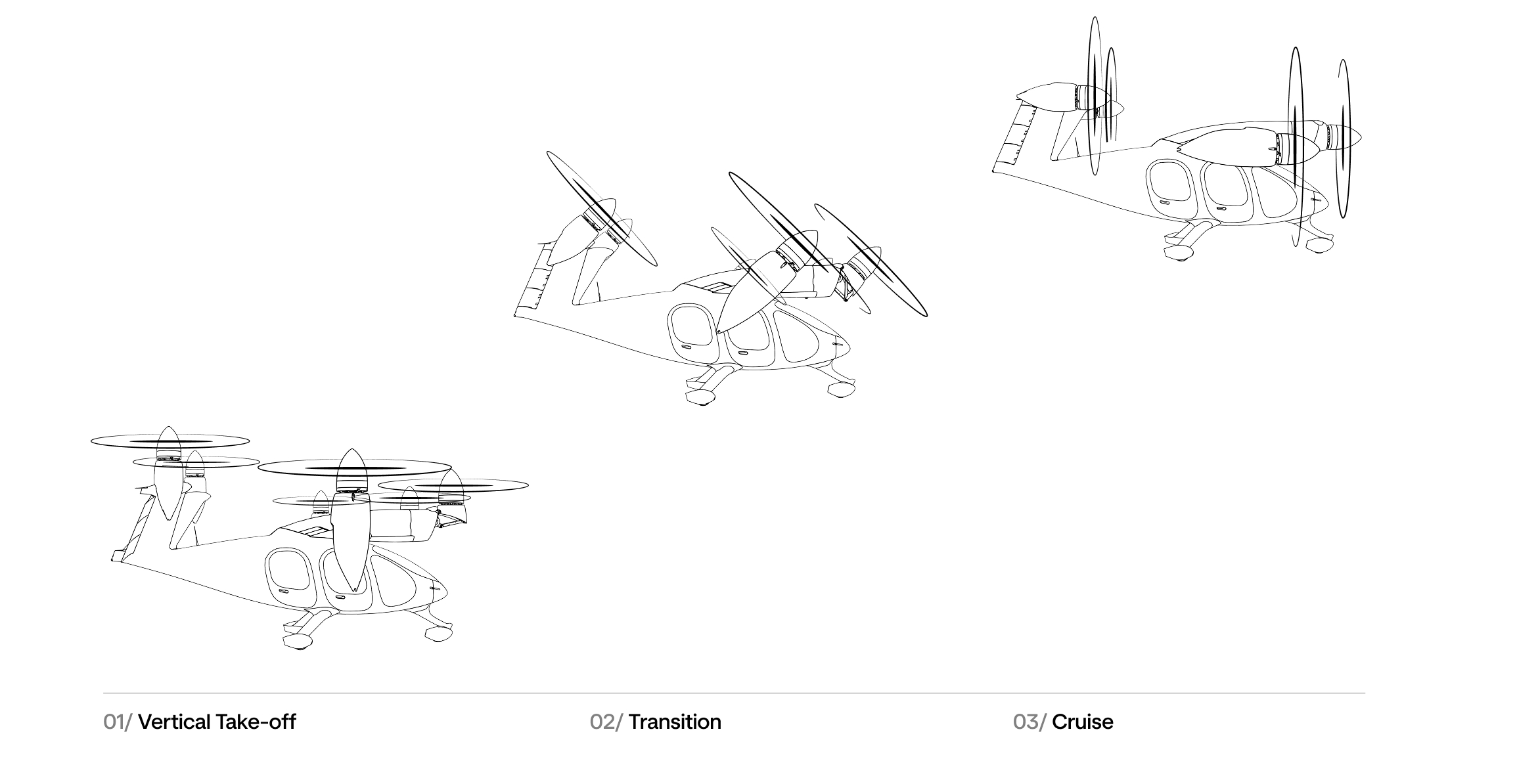
•Safe: Distributed electric propulsion has greater redundancy than centrally-located internal combustion engines. Each of our six propellers is powered by two independent electric motors, each in turn driven by independent drive-units. Each drive-unit draws power from one of four separate batteries onboard the aircraft.
This emphasis on redundancy is extended to other critical subsystems of the aircraft, including the flight computers, control surfaces, communications network and actuators. The result is a design intended to enhance safety across critical aircraft systems compared to similarly sized conventional aircraft and helicopters.
While these advancements in technology contribute to the overall safety of the aircraft, we recognize that safely delivering a commercial aviation operation requires both organizational and cultural commitments. We’ve made safety a core value, and we actively promote that value across the team.
Given our intent to both manufacture and operate our aircraft, we are developing a comprehensive, vertically-integrated, Enterprise Safety Management System (“SMS”) that covers aircraft design, manufacturing, global air operations, maintenance and training. Through the enterprise approach, SMS interfaces facilitate the exchange of information to continuously improve the safety of our aircraft and operations. In 2025, we formally initiated the implementation of a Part 5-compliant SMS for our OEM operations. This expansion builds on our established, fully compliant Part 5 SMS, which currently governs our Part 135 air operations. Our commitment to safety has been further validated by an independent, internationally recognized safety audit certification (IS-BAO Stage 2) qualification for our commercial air operations, demonstrating our adherence to internationally recognized aviation safety best practices and our dedication to continuous improvement.
•Quiet: Developing an aircraft with a low noise footprint that allows for regular operations within metropolitan areas is critical to community acceptance. In addition to the benefits afforded by an all-electric powertrain, we’ve devoted substantial engineering resources to reduce the noise signature of the aircraft even further. The result is an aircraft that is significantly quieter than a twin-engine helicopter, exhibiting a noise profile in the range of 65 dBA during takeoff and landing (the noisiest configuration), roughly the volume of a normal speaking voice. In over-head flight as low as 500 feet the aircraft is nearly silent. We have independently validated the noise footprint of our prototype aircraft through our work with the National Aeronautics and Space Administration (“NASA”).
• Performant: Our commitment to vertical integration and in-house development has allowed for optimization of systems and components across the aircraft, resulting in better energy efficiency, range, and speed than what would otherwise be available using commercial-off-the-shelf components. Our aircraft demonstrates energy efficiency comparable to best-in-class electric ground vehicles. While we anticipate our average journey to be around 25 miles, we believe the expected range and speed of our aircraft will allow us to service a more diverse set of passengers and trips, resulting in greater operational flexibility and reduced operating costs.
The end result is a transformational new electric aircraft that is uniquely capable of pioneering this exciting new market - all with a minimal environmental footprint.
The innovations that we’ve produced to deliver this best-in-class performance are supported by extensive proprietary intellectual property and defended by a robust patent portfolio. Over more than a decade of development, we have generated broad fundamental patents around the architecture of our aircraft and the core technologies that enable our best-in-class performance. We intend to continue to build our intellectual property (“IP”) portfolio with respect to the technologies that we develop and refine.
Charging
We have developed proprietary charging infrastructure optimized for electric aircraft. Joby’s Global Electric Aviation Charging System (GEACS) is designed to support the safe and efficient operations of electric aircraft, including simultaneous charging of multiple battery packs, battery conditioning for ultra-fast charging, and secure data download to address safety and cybersecurity. After 10 years of development, in 2023, we announced that we would open-source and share the specifications for the universal charging interface we developed, making it freely available to our industry.
The Urban Air Mobility Market
Ground-Based Transportation Networks are Under Strain
Population growth and urbanization are stretching ground-based transportation infrastructure to its limits. Today, more than half of the world’s approximately 8.2 billion people live in urban areas. According to a report by the United Nations (“UN”), the number of Megacities (metropolitan areas with 10 million people or more inhabitants) has increased from 8 in 1975 to 33 in 2025 and is projected to rise to 37 by 2050.
Transportation is the life-blood of urban areas, and population growth combined with increased urbanization will continue to push this infrastructure to the brink. According to a 2025 urban mobility report, Americans lost an average of 63 hours to traffic delays in 2024 (the highest level ever measured), and national congestion costs approximately $269 billion annually. The report also notes that congestion is increasingly occurring outside of traditional weekday rush hours.
New light rail lines can cost more than $100 million per mile in the U.S. and routinely exceed twice that number. Moving beneath the surface to expand subway networks is even more expensive, with new subway lines costing nearly $1 billion per mile. These ground-based networks cannot scale efficiently, and the costs are prohibitive. We believe that cities need a new, sustainable mobility solution.
Sizable Untapped Market Opportunity
Developing sustainable mobility solutions is particularly critical and timely. According to the U.S. Environmental Protection Agency (“EPA”), the top source of CO2 emissions in the U.S. is the transportation sector. Any solution to current and future transportation demands must embrace sustainability.
Over the past two decades, improvements in lithium-ion batteries and power electronics alongside the ever-increasing performance of microelectronics have enabled the development and deployment of new transportation solutions. The success of electric ground vehicles has fueled continued investments in these technologies. Battery energy densities, in particular, have improved such that application to aviation is now practical. Additionally, we believe that other future
technologies, such as hydrogen and solid-state batteries, have the potential to play an important role in decarbonizing flight in the longer term.
We believe that deploying a new type of aerial mobility network in cities represents an extensive market opportunity. Fundamentally, an aerial mobility network is nodal vs. the path-based nature of ground mobility. Each new node added to the network adds connectivity to all the other nodes, whereas each new mile of road, rail, or tunnel only extends one single route by one mile. In a nodal network, a linear increase in the number of nodes leads to an exponential increase in the number of connections.
In addition, the challenges associated with getting in and out of city centers can make frequent, casual travel impractical. We expect that streamlining this experience will open up previously untapped sources of latent demand, much the same way that the development of modern jetliners unlocked demand for transatlantic travel.
Leading investment banks and consulting firms have recently assessed the scale of this market. According to a 2021 report by Morgan Stanley, the urban air mobility sector's total addressable market is projected to reach $1 trillion globally by 2040. While this may initially reflect replacement of loud, carbon-fuel focused transportation with clean energy eVTOL options, we believe additional use cases and applications will emerge as the market evolves.
Business Model
Our business model is based on capturing the most value through vertical integration. We believe it is an important part of our design, manufacturing and operations as it enables us to develop a more performant aircraft and tightly-integrated operations with a goal of long-term, durable margins. Particularly in a new industry such as Urban Air Mobility, everything from the exacting certification requirements for an electric air taxi to the individual experience of end users can be better managed with a vertically integrated business model. When we started the business, the existing supply base did not have the technology we required in the size, dimensions and power needed. There are multiple examples of Joby-engineered parts, such as our flight control computer or direct drive electronic propulsion unit, that we believe generate more power in a smaller footprint and with fewer moving parts than ever before possible. Close collaboration between design, production and testing teams yield tight, iterative cycles, leading to innovative solutions in less time than if we were dependent on outside vendors. We expect this will be a competitive advantage now and in future years as our experience operating the air taxi service will flow into the design of next generation products.
Our Aerial Ridesharing Service
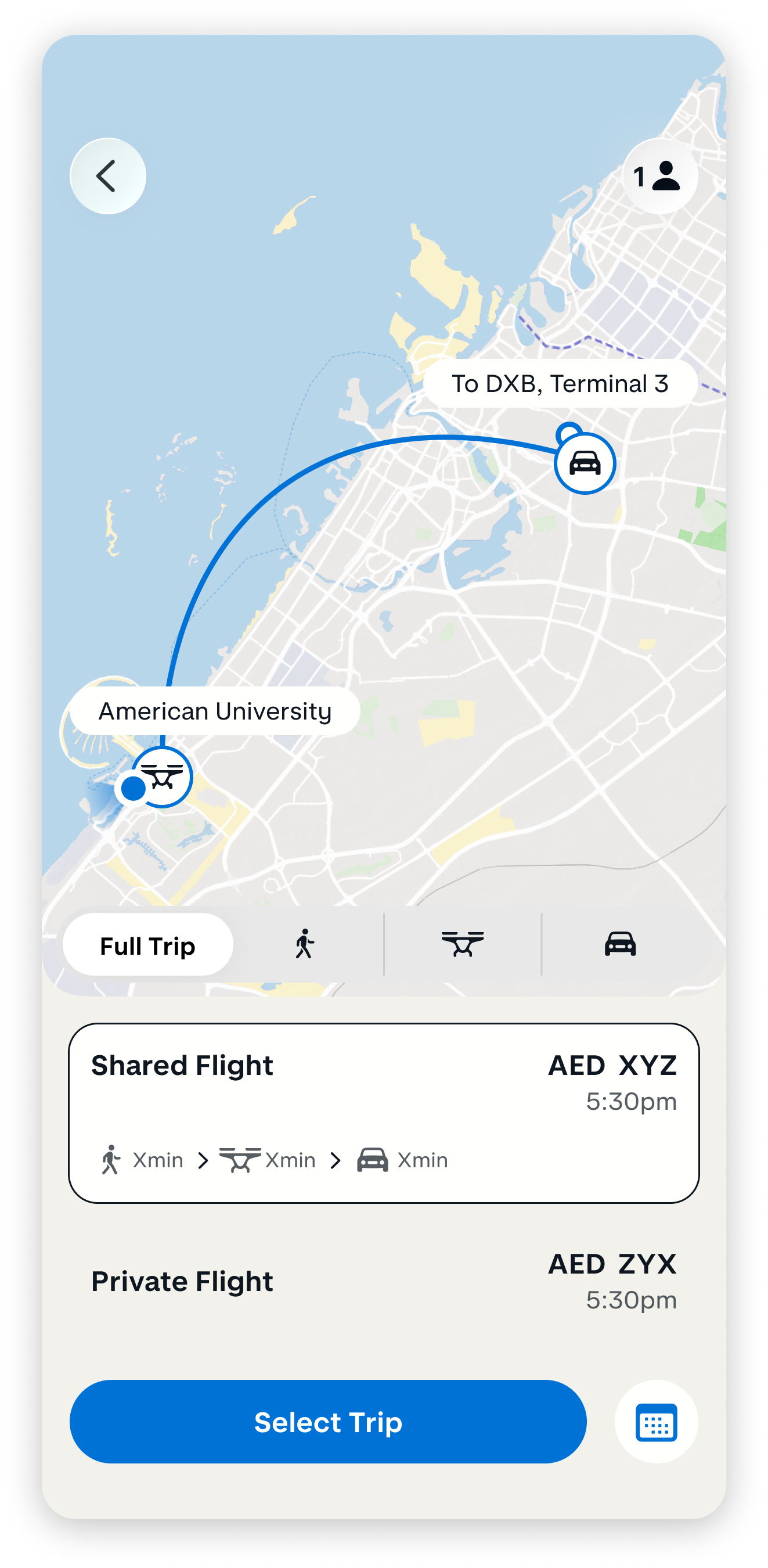
We intend to build an aerial ridesharing service powered by a network of eVTOL aircraft that we will manufacture and operate. We are developing an app-based platform that will enable consumers to book rides directly through our service. We also plan to integrate access to our service into leading third-party demand aggregation platforms, including through our partnerships with Uber and Delta Air Lines. Whether our service is accessed through our own platform, or through a partner app, we will integrate ground transportation providers for the first and last mile with our aerial service, providing a seamless, end-to-end travel experience.
We refer to trips that integrate air and ground legs together as ‘multimodal.’ By building network management software that efficiently sequences multimodal trips, we believe we can provide substantial time savings to travelers while coordinating the development of optimally-located vertiport infrastructure. Additionally, we are developing software that will coordinate multiple riders into each air leg, allowing us to drive high utilization rates for our aircraft and, in turn, progressive reduction in end-user pricing.
We believe that our app-based aerial ridesharing service will be fast, convenient, comfortable, environmentally sustainable and, over time, progressively more affordable. By maintaining full control over the design, development, test, manufacture and operations of our aircraft, we intend to deliver a service that is optimized from beginning to end, positioning us to be the leading company in this market.
Additional Opportunities at Scale
We believe that being early to market with the right aircraft will provide important first mover advantages that will enable us to steadily drive down end-user pricing in the years following commercial launch. Emerging technologies often benefit from positive network effects as the product or service enters the market, and we expect this to hold true for aerial ridesharing. We have identified 3 routes to bring our eVTOL aircraft to markets globally.
Joby Owned & Operated Air Taxi Service
We plan to own and operate our aircraft in markets including the United States and Dubai. As additional passengers enter the network, we expect utilization rates for our aircraft will increase, thereby improving unit economics and allowing costs to be amortized over a greater number of trips. At the same time, we believe reductions in per aircraft costs driven by greater manufacturing scale will be able to support progressively lower pricing to consumers while maintaining similar per aircraft unit profitability. As our networks expand and grow in utilization, their value is also expected to grow to produce enduring, long-term margins.
Affiliate Owned & Operated Service
In other markets, we intend to collaborate with established local partners to facilitate the operation of Joby eVTOL aircraft. This strategic approach offers several advantages. Partnering with regional entities allows Joby to leverage partners’ deep understanding of local regulations, market dynamics, and customer preferences. Additionally, by sharing startup costs with regional partners, we can reduce the financial burden and risks associated with entering new markets. This collaboration model not only fosters mutual growth but also supports Joby’s goal of scaling eVTOL operations globally, while adapting to the unique needs of each market.
Direct Sales & Defense
In other instances, we anticipate selling aircraft directly into markets. In 2025, we signed a memorandum of understanding with Abdul Latif Jameel to explore the delivery of up to 200 electric aircraft and related services valued at approximately $1 billion in Saudi Arabia, and signed a letter of intent to sell aircraft and services valued at up to $250 million to Alatau Advance Air Group in Kazakhstan. We are also working with L3Harris to adapt our existing eVTOL aircraft platform to address defense applications which may also involve aircraft sales in the future.
Certification
Type Certification
In the U.S., new aircraft designs are required to pass through the rigorous FAA design certification process, known as type certification, before the aircraft can be issued a standard airworthiness certificate to fly in the National Airspace System (“NAS”). This is an exacting process that requires extensive ground and in-flight testing with the FAA. We anticipate we will initially certify the aircraft for day and night visual flight rules (“VFR”) operations and we plan to amend the design to include instrument flight rules (“IFR”) capabilities over time.
Our aircraft was originally intended to be certified in line with the FAA's existing Part 23 requirements as a normal category piloted electric airplane that can also takeoff and land vertically. We began working with the FAA in 2017, and in 2020 we became the first eVTOL company to receive a signed, stage 4 G-1 certification basis from the FAA. The G-1 certification basis is an agreement with the FAA that lays out the specific requirements that need to be met by our aircraft for it to be certified for commercial operations. In May 2022, the FAA indicated that they were revisiting the decision to certify all eVTOLs under Part 23 and would, instead, require certification under the “powered lift” classification. Based on the FAA’s revised certification requirements, we signed an updated G-1 certification basis in July 2022, which was published in the federal register in March 2024.
We think of the type certification process in five stages. Stages one to three can be considered the “definition”
phase, while stages four and five are the “implementation” phase. Progress in type certification is not always linear, meaning it is possible to make simultaneous progress in different stages on different aircraft parts or systems, depending on their maturity.
•Stage 1 - Certification Basis: The Company works with the FAA to define the scope of the type certification project, reaching an agreement on what type of aircraft is being built and which set of rules and regulations will apply.
•Stage 2 - Means of Compliance: The Company looks more closely at the safety rules and identifies the means of demonstrating compliance with them.
•Stage 3 - Certification Plans: The Company develops a wide range of detailed certification plans stipulating which tests need to be performed for each system area in order to satisfy the means of compliance.
•Stage 4 - Testing & Analysis: The Company plans, documents and completes thousands of inspections, tests and analyses in accordance with the certification plans previously drawn up in the third stage.
•Stage 5 - Show & Verify: The results of the testing are verified by the FAA. Upon successful completion of this stage, a type certification is issued.
With a mature design based on thousands of test flights to date, we are well on our way towards certification and are engaging with the FAA to perform the component and flight testing required to earn FAA type certification.
Additionally, in September 2025 the President issued an Executive Order directing the U.S. Department of Transportation (“DOT”) and FAA to ensure that mature eVTOL aircraft can begin operations in select markets ahead of full FAA certification. This eVTOL Integration Pilot Program, or “eIPP” is designed to allow mature aircraft designs to demonstrate eVTOL use cases, such as passenger transportation, cargo delivery, and emergency response, ahead of achieving type certification. We supported several state and local governments in submitting proposals under the eIPP.
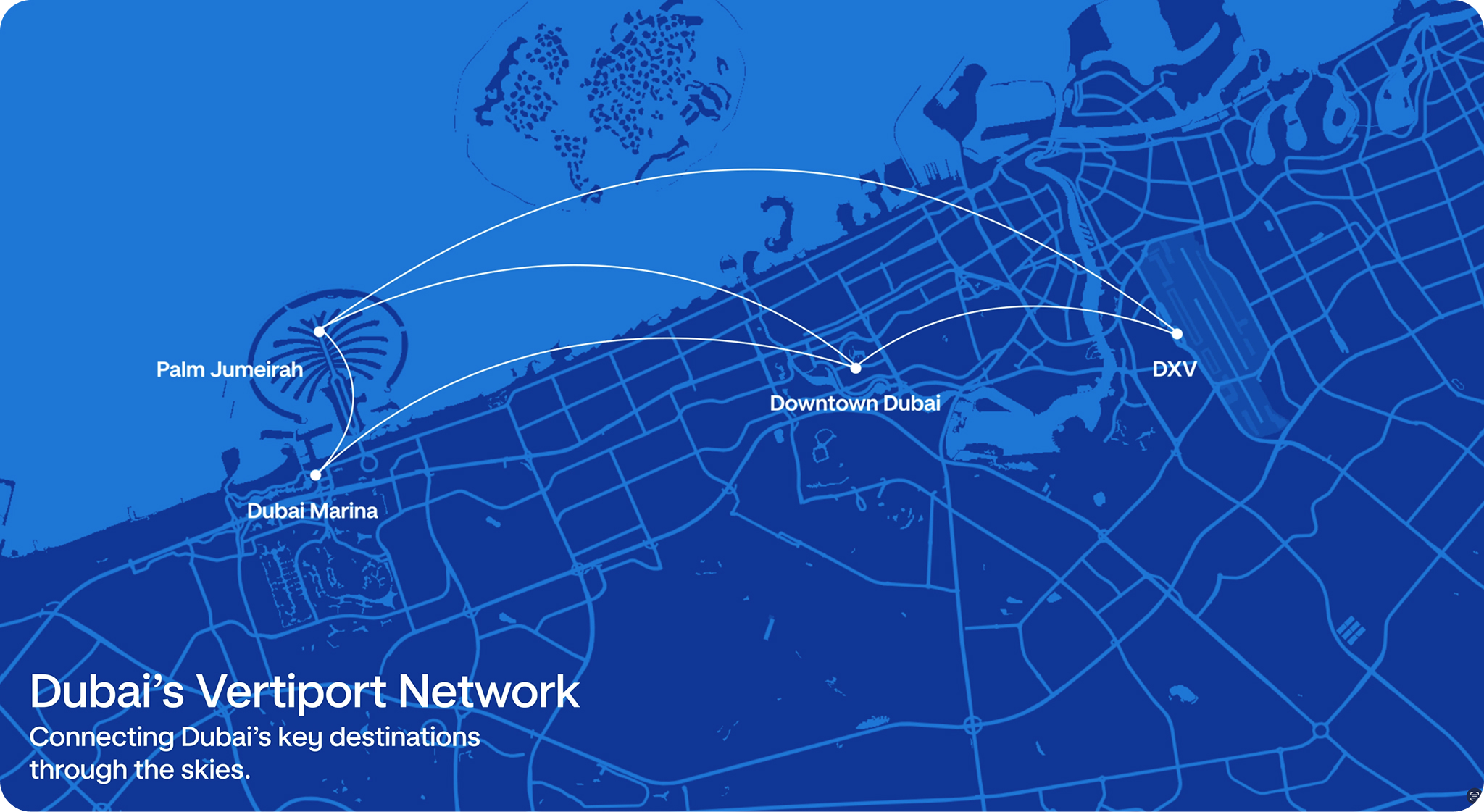
We expect the FAA type certificate will be reciprocated in certain international markets pursuant to bilateral agreements between the FAA and its counterpart civil aviation authorities. In 2022, we applied for aircraft certification in the United Kingdom and Japan and in 2024, we applied for aircraft certification in Australia, following announcements by regulators in those countries adopting streamlined certification processes based on FAA certification. In 2023, we signed an agreement with Road and Transport Authority of Dubai (“RTA”) for Joby to provide air taxi services in Dubai. The RTA agreement includes a roadmap for local approval by the UAE General Civil Aviation Authority (“GCAA”) that could precede type certification by the FAA. These arrangements provide a means of efficient international expansion as we develop commercial operations around the world.
Our path to certification leverages a large body of existing processes, procedures and standards. However, many of the rules for eVTOL certification and operations are still being finalized by the FAA, and the FAA could revise the existing rules and regulations or impose additional requirements that would extend our timeline for certification.
Production Certification
We are developing the systems and processes needed to obtain FAA production certification and intend to obtain our production certificate shortly after completion of our aircraft type certificate. We believe there are opportunities to leverage advanced manufacturing techniques such as additive manufacturing to further improve the performance of the aircraft. However, if additively manufactured components or other advanced production processes cannot be certified expediently, our aircraft can be produced using conventional aerospace manufacturing techniques.
Operating Certification
The U.S. Department of Transportation (“DOT”) and the FAA exercise regulatory authority over air transportation operations in the U.S. Our intended transportation service is expected to be regulated by the Federal Aviation Regulations, including 14 Code of Federal Regulations 135 (“Part 135”). We received our Part 135 Air Carrier Certificate in 2022, demonstrating the advancement of our procedures and training program and, importantly, enabling our team to begin utilizing the operations and customer technology platforms that will underpin our multi-modal ridesharing service in the future. Air carriers holding Part 135 operations specifications can conduct on-demand operations, which may include limited scheduled operations. If such an air carrier receives a commuter air carrier authorization from the DOT, the air carrier may provide unlimited scheduled operations as well as on-demand operations. We received our Part 145 Repair Station Certificate in February 2024, which qualifies us to perform select aircraft maintenance activities and will lay the foundation for us to perform maintenance, repair, and overhaul services on our eVTOL aircraft once it is certified for commercial operations. Additionally, in December 2024, we received our Part 141 Flight School Certificate for our Joby Aviation Academy pilot training program.
In October 2024, the FAA published the Special Federal Aviation Regulations (“SFARs”), which include operational regulations for eVTOL aircraft. We will need to comply with these SFARs as we add our aircraft to our Part 135 operating certificate. If there are other changes or revisions to the SFARs or other applicable regulations, this could delay our ability to obtain type certification, and could delay our ability to launch our commercial passenger service.
Our operations may become subject to additional federal, state and local requirements in the future.
Airspace Integration
The aircraft has been designed to be operated within the existing airspace rules and regulations with a qualified pilot in command onboard the aircraft. As the density of air traffic increases, we believe there are opportunities to expand ground infrastructure and create air traffic efficiencies. Over time, we anticipate the importance of working with the FAA, local authorities and other stakeholders to identify and develop procedures along high demand routes to support increased scale and operational tempo. Constructs for operating along those routes may include specific airspace corridors like those outlined by the FAA. In the long term, digital clearance deliveries, airspace authorizations and automated coordination between service providers and operators may be required to further increase airspace scalability. We expect to continue to be involved in long-term activities to develop concepts and technologies (for example those led by NASA and the FAA) to further enable scaling towards mature and autonomous operations.
Policy Engagements with Decision Makers & Communities
Providing a successful air transportation service requires collaboration with local communities to ensure the services provide the right solutions in the right locations. We plan to grow our engagement at the state and local levels within the U.S. and with key international partners in the coming years.
While the regulation of the aircraft and its operation with the NAS falls within the purview of the FAA, takeoff and landing locations often require state and local approval for zoning and land use. In many cases, existing airports and heliports are subject to regulations by local authorities.
Noise Regulations
The Airport Noise and Capacity Act of 1990 recognizes the rights of operators of airports to implement noise and access restrictions so long as such programs do not interfere unreasonably with interstate or foreign commerce or the national air transportation system. In addition, states and local municipalities are able to set ordinances for zoning and land use, which
may include noise or other restrictions such as curfews. Finally, foreign governments may allow airports and/or municipalities to enact similar restrictions. Accordingly, minimizing the volume and characteristics of noise within and above communities has been an important focus for us in order to drive community acceptance.
Our aircraft has been designed to minimize noise to allow for operations in and out of new vertiports that are nearer to where people want to live and work. At our noisiest configuration, the aircraft has a noise profile in the range of 65 dBA, roughly the volume of a normal talking voice. Given our low noise profile, we do not expect our operations to be constrained to on-airport operations.
Partnerships
We believe that our strategic relationships reflect another point of competitive differentiation. Across each of the important activities of high-volume manufacturing, go-to-market strategy and pre-certification operations, we have established strong collaborations and relationships with Toyota, Delta, Uber, L3 Harris and the Department of Defense (“DOD”) to help achieve our objectives and de-risk our commercial strategy.
Toyota Motor Corporation
As of December 31, 2025, Toyota has invested nearly $650 million in Joby, making Toyota our largest outside investor. In 2024, Toyota signed a stock purchase agreement pursuant to which they committed to invest up to an additional $500 million, subject to the satisfaction of certain closing conditions. In May 2025, Toyota invested the first $250 million contemplated under the purchase agreement. In addition to their substantial financial backing, Toyota engineers are working shoulder to shoulder with their Joby counterparts on a daily basis, collaborating on projects such as factory planning and layout, manufacturing process development and design for manufacturability. In 2023, we signed a long-term supply agreement with Toyota to supply key powertrain and actuation components for our aircraft.
We believe that our collaboration with Toyota has provided and continues to provide us with a significant competitive advantage as we design and build out our high-volume manufacturing capability. In addition to being the world’s largest automaker, Toyota is globally recognized for delivering quality, safety and reliability at scale, all of which are necessary characteristics in aerospace manufacturing. We believe this makes Toyota a strong collaboration partner as we continue to develop our high-volume manufacturing capabilities.
Uber Technologies, Inc.
We believe that our partnership with Uber Technologies, Inc. and our acquisition of Uber’s Elevate business, provides us with two important competitive advantages in our go-to-market planning and execution.
Through our 2021 acquisition of Elevate we welcomed experienced team members from Uber and acquired a set of software tools focused on planning and operations the Elevate team had developed over several years. We believe this positions us to make uniquely informed, data-driven decisions in the lead up to commercial launch, as well as accelerating our operational readiness.
Additionally, our collaboration agreement with Uber provides for the integration of our aerial ridesharing service into the Uber app across global markets. We believe this will provide a best-in-class platform to funnel demand to our aerial ridesharing service, while allowing us to reduce customer acquisition costs in the early years of commercial operations. Uber will also be reciprocally integrated into any future Joby Aviation mobile application on a non-exclusive basis to service the ground-based component of multi-modal journeys booked by customers through our application. In September 2025, we announced plans to integrate Blade’s air mobility services into the Uber app, and we are working with Uber to integrate ground transportation into our planned service in the UAE. The goal of this mutual integration is to ensure passengers can access a multi-modal travel experience, seamlessly transitioning from ground-to-air-to-ground with unified, one-click booking.
Delta Air Lines, Inc.
In October 2022, we entered into a collaboration agreement with Delta Air Lines, Inc. (“Delta”) to develop a long-term strategic relationship for a premium airport transportation service that we plan to offer to Delta passengers in select markets through the Delta booking platform. At the same time, Delta invested $60 million through a purchase of our common stock and also received warrants which, if exercised, could expand their total investment to $200 million. In January 2026, Delta exercised 7,000,000 warrants at an exercise price of $10 per share. We believe that our relationship with Delta, in addition to providing additional capital, will be another important method of customer acquisition when we launch our commercial
passenger service, and will also provide opportunities to leverage Delta’s expertise in providing a seamless passenger experience and expertise in building out infrastructure at key airports.
U.S. Air Force
Throughout our company’s history, Joby has benefitted from a relationship with the United States Air Force (“USAF”). As a leader in eVTOL technology and a participant in numerous public-private sector programs, Joby has delivered value in multiple USAF programs and continues to target new ones.
In December 2020, we became, to our knowledge, the first company to receive airworthiness approval for an eVTOL aircraft from the USAF. In 2023, we marked our first delivery to a customer by delivering and flying the first eVTOL aircraft at Edwards Air Force base as part of our contract with the DOD, and in January 2025, we delivered our second aircraft under this contract. The Agility Prime program also supported our June 2024 flight of our hybrid hydrogen-electric demonstrator.
With growing USAF interest in hybrid powertrains and autonomy in aviation, we leveraged our existing aircraft platform to address these areas. In the summer of 2025, we participated in the USAF’s Resolute Force Pacific (“REFORPAC”) exercise, successfully demonstrating our Superpilot(TM) autonomous flight technology, logging over 7,000 miles of autonomous operations. We continue to work on autonomy programs with the USAF. Additionally, we are working with L3Harris on leveraging our platform to address opportunities to sell aircraft for defense applications. Just three months after announcing the aircraft concept and collaboration with L3Harris, we conducted the first flight of our turbine electric autonomous VTOL aircraft. The successful REFORPAC exercise positions Joby to compete for upcoming Department of Defense programs. In addition, our work with defense partners can inform future integration of autonomous capabilities into our commercial air taxi platform.
Dubai Road & Transport Authority
In 2024, Joby signed a definitive agreement with Dubai’s Road and Transport Authority (“RTA”) to launch air taxi services in the Emirate. The agreement provides Joby with the exclusive right to operate air taxis in Dubai for six years and secures a variety of support from the RTA, including financial mechanisms, for entry and maturing of service operations in Dubai.
Future Market Opportunities
We believe there are opportunities to address markets that are adjacent to our core mobility business, including delivery and logistics, communications, and emergency services. We may make select investments to address these market adjacencies over time.
We also believe that developments in advanced flight controls, battery technologies and alternative methods of energy storage could have a meaningful impact on our core mobility business. Advanced flight controls, including additional “pilot assist” features and, in time, fully-autonomous flight, may allow us to drive-down cost and lower customer pricing as well as relieve operational constraints to scaling our service. Improvements in battery technology or alternative methods of energy storage may allow us to increase the range, speed and/or payload of our vehicles, dramatically expanding the range of trips and use-cases we can serve.
We are investing, and will continue to invest, strategically in these areas to ensure that we are well-positioned to capture the benefits offered by these new developments. From time to time, we may seek to partner with or acquire, when appropriate, companies that have products, personnel, and technologies that complement our strategic direction. For example, we believe that other future technologies, such as hydrogen fuel cells or solid-state batteries, have the potential to play an important role in decarbonizing flight in the longer term and may seek to invest in or develop these opportunities as they arise. In 2021 we acquired H2FLY, which, in 2023, accomplished the world’s first piloted flight of a liquid hydrogen-powered electric aircraft. In 2024, using a fuel cell system designed and built by H2FLY, we successfully flew a hydrogen-electric demonstrator based off of our current aircraft design more than 500 miles. Additionally, in 2024 we acquired certain assets of the autonomy division of Xwing Inc., and the acquired technology was subsequently used to fly a fully-autonomous Cessna Caravan over 3,900 miles as part of the U.S. Air Force’s Agile Flag 24-3 exercise.
Intellectual Property
Our success depends in part upon our ability to protect our core technology and intellectual property. To establish and protect our proprietary rights, we rely on a combination of intellectual property rights (e.g., patents, patent applications, trademarks, copyrights, and trade secrets, including know-how and expertise) and contracts (e.g., license agreements,
confidentiality and non-disclosure agreements with third parties, employee and contractor disclosure and invention assignment agreements, and other similar contractual rights).
As of January 31, 2026, we have over 330 issued or allowed patents (of which over 230 are U.S. filings) and over 250 pending patent applications (of which over 160 are U.S. filings). The patent portfolio is primarily related to eVTOL vehicle technology and UAM/aerial rideshare technology. We regularly file patent applications and from time to time acquire patents from third parties.
Our patent filings include over 190 issued or allowed patents and over 180 pending patent applications relating to our aircraft, its architecture, powertrain, acoustics, energy storage and distribution systems, flight control system and system resiliency, as well as certain additional aircraft configurations and technologies. Additionally, we have over 130 issued or allowed patents and over 70 pending patent applications related to aerial rideshare technology, such as fleet and infrastructure utilization, routing, air traffic coordination, rideshare software applications, vertiport infrastructure, and ancillary computer technologies.
Our Commitment to having a Positive Impact
By developing an efficient, all-electric aircraft with no operating emissions, a low noise footprint and multiple redundancies designed to enhance safety, we believe we can help reduce congestion in cities while also reducing the transportation sector’s environmental impact. We are building a dedicated workforce to achieve this goal while aiming to adhere to best practices in risk assessment, mitigation and corporate governance.
Our Board of Directors and management team oversee the company’s strategy and programs as it relates to corporate responsibility topics. At the board level, this specifically includes our Nominating and Corporate Governance Committee and the Compensation Committee of our Board of Directors. Topics range from the Company’s environmental impact, talent management and workforce development, and corporate governance practices.
Our Focus on Safety and Sustainable Manufacturing
With safety as a core value, we emphasize the importance of safety in everything that we do. This includes adherence to safety rules, best practices, and compliance standards. Every employee is trained in the safety policies and procedures that are relevant to their role, and we encourage all employees to participate in company-wide safety initiatives, including participating in our non-punitive safety reporting program to identify hazards and reduce risks. Employees are reminded that everyone is part of the safety team and we conduct regular audits with the goal of ensuring proper safety procedures are being used and that hazard identification and risk assessment information is being collected and acted on in a timely and appropriate manner.
Our engineering and design standards are designed with the goal of operating in a safe, efficient, sustainable and compliant manner, and encourage us to be leaders in pursuing environmentally friendly production practices. This is demonstrated in our energy and waste management programs. Our Sustainability team works closely with our operating units and Facilities teams to measure our energy consumption, identify reduction opportunities and implement energy efficiency measures. We strive to source renewable electricity for all primary facilities in the most cost effective manner, further reducing our manufacturing impact. In 2024, we increased our total renewable electricity procured by 19% while significantly increasing manufacturing capacity. Additionally, these teams along with our Environmental Health and Safety team ensure proper handling and disposal of our manufacturing materials including carbon fiber, spent batteries, and electronic waste. As our testing and production operations have scaled, we have continued to recycle our aircraft batteries, and any carbon fiber scraps are recycled into inputs for high strength steel. These programs allow us to streamline our manufacturing lines, reduce hazardous waste processing costs and reduce our impact.
Social and Human Capital
To achieve our goal of enabling the world to connect faster and more easily with the people and places that matter most, we will need to attract and retain employees with a diverse set of skills and perspectives as we grow our business. Many of our employees are located in highly competitive labor markets. In addition to competitive cash, benefits, and equity compensation, offering employees a compelling vision and an opportunity to positively impact their communities is a key part of our strategy to grow our workforce. Additionally, we invest in the communities where we operate, with programs enabling accessibility, education and training. This has multiple benefits including broadening the reach of new technologies such as electric aviation, improving awareness and acceptance to operate in communities, extending opportunities to underserved communities, and developing our future workforce. Our manufacturing apprentice program in
our Marina, California location provides paid training opportunities for individuals with no prior experience to prepare them for fulfilling careers in aerospace manufacturing.
We work diligently to create a work environment that is welcoming for all. We provide equal opportunities for growth, success, promotion, learning and development. We encourage employee engagement through a variety of mechanisms including seminars and panel discussions where our employees can gather and discuss topics that are important to them and provide feedback on how we can better support their growth and career development. We are focused on building support across all teams and individuals, ensuring everyone has a voice, and treats each other with respect.
As of January 31, 2026, we had 2,559 employees. None of our employees are represented by a labor union. We believe we have good relationships with our employees and have not experienced any interruptions of operations due to labor disagreements.
Competition
We believe that the primary sources of competition for our service are ground-based mobility solutions, other eVTOL developers/operators and local/regional incumbent aircraft charter services.
We believe the primary factors that will drive success in the UAM market include:
•the performance of our eVTOL aircraft relative to both competitive eVTOL aircraft and traditional aircraft;
•the ability to certify the aircraft and begin service operations in a timely manner;
•the ability to manufacture efficiently at scale;
•the ability to scale the service adequately to drive down end-user pricing;
•the ability to capture first-mover advantage, if any;
•the ability to offer services and routes that provide adequate value proposition for passengers;
•the ability to develop or otherwise capture the benefits of next generation technologies; and
•the ability to deliver products and services to a high-level of quality, reliability and safety.
While there are differentiated approaches to vehicle designs and business models, we believe that our aircraft and vertically-integrated approach offer the greatest long-term prospects to certify and produce the best aircraft to serve our customers and, in turn, to monetize the full value chain from development through operations.
Item 1A. Risk Factors
In the course of conducting our business operations, we are exposed to a variety of risks. Any of the risk factors we describe below have affected or could materially adversely affect our business, financial condition, results of operations, and brand. The market price of shares of our common stock could decline, possibly significantly or permanently, if one or more of these risks and uncertainties occurs. Certain statements in “Risk Factors” are forward-looking statements. See “Special Note Regarding Forward-Looking Statements.”
Risks Related to Our Business and Industry
Certification & Regulatory
We may be unable to obtain relevant regulatory approvals for the commercialization of our aircraft or operation of our mobility service, either in the United States or in foreign markets.
The commercialization of new aircraft and the operation of an aerial mobility service requires certain regulatory authorizations and certifications, including Type Certification, Production Certification and an air carrier certificate issued by the FAA under Part 119 with Part 135 operations specifications. While we have received our Part 135 Air Carrier Certificate and anticipate being able to obtain the remaining required authorizations and certifications, we may be unable to do so on the timeline we project or at all. Circumstances outside of our control could delay the receipt of our required certifications. For example, FAA staffing depends, in large part, on the annual appropriations process and the agency’s ability to retain and recruit sufficient resources with relevant experience and expertise. Failure to pass an annual appropriation bill has in the past resulted in temporary government shutdowns. A future shutdown, or a failure by Congress to pass an FAA reauthorization bill (or extension) could delay the rulemaking and certification process. Additionally, recent focus on reducing the size of the federal workforce could negatively impact the availability of resources within the FAA which could delay our progress towards certification.
We are also pursuing certification of our aircraft and approval to operate our services in other countries. While many of these countries have established processes for validating a type certificate issued by the FAA, others, such as the UAE, are developing new processes to leverage our work with the FAA and provide a path for approval of initial operations that could precede type certification in the United States. The regulatory agencies charged with granting approval for our aircraft and our services in other countries may be subject to many of the same funding and staffing risks that exist in the United States. Additionally, pursuing certification and operations outside the United States is subject to additional risks, including regulatory regimes that may be less familiar to us or may have less experience in certifying and approving new and novel aircraft. If we fail to obtain any of the required authorizations or certificates, or do so in a timely manner, or any of these authorizations or certificates are modified, suspended or revoked after we obtain them, we may be unable to launch our commercial service or do so on the timelines we project and may have an adverse impact on our business, financial condition and results of operations.
Regulatory authorities may disagree with our view that integrating our service into the National Airspace System is possible without changes to existing regulations and procedures.
There are a number of existing laws, regulations and standards that apply to our aircraft and our service, including standards that were not originally intended to apply to eVTOL aircraft or air taxi services. While our aircraft and our service are designed, at launch, to operate within the existing U.S. regulatory framework, the FAA or other regulatory authorities within the markets in which we intend to operate may disagree with this view, which may prohibit, restrict, or delay our ability to launch in the relevant market. In addition, any changes to the NAS, as a result of privatization or otherwise, could increase the costs to operate our service. Finally, regulatory authorities have in the past and may in the future introduce changes specifically to address high-volume flights that could delay our ability to launch our service and have an adverse impact on our business, financial condition and results of operations.
If current airspace regulations are not modified to increase air traffic capacity, our business could be subject to considerable capacity limitations.
A failure to increase air traffic capacity in the airspace serving key markets, including around major airports, could create capacity limitations for our future operations and could have a material adverse effect on our business. Weaknesses in the NAS and the Air Traffic Control (“ATC”) system, such as outdated procedures and technologies, could result in capacity constraints during peak travel periods or adverse weather conditions, resulting in delays and disruptions to our service. While our aircraft is designed to operate in the NAS under existing rules, our business at scale will likely require airspace allocation for UAM operations and could result in regulatory changes. Our inability to obtain sufficient access to the NAS or to comply with any regulatory changes could increase our costs and pricing of our services, which could reduce demand and have an adverse impact on our business, financial condition and results of operations.
Changes in government regulation could increase our operating costs or extend our certification timeline.
Aerospace manufacturers and aircraft operators are subject to extensive regulatory and legal requirements that involve significant compliance costs. In May 2022, the FAA decided to certify eVTOLs under the “powered lift” classification, rather than existing Part 23 requirements for Normal Category Airplanes. The FAA finalized the relevant operational regulations, or Special Federal Aviation Regulations (“SFARs”), for eVTOL aircraft in October 2024. If the FAA requires further modification to our existing G-1 certification basis, or if there are other regulatory changes or revisions to the SFARs or other regulations, this could delay our ability to obtain type certification, and could delay our ability to launch our commercial passenger service.
The DOT and the FAA could issue additional regulations relating to the operation of our aircraft or further revise existing requirements that could require significant expenditures, resulting in additional time to certification as well as increased costs for us and our passengers. Additional laws, regulations, taxes and airport rates and charges have been proposed from time to time that could significantly increase the cost of our operations or reduce the demand for air travel. If adopted, these measures could have the effect of raising fares, reducing revenue and increasing costs, which could have an adverse impact on our business, financial condition and results of operations.
To sell air transportation services in the United States, we will also need DOT authorization of the sale of any charter flights and by-the-seat ridesharing services. The DOT further prescribes standards for, among other things, advertising, ticket refunds, baggage liability, consumer disclosures, customer service commitments, customer complaints and the transportation of passengers with disabilities. In the future, the DOT may adopt additional regulations that increase the costs or otherwise adversely impact our business, financial condition and results of operations.
We may be subject to security regulation that will increase our operating costs.
The Transportation Security Administration (“TSA”) is responsible for certain civil aviation security matters, including the regulation of air carriers that operate under Part 135 of the Federal Aviation Regulations as well as passenger and baggage screening at U.S. airports. Because we are introducing an innovative service that operates from both airports and vertiports, the security regulatory scheme that will apply is uncertain. If the TSA imposes burdensome security requirements on our services, it could reduce the convenience of our service for our customers, resulting in lower demand and higher cost and have an adverse impact on our business, financial condition and results of operations.
We are subject to stringent U.S. export and import control laws and regulations, which may change. We may be unable to comply with these laws and regulations or U.S. government licensing policies, or to secure required authorizations in a timely manner.
Our business is subject to stringent U.S. import and export control laws and regulations as well as economic sanctions laws and regulations. We are required to import and export our products, software, technology and services, and run our operations in the United States, in full compliance with such laws and regulations, which may include the Export Administration Regulations (“EAR”), the International Traffic in Arms Regulations (“ITAR”), and economic sanctions administered by the Treasury Department’s Office of Foreign Assets Control (“OFAC”). Similar laws impact our business in other jurisdictions. These trade controls prohibit, restrict, or regulate our ability to, directly or indirectly, export or transfer certain hardware, technical data, technology, software, or services to certain countries and territories, entities, and individuals, and for certain end uses. If we are found to be in violation of these laws and regulations it could result in civil and criminal penalties, including the loss of export or import privileges, debarment and reputational harm. While none of our current technologies require us to maintain a registration under ITAR, we may become subject to ITAR in the future.
Pursuant to these trade control laws and regulations, we are required, among other things, to (i) determine the proper licensing jurisdiction and export classification of products, software and technology, and (ii) obtain licenses or other forms of authorization to conduct our business. These requirements include the need to get permission to release controlled technology to foreign person employees and other foreign persons. Changes in U.S. trade control laws and regulations, or reclassifications of our products or technologies, may restrict our operations. The inability to secure and maintain necessary licenses and other authorizations could negatively impact our ability to compete successfully or to operate our business as planned. Any changes in the export control regulations or U.S. licensing policy, such as those necessary to implement U.S. commitments to multilateral control regimes, may restrict our operations. Given the great discretion the government has in issuing or denying such authorizations, there can be no assurance we will be successful in our future efforts to secure and maintain necessary licenses, registrations, or other regulatory approvals which may have an adverse impact on our business, financial condition and results of operations.
Global trade policies, including tariffs, could adversely affect our operations.
The global economy has recently seen a rise in tariffs and other protective trade measures. In 2025, significant new and expanded tariffs were imposed by the United States, and reciprocal tariffs were imposed by other countries. These tariffs
have applied to a wide range of finished goods and raw materials. In some cases, these tariffs were later paused, modified or suspended, making it difficult to plan for or predict the ultimate impact of these tariffs. In response to the U.S. imposed tariffs and other geopolitical events, some countries have imposed or threatened to impose reciprocal tariffs, export restrictions and other protective trade measures. While we manufacture many of the components for our aircraft in the United States, our supply chain depends, in part, on components and raw materials acquired from third-party suppliers across the globe, particularly with respect to batteries and related materials. While tariffs have not had a material impact on our business, financial condition or results of operations to date due to the limited scale of our prototype manufacturing and focus on certification efforts, over time, new tariffs or other restrictions imposed in connection with trade wars or political instability could increase the costs of raw materials and other goods, both for us and our suppliers, and could make it difficult to source certain materials or components on which we rely for our production and certification efforts. This could impact our business, financial condition and prospects, particularly as we begin to scale our manufacturing operations and produce aircraft for commercial use. In addition, the imposition of tariffs and threats of tariffs has contributed to volatility in global equity markets which, we believe, has also impacted and may continue to impact the price of our common stock.
We are subject to rapidly changing and increasingly restrictive laws, regulations and other obligations relating to privacy, data protection, and data security, which may be costly and difficult to comply with.
Our Blade subsidiary collects, uses, and discloses personal information of passengers and others in the course of operating its business, and we will do so in connection with our air taxi services. These activities are regulated by a variety of domestic and foreign laws and regulations relating to privacy, data protection, and data security, which are complex, rapidly evolving, and increasingly restrictive.
Several states and foreign countries have granted residents expanded rights related to their personal information, including the right to request deletion of their personal information and receive detailed reports of how their personal information is used and shared. Such laws and any laws adopted in the future could have potentially conflicting requirements that would make compliance challenging.
Despite our best efforts, we may not be successful in complying with the rapidly evolving privacy, data protection, and data security requirements. Any actual or perceived non-compliance could result in litigation and proceedings against us by governmental entities, passengers, or others, which could result in fines, penalties, limited ability or inability to operate our business, offer services, or market our platform in certain jurisdictions, negative publicity and harm to our brand and reputation, which could have a material adverse effect on our business, financial condition or results of operations.
Market & Service
The market for UAM has not been established with precision. Customers may be reluctant to adopt this new form of mobility, or to pay our projected prices.
Our growth is highly dependent upon consumer adoption of an entirely new form of mobility offered by eVTOL aircraft and the UAM market. If the public does not perceive UAM as beneficial, chooses not to adopt this new form of mobility, or is unwilling to pay the prices we project for our services, then the market for our offerings may not develop, may develop more slowly than we expect or may not achieve the growth potential we expect. As a result, the number of potential passengers using our services cannot be predicted with any degree of certainty, and we cannot assure you that we will be able to operate in a profitable manner in any of our targeted markets. Our success in a given market will depend on our ability to develop a service network that provides passengers significant time savings when compared with alternative modes of transportation and accurately assess and predict passenger demand and price sensitivity, which may fluctuate based on a variety of factors, including general economic conditions, quality of service, negative publicity, safety incidents, perceived political or geopolitical affiliations, or general dissatisfaction with our services. If we fail to attract passengers, deliver sufficient value to our passengers, or accurately predict demand and price sensitivity, it could materially adversely affect our business, financial condition and results of operations.
We may face delays in launching our commercial service.
We will need to address significant regulatory, political, operational, logistical, and other challenges in order to launch our commercial service. We do not currently have infrastructure in place to operate the service and such infrastructure may not be available or may be occupied on an exclusive basis by competitors. We also have not yet received FAA certification of our aircraft or other required airspace or operational authority and approvals, which are essential to operate our service, and for aircraft production and operation.
Our pre-certification operations may also reveal issues with our aircraft design, which could result in certification delays. For example, in February 2022, one of our remotely piloted, experimental prototype aircraft was involved in an accident during flight testing. Although the accident did not have a significant impact on our business operations or certification timing, any similar event occurring closer in time to the launch of our commercial service could result in significant delays.
Any delay in the financing, design, manufacture and commercial release of our aircraft, which are often experienced by aircraft manufacturers, could materially damage our brand, business, prospects, financial condition and operating results.
Errors or vulnerabilities in software code could harm our business.
The application through which users will book trips is still under development. We may experience difficulty in developing the applications necessary to operate the business, including the customer-facing application. The software underlying the application will be complex and may contain undetected errors or vulnerabilities, some of which may only be discovered after the code has been released. The third-party software that we incorporate into our platform may also be subject to errors or vulnerabilities. Any errors or vulnerabilities, whether in our proprietary code or any third-party software on which we rely, could result in negative publicity, a loss of users or revenue, access or other performance issues, security incidents, or other liabilities. Such vulnerabilities could also prevent passengers from booking flights, which would adversely affect our passenger utilization rates, or disrupt communications within the Company (e.g., flight schedules or passenger manifests), which could affect our performance. We may need to expend significant financial and development resources to address any errors or vulnerabilities. Any failure to timely and effectively resolve any such errors or vulnerabilities could adversely affect our business, financial condition and results of operations as well as negatively impact our reputation or brand.
We may be unable to reduce end-user pricing at rates sufficient to drive growth for our service.
We may not be able to reduce end-user pricing over time to increase demand, address new market segments and develop a significantly broader customer base. We expect that our initial end-user pricing may be most attractive to relatively affluent consumers, and we will need to address new markets and expand our customer base in order to further grow our business. In time, we intend for our aerial ridesharing service to be economically accessible to a broad segment of the population and appeal to the customers of ground-based ridesharing services, taxis, and other methods of transportation.
Reducing end-user pricing is dependent on accurately estimating the unit economics of our aircraft and the corresponding service. Our estimates rely, in part, on future technology advancements, such as aerial and ground-based autonomy. If our estimates are inaccurate regarding factors such as production volumes, utilization rates, demand elasticity, operating conditions, deployment volumes, production costs, cost of goods sold, landing fees, charging fees, electricity availability and/or other operating expenses, or if technology such as aerial and ground-based autonomy fails to develop, mature or be commercially available within the periods we expect, we may be unable to offer our service at pricing that is sufficiently compelling to bring about the local network effects that we are predicting, and this may have an adverse impact on our business, financial condition and results of operations.
Our competitors may commercialize their technology before us, or we may not be able to fully capture the first mover advantage that we anticipate.
While we believe we are well positioned to be first to market with an eVTOL piloted aerial ridesharing service, we expect this industry to be increasingly competitive and our competitors could get to market before or at the same time as us, either generally or in specific markets. Even if we are first to market, we may not fully realize the benefits we anticipate, and we may not receive any competitive advantage or may be overcome by other competitors. If new or existing companies launch competing solutions in the markets in which we intend to operate and obtain large scale capital investment, we may face increased competition. Additionally, our competitors may benefit from our efforts in developing consumer and community acceptance for eVTOL aircraft and aerial ridesharing, making it easier for them to obtain the permits and authorizations required to operate an aerial ridesharing service.
Many of our current and potential competitors are larger and have substantially greater resources or are affiliated with larger companies that may allocate greater resources than we have and expect to have in the future, which may allow them to devote greater resources to the development, certification and marketing of their products and services or to offer lower prices. Our competitors may also establish strategic relationships amongst themselves or with third parties that may further enhance their resources and offerings. Some have more experience in the aerospace industry than we have, and foreign competitors could benefit from subsidies or other protective measures offered by their home countries. If our competitors commercialize their technology before us, or if we do not capture the first mover advantage that we anticipate, it may harm our business, financial condition, operating results and prospects.
If we are unable to integrate our service with ground transportation services it may limit customer adoption and harm our business.
Our service will depend, in part, on third-party ground operators to take customers from their origin to their departure vertiport and from their arrival vertiport to their ultimate destination. While we expect to be able to integrate these third-party ground operators into our service, we cannot guarantee that we will be able to do so effectively, at prices that are favorable to us, or at all. We do not intend to own or operate the ground portion of our multimodal service. Our business
and our brand will be affiliated with these third-party ground operators, and we may experience harm to our reputation if they suffer from financial instability, poor service, negative publicity, accidents, or safety incidents which could have an adverse impact on our business, financial condition and results of operations.
Customers may not differentiate our services from our competitors.
Passengers and other stakeholders may not differentiate between us and the broader aviation industry or, more specifically, the UAM service industry. If other participants in this market have problems related to matters such as safety, technology development, engagement with certification authorities or other regulators, community engagement, security, data privacy, flight delays, or customer service, such problems could impact the public perception of the entire industry, including our business. We may fail to adequately differentiate our brand, our services and our aircraft from others in the market which could impact our ability to attract passengers or engage with other key stakeholders and have an adverse impact on our business, financial condition and results of operations.
Our prospects may be adversely affected by changes in consumer preferences, discretionary spending and other economic conditions that affect demand for our services.
Our business is primarily concentrated on UAM services, which we expect may be vulnerable to changes in consumer preferences, discretionary spending and other market changes. The global economy has in the past, and will in the future, experience periods of economic instability, inflation and recession. During such periods, passengers may reduce overall spending on discretionary purchases. Such changes could result in reduced consumer demand for our services, which could adversely impact our business, financial condition and results of operations.
If we are unable to obtain and maintain adequate facilities and infrastructure, including access to key infrastructure such as airports, we may be unable to offer our service in a way that is useful to passengers.
To operate and expand our proposed aerial ridesharing service, we must secure or otherwise develop adequate landing, charging and maintenance infrastructure in desirable locations. We may not be able to ensure that our plans can be implemented in a commercially viable manner given present landing fee structures and infrastructure constraints, including those that may exist at desirable locations and increasingly congested airports and heliports. Access to these facilities may be prohibitively expensive, unavailable, or may be inconsistent with our projections. Additionally, our industry has not aligned around a single charging standard. While we have developed a charging system designed to support all types of electric aircraft, if vertiport operators select a different charging system it could result in longer charge times and increase our operating costs.
There is also a complex patchwork of federal, regional and municipal regulatory considerations applicable to asset management and property development in general, and aviation assets and infrastructure in particular. These regulations can vary widely by locality. Local community groups, some of which may be opposed to property development in general, and new aviation infrastructure in particular, can impact the application of these regulations or the development of new regulations. We may not be able to obtain necessary permits and approvals to make necessary infrastructure changes to enable adoption of our aircraft, such as installation of charging equipment. If we are unable to acquire or maintain space for passenger terminal or maintenance operations in desirable locations, this could prevent our service from being practical for our customers and have a material adverse effect on our business, results of operations and financial condition.
Our aircraft utilization may be lower than expected due to weather and other factors.
Our aircraft may not be able to fly in poor weather conditions, including snowstorms, thunderstorms, high winds, lightning, hail, known icing conditions and/or fog. Our inability to operate in these conditions will reduce our aircraft utilization and cause delays and disruptions in our services. We intend to maintain a high daily aircraft utilization rate, which is the amount of time our aircraft spend in the air carrying passengers. This is achieved, in part, by reducing turnaround times at vertiports. Aircraft utilization is reduced by delays and cancellations from various factors, many of which are beyond our control, including adverse weather conditions, security requirements, air traffic congestion and unscheduled maintenance events. The success of our business is dependent, in part, on the utilization rate of our aircraft, and reductions in utilization will adversely impact our financial performance, cause passenger dissatisfaction and may have an adverse impact on our business, financial condition and results of operations.
Aircraft and Production
Our aircraft may fail to achieve performance expectations.
Our aircraft may fail to achieve our performance expectations. For example, our aircraft may have a higher noise profile, carry a lower payload or have shorter maximum range than we estimate. Our aircraft also use a substantial amount of software code to operate. Software is inherently complex and often contains defects and errors when first introduced. While we have performed extensive testing, in some instances we are still relying on projections and models to validate the
expected performance of our aircraft. To date, we have been unable to validate the performance of our aircraft over the expected lifetime of the aircraft. We may incur significant costs to address any performance issues, or if not detected or addressed, such issues could negatively impact our business, financial condition, operating results and prospects.
We expect to introduce new and additional features and capabilities to the aircraft and our service over time through block upgrades. For example, we may implement the ability to operate under IFR conditions or advancements to battery or other technologies that may increase our range or other performance specifications pursuant to block upgrades to the aircraft. We may be unable to develop or certify these upgrades in a timely manner or at all which may have an adverse impact on our business, financial condition and results of operations.
We may not be able to produce aircraft in the volumes and on the timelines we project.
There are significant challenges associated with producing aircraft in the volumes that we are projecting. Our manufacturing facility and processes are in the early pre-type-certification production stage. The aerospace industry has traditionally been characterized by significant barriers to entry, including large capital requirements, investment costs of designing and manufacturing aircraft, long lead times to bring aircraft to market, the need for specialized design and development expertise, extensive regulatory requirements, and the need to establish maintenance and service locations. As a manufacturer of electric aircraft, we face a variety of added barriers to entry including additional costs of developing and producing an electric powertrain, regulations associated with the transport of lithium-ion batteries, and unproven customer demand for a fully electric aerial mobility service and aircraft. Additionally, we are developing production lines for components and at volumes for which there is little precedent within the traditional aerospace industry.
We have not yet constructed a high-volume production facility in which to manufacture and assemble our aircraft. Final designs for the build out of the planned manufacturing facility are still in process, and various aspects of the component procurement and manufacturing plans have not yet been determined. We are currently evaluating, qualifying and selecting our suppliers for the planned production aircraft, and we have engaged suppliers for certain necessary components. However, we may not be able to engage suppliers for the remaining components in a timely manner, at an acceptable price, in the necessary quantities or at all.
We will need to do extensive testing to ensure that the aircraft is in compliance with all applicable regulations prior to beginning scaled production. In addition to certification of the aircraft, we will be required to obtain approval from the FAA to manufacture completed aircraft pursuant to an FAA-approved type certificate. Production approval involves initial FAA manufacturing approval and extensive ongoing oversight of aircraft production. If we are unable to obtain production approval for the aircraft, or the FAA imposes unanticipated restrictions as a condition of approval, our projected costs of production could increase substantially.
The timing of our production ramp is dependent upon finalizing certain aspects of the design, engineering, component procurement, testing, build out, and manufacturing plans in a timely manner and upon our ability to execute these plans within the current timeline. It also depends on being able to obtain timely Production Certification from the FAA and sufficient staffing to support production objectives. We intend to fund the build out of our manufacturing facility using existing cash and future financing opportunities. If we are unable to obtain the funds required on the timeline that we anticipate, our plans for building our manufacturing plants could be delayed. If any of the foregoing risks occurs, it could adversely affect our business, financial condition, operating results and prospects.
Crashes, accidents or incidents of eVTOL and other aircraft could have a material adverse effect on our business, financial condition, and results of operations.
Test flying prototype aircraft is inherently risky, and crashes, accidents or incidents involving our aircraft are possible. In February 2022, one of our remotely piloted, experimental prototype aircraft was involved in an accident during flight testing. Although the accident did not have a significant impact on our business operations or certification timing, any other such occurrence in the future could negatively impact our development, testing and certification efforts, and could result in re-design, certification delay and/or postponements or delays to our commercial service launch.
Operating aircraft is subject to various risks, and we expect demand for our aerial ridesharing services to be impacted by accidents or other safety issues regardless of whether such accidents or issues involve our aircraft. Such accidents or incidents could also have a material impact on our ability to obtain or maintain FAA certification for our aircraft and could impact confidence in our aircraft type or the eVTOL industry as a whole, particularly if such accidents were due to a safety issue. We believe that regulators and the general public are still forming their opinions about the safety and utility of aircraft that are highly reliant on lithium-ion batteries and advanced flight control software capabilities and that operate in and around urban areas. An accident or incident involving either our aircraft or a competitor’s aircraft while these opinions are being formed could have a disproportionate impact on the longer-term view of the emerging UAM market.
Additionally, adverse publicity stemming from actual or alleged behavior of any of our employees or third-party contractors could expose us to significant reputational harm and potential legal liability. The insurance we carry may be inapplicable or inadequate to cover any such matter, in which case we may be forced to bear substantial losses. Any such incident, even if unrelated to the safety of our aircraft or our services, could result in passengers being reluctant to use our services, which could adversely impact our business, results of operations, financial conditions and prospects.
We will initially rely on a single type of aircraft to support our commercial UAM business, which makes us vulnerable to design defects or mechanical problems.
Our service will initially rely on a single aircraft type. Our dependence on our aircraft makes us particularly vulnerable to any design defects, performance shortfalls or mechanical problems associated with our aircraft or its component parts. Any actual or perceived safety issues may result in significant reputational harm to our businesses, in addition to legal liability, increased maintenance, safety infrastructure and other costs. Such issues could result in delaying or cancelling planned flights, increased regulation, grounding of aircraft or other systemic consequences, which could have a material adverse impact on our business, financial condition, operating results and prospects.
We depend on suppliers and service partners for raw materials, parts and components.
Despite our high degree of vertical integration, we still rely on purchased parts and materials for aircraft production and manufacturing equipment which we source from suppliers globally, some of whom are currently single source suppliers. Many of the components used in our aircraft must be custom made for us. This exposes us to multiple potential sources of production constraints, disruption, delivery failure, or component shortages. While we believe that we may be able to establish alternate supply relationships and can obtain replacement components, we may be unable to do so in the short term, or at all, at prices that are favorable to us. While we have not experienced material supply chain disruptions to date, we may in the future, which could cause delays in our production process for both prototype and commercial production aircraft. Furthermore, if we experience significant increased demand, or need to replace our existing suppliers, there can be no assurance that additional supplies will be available when required on terms that are acceptable to us, or at all. The disruption in the supply of components from suppliers could lead to delays in aircraft production, which could adversely affect our business, financial condition, operating results and prospects.
Our aircraft may require maintenance at frequencies or at costs which are unexpected.
Our aircraft will require regular maintenance and support. We are still developing our understanding of the long-term maintenance profile of the aircraft. If useful lifetimes are shorter than expected this may lead to greater maintenance costs than we anticipate. If our aircraft and related equipment require maintenance more frequently than we plan for or at costs that exceed our estimates, that would disrupt the operation of our service and result in higher operating costs, which could have a material adverse effect on our business, financial condition and results of operations.
U.S. Government Contracts and Pre-Certification Operations
The U.S. government may modify or terminate one or more of our existing contracts.
The U.S. government may modify or terminate its contracts with us, without prior notice and at its convenience. In addition, funding may be reduced or withheld as part of the annual U.S. Congressional appropriations process due to fiscal constraints, changing priorities or other reasons. Any loss or reduction of expected funding and/or modification or termination of one or more of our U.S. government contracts could have a material adverse effect on our access to government testing facilities and/or our ability to secure pre-certification operating experience and/or revenues, which could have an adverse impact on our business, financial condition and results of operations.
We may be unable to grow our relationship with the U.S. government and the Department of Defense.
We may enter into additional contracts with the U.S. government which would enable us to operate our aircraft as a service provider for the Department of Defense or other U.S. government agencies both prior to receiving an airworthiness certificate from the FAA and after. While we believe we are uniquely qualified to participate in future initiatives, particularly those related to autonomous flight and hybrid aircraft, there can be no guarantees of our ability to negotiate and secure additional contracts in these areas. Failure to obtain these contracts could limit our ability to gain additional operational learnings about our aircraft and secure meaningful revenue, which could have a material adverse effect on our business, financial condition and results of operations.
We conduct a portion of our business pursuant to U.S. government contracts, which are subject to unique risks.
Contracts with the U.S. government are subject to extensive regulations. New regulations, or changes to existing regulations, could result in increased compliance costs, and we could be subject to withheld payments and/or reduced future business if we fail to comply with new or existing requirements in the future. Compliance costs attributable to current or future regulations such as these could negatively impact our financial condition and operating results.
Contracts with the U.S. government are also subject to a variety of other requirements and risks including government reviews, audits, investigations, False Claims Act cases, suspension and debarment as well as other legal actions and proceedings that generally do not apply to purely commercial contracts. In addition, transactions involving government contractors may be subject to government review and approvals. Failure to comply with these requirements or secure necessary approvals could negatively impact our business, financial condition and operating results.
Risks Related to our Blade Air Charter Operations
We may not realize the anticipated benefits of our acquisition of Blade, and the acquisition may expose us to integration challenges, additional liabilities and costs, and potential dilution.
Successfully integrating Blade’s business and operations, retaining key personnel, and realizing anticipated benefits will require significant management attention and could divert resources from our core aircraft development, certification and manufacturing efforts. In addition, our acquisition agreement provides for additional payments of up to $45 million that may become payable in the future. We may elect to satisfy all or a portion of these payments in shares of our common stock. Any issuance of shares could be dilutive to our stockholders and could depress our stock price, and any failure to achieve expected benefits from the acquisition could adversely affect our business, financial condition and results of operations.
We may not recognize the expected benefits of our acquisition of the Blade business, including market access, an established customer base, operational expertise, airport relationships and infrastructure across key markets. Following certification of our eVTOL aircraft, we intend to begin integrating that aircraft into our Blade operations over time. If we are unable to integrate and operate the Blade business, this could harm our broader eVTOL commercialization strategy and ultimately impact our business, financial condition and operating results.
We could suffer losses and adverse publicity stemming from accidents involving small aircraft, helicopters, or charter flights generally and, in particular, from any accident or incident involving Blade charter flights.
Aircraft operations are subject to various risks, and demand for air transportation has been and may in the future be impacted by accidents or other safety issues regardless of whether such accidents or issues involve Blade charter flights. Hazards, such as adverse weather conditions, fire or mechanical failures, could result in death or injury to personnel and passengers which could impact passenger confidence and could lead to a reduction in volume, particularly if such accidents were due to a safety issue.
We believe that safety and reliability are two of the primary attributes passengers consider when selecting air transportation services. Our failure, or that of our third-party operators, to maintain standards of safety and reliability that are satisfactory to our customers may adversely impact our ability to retain current customers and attract new customers. We are at risk of adverse publicity stemming from any public incident involving our company, our people, or our brand. Such an incident could involve the actual or alleged behavior of any of our employees or third-party aircraft operators. Further, if our personnel, one of our third-party operators’ aircraft, or one of our third-party operators’ Blade-branded aircraft, is involved in an incident, accident, or regulatory enforcement action, which could be attributed, in part, to a lack of sufficient safety auditing, we could be exposed to significant reputational harm and potential legal liability. Blade-branded aircraft have in the past been involved in accidents and despite our best efforts, there can be no guarantee that such events will not occur in the future. The insurance we carry may be inapplicable or inadequate to cover any such incident or accident, or regulatory action. In the event that our insurance is inapplicable or inadequate, we may be forced to bear substantial losses from an incident or accident. In addition, any such incident, accident, or action involving our employees, one of the Blade-branded aircraft used by us belonging to our third-party operators’ fleet (or personnel and aircraft of our third-party operators), or the same type of aircraft as used by our third-party operators could create an adverse public perception, which could harm our reputation, resulting in current or prospective customers being reluctant to use our services and adversely impacting our business, results of operations, and financial condition. If one or more of our third-party aircraft operators were to suffer an accident or lose the ability to fly certain aircraft due to safety concerns or investigations, we may be required to cancel or delay certain flights until replacement aircraft and personnel are obtained.
The markets for our Blade offerings are still in relatively early stages of growth, and such markets may not continue to grow, or may grow more slowly than we expect.
Blade’s urban air mobility services have grown rapidly, however, our service offerings are still relatively new, and it is uncertain to what extent market acceptance will continue to grow, if at all. We currently operate our Blade offering in a limited number of metropolitan areas. The success of these markets to date and the opportunity for future growth in these markets may not be representative of the potential market for urban air mobility in other metropolitan areas. In new markets, the lack of brand recognition may result in difficulties gaining and retaining customers and building partnerships with local entities. In addition, competition in new markets may be strong, with established companies and new entrants
offering similar services. The potential intense competition and limited brand recognition could make it difficult for us to establish a strong market position and generate profitable returns.
Growth of our Blade offering will require significant investments in our infrastructure, technology, and marketing and sales efforts. Historically, cash flow from Blade operations has not been sufficient to support these needs and additional cash flow required to support the Blade offering could negatively impact our core eVTOL operations. Further, our ability to effectively manage growth and expansion of Blade operations may require us to enhance operational systems, internal controls and infrastructure, human resources policies, and reporting systems, which could require significant capital expenditures and allocation of valuable resources.
If we are unable to obtain and maintain adequate facilities and infrastructure, we may be unable to offer our existing Blade flight schedule and to expand our route network in the future.
To operate our existing and proposed schedule and, where desirable, add service along new or existing routes, we must be able to maintain or obtain space for passenger terminals. As airports and heliports around the world become more congested, it may not be possible for us to ensure that our plans for new service can be implemented in a commercially viable manner, given operating constraints at airports and heliports throughout our network, including those imposed by inadequate facilities at desirable locations. Any limitation on our ability to acquire or maintain space for passenger terminal operations could have a material adverse effect on our business, results of operations, and financial condition.
Blade leases and licenses exclusive passenger terminal infrastructure from airport and heliport operators in key markets. These leases, licenses, and permits vary in term, ranging from month-to-month permits to multi-year use and occupancy agreements that are coterminous with the airport or heliport operator’s underlying lease with the municipality that owns the premises. While our experience with these multi-year use and occupancy agreements have led to long-term uninterrupted usage thus far, certain municipalities, including New York, retain the authority to terminate a heliport operator’s lease upon as short as 30 days’ notice. If a municipality exercised its termination rights, under certain conditions, our agreements with the airport or heliport operator would concurrently terminate. Termination of one or more of our leases could negatively impact our ability to provide services in our existing markets and have a material adverse effect on our business, results of operations, and financial condition.
We rely on our third-party operators to provide and operate aircraft. If such third-party operators do not perform adequately or terminate their relationships with us, our costs may increase.
We rely on third-party contractors to own and operate aircraft. Should we experience complications with any of these third-party contractors or their aircraft, we may need to delay or cancel flights. We have experienced, and may in the future experience, operational complications with our contractors. The ability of our contractors to effectively satisfy our requirements could also be impacted by any such contractor’s financial difficulty or damage to their operations caused by fire, terrorist attack, natural disaster and public health threats. The failure of any contractors to perform to our expectations could result in delayed or canceled flights and harm our business. Our reliance on contractors and our inability to fully control any operational difficulties with our third-party contractors could have a material adverse effect on our business, financial condition, and results of operations.
Illegal, improper, or otherwise inappropriate operation of branded aircraft by our third-party aircraft operators, regardless of whether they are operating aircraft on our behalf, could harm our reputation, business, brand, financial condition, and results of operations.
Some of our third-party aircraft operators operate Blade-branded aircraft on a non-exclusive basis, enabling them to utilize Blade-branded aircraft for flight operations unrelated to Blade. If our third-party aircraft operators were to operate Blade-branded aircraft, regardless of whether such aircraft is flying on our behalf, in an illegal, improper, or otherwise inappropriate manner, such as violating local noise-abatement regulations or ignoring suggested noise-abatement flight paths and procedures, we could be exposed to significant reputational harm. While we have implemented various measures intended to anticipate, identify, and address the risk of these types of activities, these measures may not adequately address or prevent all illegal, improper, or otherwise inappropriate activity by our third-party aircraft operators. Negative publicity related to the foregoing, whether or not such incident occurred while flying on our behalf, could adversely affect our reputation and brand or public perception of the urban air mobility industry as a whole, which could negatively affect demand for platforms like ours and potentially lead to increased regulatory or litigation exposure. Any of the foregoing risks could harm our business, financial condition, and results of operations.
Risks Related to Our Finances and Operations
We have incurred significant losses since inception, we expect to incur losses in the future, and we may not be able to achieve or maintain profitability.
We have incurred significant losses since inception. We incurred net losses of $929.8 million, $608.0 million and $513.1 million for the years ended December 31, 2025, 2024 and 2023, respectively. We have not yet started commercial operations, and it is difficult for us to predict our future operating results. As a result, our losses may be larger than anticipated, and we may not achieve profitability when expected, or at all, and even if we do, we may not be able to maintain or increase profitability.
We expect our operating expenses to increase over the next several years as we move towards commercial launch, expand our manufacturing operations, increase our flight cadence, hire more employees and continue research and development efforts relating to new products and technologies. These efforts may be more costly than we expect and may not result in increased revenue or growth in our business. Any failure to generate revenue sufficient to keep pace with our investments and other expenses could prevent us from achieving or maintaining profitability or positive cash flow. Furthermore, if our future growth and operating performance fail to meet investor or analyst expectations, or if we have future negative cash flow or losses resulting from our investment in acquiring customers or expanding our operations, this could have a material adverse effect on our business, financial condition and results of operations.
We will need additional capital in the future, including to build high-volume manufacturing, and to develop a vertiport network to support a high-volume service.
Our proposed operations contemplate significant manufacturing capacity, aircraft fleet and infrastructure development, including additional vertiports where our aircraft can land, both within the United States and internationally. Construction of manufacturing facilities, vertiports or other operating facilities will require significant capital expenditures, as will future expansion of and improvements to our operations. Although we intend to partner with third-party owners and operators for some of these facilities, we cannot be assured that such partnership opportunities will be available on commercially reasonable terms, or at all.
In addition, as our facilities and aircraft mature, our business will require capital expenditures for the maintenance, renovation and improvement of such locations to remain competitive. This creates an ongoing need for capital, and, to the extent we cannot fund capital expenditures from cash flows from operations, we will need to borrow or otherwise obtain funds.
In the future, we may need to raise capital through public or private financing or other arrangements. Such financing may not be available on acceptable terms, or at all, and our failure to raise capital when needed could harm our business. We may sell equity securities or debt securities in one or more transactions at prices and in a manner that may materially dilute our current investors. For example, in 2025 we sold 35,075,000 shares of our common stock at a price per share of $16.85 in an underwritten public offering for net proceeds of $575.9 million, and sold 49,701,790 shares of our common stock to Toyota at a price per share of $5.03 pursuant to the Stock Purchase Agreement we signed in October 2024 for net proceeds of $249.9 million. We also entered into an Equity Distribution Agreement in December 2024 for the sale of up to an additional $300.0 million of our common stock in an “at the market” offering of which we sold 29,950,799 shares during 2024 and 2025 for net proceeds of $282.4 million. Any debt financing, if available, may involve restrictive covenants that could reduce our operational flexibility or profitability and may result in a significant financial burden if interest rates remain high for a prolonged period or increase in the future. If we cannot raise funds on acceptable terms, we may not be able to grow our business or respond to competitive pressures which may have an adverse impact on our business, financial condition and results of operations.
The Toyota Investment is subject to closing conditions, including conditions beyond our control, and no assurance can be given that the second tranche closing will take place on the timeline currently anticipated or at all. Any failure to close the second tranche of the Toyota Investment could adversely impact our future liquidity and our financial condition.
On October 1, 2024, we entered into the Stock Purchase Agreement with Toyota providing for the potential issuance and sale of up to an aggregate of 99,403,579 shares of our common stock to Toyota (the “Toyota Investment”). The Toyota Investment is structured in two equal tranches of $250.0 million each. The closing of each tranche is subject to the satisfaction of certain closing conditions set forth in the Stock Purchase Agreement. The first tranche closing occurred in May 2025. The second tranche is subject to conditions including, but not limited to the execution of a strategic alliance agreement relating to, among other things, manufacturing arrangements, by us and Toyota and certain other customary closing conditions. The agreements to be entered into in connection with such conditions are subject to the receipt of regulatory approvals, the parties negotiating and entering into definitive agreements and the conditions included within the applicable definitive documents.
We may experience delays and difficulties in satisfying the conditions for closing the second tranche of the Toyota Investment, and no assurance can be given that closing will take place on the timeline currently anticipated or at all. Some of the conditions to closing are outside of our control and it is possible that not all of the closing conditions to the Toyota Investment will be satisfied or that we will not receive the entire amount of expected proceeds on the timeline currently anticipated or at all. For example, certain closing conditions require us and Toyota to successfully negotiate and enter into definitive agreements. The final terms of such definitive agreements are not yet established and the negotiation and execution of such agreements may take longer than expected or may not be possible to accomplish on terms acceptable to us, or at all. No assurance can be given that any agreement we may reach will achieve our goals or be on terms that prove to be economically or strategically beneficial to us. Such adverse developments, including any failure to close the second tranche of the Toyota Investment, could adversely impact our business, financial condition, results of operations and liquidity.
We have broad discretion in how we use our assets, and we may not use them effectively.
Our management has broad discretion in the use of our assets, including capital raised. We may use capital for general corporate purposes, including working capital, operating expenses, and capital expenditures, and we may acquire complementary businesses, products, offerings, or technologies. We may also spend or invest in a way with which our stockholders disagree. If our management fails to use our capital effectively, our business could be seriously harmed.
Our ability to use our net operating loss carryforwards and certain other tax attributes may be limited.
As of December 31, 2025, Joby had approximately $1,662.0 million and $601.0 million of federal and state net operating loss carryforwards (“NOLs”) and $105.1 million and $60.0 million federal and state research and development tax credits. Under the Tax Cuts and Jobs Act, federal NOLs generated by the Company in tax years through December 31, 2017 may be carried forward for 20 years and may fully offset taxable income in the year utilized and federal NOLs generated by the Company in tax years beginning after December 31, 2017 may be carried forward indefinitely but may only be used to offset 80% of our taxable income annually. Under Sections 382 and 383 of the Code, if a corporation undergoes an “ownership change,” the corporation’s ability to use its pre-change federal NOLs and other tax attributes (such as research and development tax credits) to offset its post-change income and taxes may be limited. In general, an “ownership change” occurs if there is a greater than 50 percentage point change (by value) in a corporation’s equity ownership by certain stockholders over a rolling three-year period. We may have experienced ownership changes in the past and may experience ownership changes in the future as a result of subsequent shifts in our stock ownership (some of which shifts are outside our control). As a result, our ability to use our pre-change federal NOLs and other tax attributes to offset future taxable income and taxes could be subject to limitations. Similar provisions of state tax law may also apply. For these reasons, even if we achieve profitability, we may be unable to use a material portion of our NOLs and other tax attributes which may have an adverse impact on our business, financial condition and results of operations.
If we fail to maintain an effective system of disclosure controls and internal control over financial reporting, investors may lose confidence in the accuracy and completeness of our financial reports and our ability to comply with applicable regulations could be impaired.
As a public company we are required, pursuant to Section 404 of the Sarbanes-Oxley Act, to furnish a report by management on, among other things, the effectiveness of our internal control over financial reporting for each annual report on Form 10-K to be filed with the SEC. This assessment needs to include disclosure of any material weaknesses identified by our management in our internal control over financial reporting. Additionally, our independent registered public accounting firm is required to attest to the effectiveness of our internal control over financial reporting. An adverse report may be issued if our auditor is not satisfied with the level at which our controls are documented, designed, or operating.
In connection with the audit of our consolidated financial statements as of and for the year ended December 31, 2022, we identified a material weakness in our internal control over financial reporting which was fully remediated as of the year ended December 31, 2023. If we fail to implement and maintain effective internal control over financial reporting could result in errors in our financial statements that may lead to a restatement of our financial statements or cause us to fail to meet our reporting obligations. In addition, our internal control over financial reporting will not prevent or detect all errors and fraud. Because of the inherent limitations in all control systems, no evaluation can provide absolute assurance that misstatements due to error or fraud will not occur or that all control issues and instances of fraud will be detected.
In order to maintain and improve the effectiveness of our internal control over financial reporting, we have expended, and anticipate that we will continue to expend, significant resources, including accounting-related costs and significant management oversight. If any of these new or improved controls and systems, or the existing systems and third-party
software applications that we rely on for financial reporting, do not perform as expected, we may experience further deficiencies in our controls and we may not be able to meet our financial reporting obligations.
If there are material weaknesses or failures in our ability to meet any of the requirements related to the maintenance and reporting of our internal control, investors may lose confidence in the accuracy and completeness of our financial reports and that could cause the price of our common stock to decline. In addition, we could become subject to investigations by the SEC, the New York Stock Exchange (“NYSE”) or other regulatory authorities, which could require additional management attention and which could adversely affect our business.
We may be unable to protect our intellectual property rights from unauthorized use by third parties.
Our success depends, in part, on our ability to protect our proprietary intellectual property rights, including technologies deployed in our current or future aircraft or utilized in arranging air transportation. To date, we have relied primarily on patents and trade secrets to protect our proprietary technology. Our software is also subject to certain protection under copyright law, though we have chosen not to register any of our copyrights to date. We routinely enter into non-disclosure agreements with our employees, consultants, third parties and others and take other measures to protect our intellectual property rights, such as limiting access to our trade secrets and other confidential information. We intend to continue to rely on these and other means, including patent protection, in the future. However, the steps we take to protect our intellectual property may be inadequate or circumvented, and unauthorized parties may attempt to copy or misuse aspects of our intellectual property, or otherwise improperly obtain and use information that we regard as proprietary. If successful, these attempts may harm our ability to compete, may benefit our competitors’ programs, including by accelerating their development, and/or harm our competitive position in the market. Further, we may not be able to prevent or seek redress for infringement upon our intellectual property rights without incurring substantial time and expense, or at all. For example, in November 2025, we filed a complaint against a competitor and a former employee alleging, among other things, breach of contract and misappropriation of trade secrets related to the improper acquisition, retention, and use of our confidential and proprietary business information and trade secrets.
Moreover, our non-disclosure agreements do not prevent our competitors from independently developing technologies that are substantially equivalent or superior to ours. Our competitors or third parties may not comply with the terms of these agreements, and we may not be able to successfully enforce such agreements or obtain sufficient remedies if they are breached. In addition, we accept government funding for the development of some intellectual property which may result in the government obtaining some rights in our intellectual property. The intellectual property rights we own or license may not provide competitive advantages and could be challenged or circumvented by our competitors.
Further, obtaining and maintaining patent, copyright, trademark, and other intellectual property protections can be costly. We may choose not to, or may fail to, pursue or maintain such forms of protection for our technology in the United States or foreign jurisdictions, which could harm our ability to maintain our competitive advantage in such jurisdictions. It is also possible that we will fail to identify patentable aspects of our technology before it is too late to obtain patent protection, that we will be unable to devote the resources to file and prosecute all patent applications for such technology, or that we will lose protection for failing to comply with all procedural, documentary, payment, and other obligations during the patent prosecution process. The laws of some countries do not protect proprietary rights to the same extent as the laws of the United States, and mechanisms for enforcement of intellectual property rights in some foreign countries may be inadequate to prevent other parties from infringing our proprietary technology. We may also fail to detect unauthorized use of our intellectual property, or be required to expend significant resources to monitor and protect our intellectual property rights, including engaging in litigation, which may be costly, time-consuming, and divert the attention of management and resources, and may not ultimately be successful. If we fail to meaningfully establish, maintain, protect and enforce our intellectual property rights, our business, financial condition and results of operations could be adversely affected.
If conflicts arise between us and our strategic partners, our business could be adversely affected, or these parties may act in a manner adverse to us.
If conflicts arise between our collaborators or strategic partners and us, the other party may act in a manner adverse to us which could limit our ability to implement our strategies. Our collaborators or strategic partners may develop, either alone or with others, products in related fields that are competitive with our products. Specifically, conflicts with Toyota Motor Corporation could adversely impact our ability to manufacture aircraft or scale production, while conflicts with Uber Technologies, Inc. and Delta Air Lines could adversely impact our ability to successfully launch and maintain our consumer-facing UAM services. Conflicts with foreign partners could adversely impact our ability to scale operations outside the U.S. effectively. If such conflicts arise, it could adversely affect our business, financial condition and results of operations.
We may invest significant resources in developing new offerings and exploring the application of our proprietary technologies for other uses and those opportunities may never materialize.
While our primary focus is on the design, manufacture and operation of our eVTOL aircraft and the related aerial mobility service, we may invest significant resources in developing new technologies, services, products and offerings. For example, our subsidiary, H2FLY, is working on the development of an optimized fuel cell system for hydrogen-electric aircraft. In 2024 we acquired the assets of the autonomy division of Xwing Inc., and in 2025 announced a collaboration with L3Harris Technologies on a gas-turbine hybrid variant of our aircraft for defense applications. Additionally, in August 2025 we acquired the Blade passenger business. Our initiatives related to new offerings and technologies can have a high degree of risk and involve unproven business strategies and technologies with which we have limited operating or development experience. Further, we have and may in the future seek to acquire or invest in businesses, applications or technologies that we believe could compliment or expand our technical or other capabilities or otherwise offer growth opportunities. However, we may not realize the expected benefits of these investments and we cannot assure you that we would be able to successfully complete any acquisition or investment we choose to pursue, or that we would be able to successfully integrate any acquired personnel, operations, business, product or technology in a cost-effective and non-disruptive manner. In addition, we may not be able to successfully or effectively manage the combined business following an acquisition. The pursuit of these potential opportunities may divert the attention of management and cause us to incur costs and expenses in identifying, investigating and pursuing suitable acquisitions and other opportunities, whether or not they are consummated. In addition, such opportunities may involve claims and liabilities, expenses, regulatory challenges and other risks that we may not be able to anticipate. We may not be able to predict whether consumer demand for such initiatives will exist or be sustained at the levels that we anticipate, or whether any of these initiatives will generate sufficient revenue to offset any expenses or liabilities associated with these investments. We may not be able to identify desirable opportunities or be successful in entering into an agreement with any particular counterparty or obtain the expected benefits of any opportunity or investment. Even if we are successful, regulatory authorities may subject us to new rules or restrictions that may increase our expenses or prevent us from successfully commercializing new products, services, offerings or technologies. Such transactions and acquisitions could result in dilutive issuances of equity securities, the use of our available cash, or the issuance of debt, which could harm our operating results. These risks may have an adverse impact on our business, financial condition and results of operations.
Any material disruption in our information systems could adversely affect our business.
Our systems, or those of third-parties upon which we rely, may experience service interruptions, outages, or degradation because of hardware and software defects or malfunctions, human error or intentional bad acts by third parties or our employees, contractors, or service providers, natural disasters, power losses, disruptions in telecommunications services, fraud, military or political conflicts, terrorist attacks, cyberattacks or other events. Our insurance may not be sufficient, and we may not have sufficient remedies available to us from our third-party service providers, to cover all of our losses that may result from such issues which may have an adverse impact on our business, financial condition and results of operations.
If we or our third-party service providers experience a security breach, or if unauthorized parties otherwise obtain access to our customers’ data, our reputation may be harmed, demand for services may be reduced, and we may incur significant liabilities.
We rely on information technology networks and systems to operate and manage our business and store our confidential and proprietary information. The services of our Blade subsidiary involve, and our planned air taxi services will also involve the storage, processing and transmission of our customers’ data, including personal and financial information. We engage third-party service providers to store and process this data. While we believe we and our service providers take reasonable steps to secure these networks and systems, our information technology infrastructure may be vulnerable to computer viruses or physical or electronic intrusions that our security measures may not detect. Any such security incident, including those resulting from cybersecurity attacks, phishing attacks, unauthorized access or usage, virus or similar breach or disruption could result in the loss, destruction, alteration or disclosure of this data, which could damage our reputation and lead to litigation, regulatory investigations, or other liabilities. These attacks may come from individual hackers, corporations, criminal groups, and state-sponsored organizations. Even the perception of inadequate security may damage our reputation and negatively impact our ability to win new customers and retain existing customers. Further, we could be required to expend significant capital and other resources to address any data security incident or breach, which may not be fully covered by our insurance or at all, and which may involve payments for investigations, forensic analyses, legal advice, public relations advice, system repair or replacement, or other services. Any actual or alleged security breaches or alleged violations of federal, state, or foreign laws or regulations relating to privacy and data security could result in mandated user notifications, litigation, government investigations, significant fines, and expenditures; divert management’s attention from operations; deter customers from using our services; damage our brand and reputation; force us to cease
operations for some length of time; and materially adversely affect our business, results of operations, and financial condition.
Techniques used to sabotage or obtain unauthorized access to systems or networks are constantly evolving and, in some instances, are not identified until after they have been launched against a target. We and our service providers may be unable to anticipate these techniques, react in a timely manner, or implement adequate preventative and mitigating measures. If we are unable to efficiently and effectively maintain and upgrade our system safeguards, we may incur unexpected costs and certain of our systems may become more vulnerable to unauthorized access or disruption.
Our intended initial operations are concentrated in a small number of metropolitan areas and airports which makes our business particularly susceptible to natural disasters, outbreaks and pandemics, growth constraints, economic, social, weather, and regulatory conditions or other circumstances affecting these metropolitan areas.
We intend to initially service larger metropolitan areas that will be the source of the majority of our revenue. As a result, our business and financial results are particularly susceptible to natural disasters, outbreaks and pandemics, growth constraints, economic, social, weather, and regulatory conditions or other circumstances applicable to these metropolitan areas. Because we will initially have a limited number of locations, a significant interruption or disruption in service at an individual vertiport or metropolitan area where we have a significant volume of flights could have a severe impact on our business, results of operations and financial condition.
Our concentration in large metropolitan areas and heavily trafficked airports also makes our business susceptible to an outbreak of a contagious disease, both due to the high volume of travelers flying into and out of such airports and the ease at which contagious diseases can spread through densely populated areas.
Disruption of operations at vertiports, whether caused by labor relations, utility or communications issues, power outages, or changes in federal, state and local regulatory requirements could harm our business. Certain airports may regulate our flight operations, including limiting the number of landings, banning our operations or introducing new permitting requirements, which could significantly disrupt our operations. In addition, demand for our services could be impacted if drop-offs or pick-ups of passengers become inconvenient because of airport rules or regulations, or more expensive because of airport-imposed fees, which would adversely affect our business, financial condition and operating results.
We currently have subsidiaries located outside of the United States and plans for international operations in the future, which could subject us to political, operational and regulatory challenges.
While our primary operations are in the United States, we have established relationships with subsidiaries, suppliers and potential partners in select international markets. In addition, we currently have subsidiaries engaged in limited test manufacturing, R&D and other activities in foreign countries. We have also begun working with regulators in other countries, including the United Kingdom, Japan, South Korea, Australia and the UAE to pursue commercialization opportunities in those markets and have signed contracts with potential partners in each of these markets under which we make various commitments related to early operations. While foreign certification in many countries leverages our work with the FAA and in some cases, such as the UAE, may also provide a path to commercial operations prior to receiving certification in the United States, applicable regulations outside the U.S. may differ from or be more stringent than analogous U.S. regulations. International operations are subject to a number of additional risks, including local political or economic instability, cross-border political tensions, global tariffs, challenges in effectively managing employees in foreign jurisdictions, including local labor laws that may be stricter or more costly to comply with than in the U.S., and exposure to potential liabilities under anti-corruption or anti-bribery laws, including the U.S. Foreign Corrupt Practices Act, the UK Bribery Act and similar laws and regulations. If any of these risks materialize it could adversely impact our business, financial condition and results of operations.
We are subject to risks arising from natural disasters and severe weather conditions and risks associated with climate change, including the potential increased impacts of severe weather events on our operations and infrastructure.
Natural disasters, including wildfires, tornados, hurricanes, tsunamis, floods and earthquakes, and severe weather conditions, may damage our manufacturing plants, facilities or aircraft or disrupt our operating routes. Our Santa Cruz testing facilities, in particular, are located in an area that is at high risk due to wildfire. These facilities are also subject to a risk of closure due to zoning and permitting issues. Destruction or our inability to use any of our facilities for a prolonged period of time could materially impact our ability to meet our projected timelines.
The potential effects of climate change, such as increased frequency and severity of storms, floods, fires, sea-level rise and other climate-related events, could affect our operations, infrastructure and financial results. We could incur significant costs to improve the resiliency of our infrastructure and otherwise prepare for, respond to, and mitigate such effects. We cannot accurately predict the materiality of any potential losses or costs associated with the effects of climate change.
We are subject to many hazards and operational risks that can disrupt our business, including interruptions or disruptions in service at our facilities, for which we may not be able to secure adequate insurance policies, or secure insurance policies at reasonable prices.
Our operations are subject to many hazards and operational risks, including general business risks, product liability, and damages to third parties, our infrastructure or properties that may be caused by natural disasters, power losses, telecommunications failures, terrorist attacks (including hijacking, use of the aircraft as a weapon, or use of the aircraft to disperse a chemical or biological agent), security related incidents or human errors. Additionally, our manufacturing operations are hazardous at times and may expose us to safety risks, including environmental risks and health and safety hazards to our employees or third parties. Furthermore, there is an increasing focus on environmental disclosure and regulation at the local, state and international levels. Additional laws in these areas, if enacted, could be difficult or costly to comply with.
We maintain general liability insurance, aviation flight testing insurance, aircraft liability coverage, directors and officers (“D&O”) insurance, and other insurance policies, and in some cases, we self-insure where we believe it is appropriate to do so. We believe our level of coverage is customary in the industry and adequate to protect against claims. However, there can be no assurance that our insurance will be sufficient to cover all potential claims or that present levels of coverage will be available in the future at reasonable cost or at all. Further, we expect our insurance needs and costs to increase as we build production facilities, manufacture aircraft, establish commercial operations, add routes, increase flight and passenger volumes and expand into new markets. It is too early to determine what impact, if any, the commercial operation of eVTOLs will have on our insurance costs which may have an adverse impact on our business, financial condition and result of operations.
We are dependent on our senior management team and other highly skilled personnel, including pilots and mechanics, and we may not be successful in attracting or retaining these personnel.
Our success depends, in significant part, on the continued services of our senior management team and on our ability to attract, motivate, develop and retain a sufficient number of other highly skilled personnel. While our efforts to hire key personnel have generally been successful overall, the markets in which we operate are generally characterized by high levels of competition for skilled employees. We have in the past, and may in the future, experience delays in filling certain positions. For example, our Chief Financial Officer resigned in December 2024, for personal reasons. Our current Chief Financial Officer joined in May 2025. During the interim period, the duties of the Chief Financial Officer were carried out by other individuals within the management team.
In addition, there is a shortage of pilots that is expected to exacerbate over time as more pilots in the industry approach mandatory retirement age. Trained and qualified aircraft mechanics are also in short supply. Our service is dependent on recruiting and retaining qualified pilots and mechanics, either or both of which may be difficult due to the corresponding personnel shortages. We compete against airlines and other air mobility and transportation services for pilots and other skilled labor, some of which will offer wages or benefit packages exceeding ours.
The loss of members of our senior management team or other highly skilled personnel, or our inability to hire, train, and retain qualified pilots and mechanics could harm our business and prevent us from implementing our growth plans.
Our business may be adversely affected by union activities.
Although none of our employees are currently represented by a labor union, it is common throughout the aerospace and airline industries for employees to belong to a union, which can result in higher employee costs and an increased risk of work stoppages. As we expand our business our employees could join or form a labor union and we could be required to become a union signatory. We are also directly or indirectly dependent upon companies with unionized work forces, such as parts suppliers, and work stoppages or strikes organized by such unions could delay the manufacture of our aircraft or disrupt our operations, which could have a material adverse impact on our business, financial condition or operating results.
Additional Risks Related to Ownership of Our Common Stock
The price of our common stock has been and may continue to be volatile.
The price of our common stock has been volatile and will likely continue to fluctuate due to a variety of factors. The stock market in general, and the market for pre-revenue technology companies in particular, has had and may continue to have significant price and volume fluctuations. The market for our common stock may continue to be influenced by events or occurrences including: changes to the regulations that impact our business or adverse decisions by regulators; our ability to develop the market we expect for UAM services, whether due to competition, market acceptance, performance, pricing or other factors; manufacturing and operational challenges; our failure to meet financial projections or manage our cash;
actions by shareholders, including the sale of a large volume of shares or campaigns by activist investors or short-sellers; actions taken by our competitors; and public perception of our business and our industry as a whole.
These factors, along with the occurrence of any of the risk factors described in this Annual Report, many of which are not within our control, could cause the price of our common stock to decline materially, regardless of our operating performance.
We do not intend to pay cash dividends for the foreseeable future.
We currently intend to retain our future earnings, if any, to finance the further development and expansion of our business and do not intend to pay cash dividends in the foreseeable future. Any future decision to pay dividends will be at the discretion of our board of directors and will depend on our financial condition, results of operations, capital requirements, restrictions contained in future agreements and financing instruments, business prospects and such other factors.
If analysts do not publish research about our business or if they publish inaccurate or unfavorable research, our stock price and trading volume could decline.
The market for our common stock will depend in part on the research and reports that securities or industry analysts publish about us, our business, our market and our competitors. If one or more of the analysts who cover us downgrade our common stock, provide more favorable recommendations about our competitors or publish inaccurate or unfavorable research about our business, the price of our common stock would likely decline. If few analysts cover us, or if analysts who cover us cease coverage or fail to publish regular reports, demand for our common stock could decrease and our common stock price and trading volume may decline.
We may be subject to securities litigation, activist investors and short-selling campaigns, which are expensive and could divert management attention.
The market price of our common stock has been and may continue to be volatile. Companies that have experienced volatility in the market price of their stock have, in the past, been subject to securities class action litigation, activist investor campaigns and short-selling. We may be the target of these types of activities in the future, any for which could result in substantial costs and divert management’s attention from other business concerns, which could seriously harm our business.
Future resales of common stock may cause the market price of our securities to drop significantly.
Certain Joby stockholders are contractually restricted from selling or transferring shares of common stock (the “Lock-up Shares”) for an agreed-upon period of time. For example, certain significant stockholders have agreed to a five-year lockup, with 20% of the Lock-up Shares being released on each anniversary of the closing of the Merger, subject to provisions that allow for a complete release of the Lock-Up Shares if the Company undergoes a change of control (the “Major Company Equityholders Lock-Up Agreement”). Under the Sponsor Agreement (the “Sponsor Agreement”), by and among the Company, Reinvent Sponsor, LLC (“Sponsor”) and RTP, the Sponsor’s Lock-up Shares are subject to the same releases agreed to in the Major Company Equityholders’ Lock-Up Agreement in addition to vesting conditions. Following the expiration of each lockup tranche, the applicable stockholders will no longer be restricted from selling shares of our common stock held by them, other than by applicable securities laws. As such, sales of a substantial number of shares of our common stock in the public market could occur at any time. These sales, or the perception in the market that the holders of a large number of shares intend to sell their shares, could reduce the market price of our common stock. As of February 15, 2026, there were approximately 75,945,303 shares subject to the Major Company Equityholders Lock-Up Agreement. As restrictions on resale end, the sale or possibility of sale of these shares could have the effect of increasing the volatility in our share price or the market price of our common stock could decline if the holders of currently restricted shares sell them or are perceived by the market as intending to sell them.
Our Certificate of Incorporation, Bylaws, and policies and procedures are designed to ensure compliance with applicable aviation regulations.
Our Certificate of Incorporation provides that we will ensure we are in compliance with applicable provisions of law and regulations relating to ownership and control of a United States air carrier, including Title 49, United States Code, Section 40102 and interpretations and guidance thereof issued by the United States Department of Transportation or its successor, or as the same may be from time to time amended. Current restrictions imposed by federal law on foreign ownership of United States air transportation operations require that no more than 25% of an air carrier's voting stock be voted, directly or indirectly, by persons who are not U.S. citizens. Our Bylaws contain provisions to ensure United States ownership interest in, and actual control of, the air carrier, free from non-citizen ownership, control, and influence. Pursuant to such provisions, we or a designated transfer agent shall maintain a Foreign Stock Record for registered common stock known to us to be owned and/or controlled by non-U.S. citizens, we will not operate under a Federal Aviation Administration Part 135 air carrier or operating certificate unless in compliance with applicable requirements for such certificate and we will
implement policies and procedures to ensure compliance with these requirements. If we fail to ensure such compliance or do not implement adequate policies and procedures related to voting rights of persons who are not U.S. citizens, we will be unable to operate in the United States as a United States air carrier. Once our aircraft is certified, the inability to operate as a United States air carrier could have a material adverse effect on our business, prospects, financial condition and results of operations.
If we are deemed to be an investment company under the Investment Company Act of 1940, our results of operations could be harmed.
Under the Investment Company Act of 1940, as amended (the “Investment Company Act”), absent an applicable exemption, a company generally will be deemed to be an “investment company” if (a) it is in the business of investing, reinvesting, owning, holding, or trading in securities and (b) it owns or proposes to acquire “investment securities” having a value exceeding 40% of its total assets (other than U.S. government securities and cash items) on an unconsolidated basis (such second prong, the “40% Test”). We do not believe that we or any of our subsidiaries are an “investment company” for purposes of the Investment Company Act, including in part, because neither we nor any of our subsidiaries are in the business of investing, reinvesting, owning, holding, or trading in securities, as required under Section 3(a)(1)(C) of the Investment Company Act, and because we qualify for the safe harbor from “investment company” status provided in Rule 3a-8 under the Investment Company Act.
We are engaged primarily in developing an all-electric, vertical take-off and landing air taxi, and our historical development, public representations of policy, the activity of our officers and directors, the nature of our present assets, the sources of our present income, and the public perception of the nature of our business all support the conclusion that we are an operating company and not an investment company. Further, we and certain of our subsidiaries qualify for the nonexclusive safe harbor from the definition of “investment company” provided in Rule 3a-8 under the Investment Company Act, which applies to certain research and development companies. We currently conduct, and intend to continue to conduct, our operations so that neither we, nor any of our subsidiaries, is required to register as an “investment company” under the Investment Company Act. If we were obligated to register as an “investment company,” we would have to comply with a variety of substantive requirements under the Investment Company Act that impose, among other things, limitations on capital structure, restrictions on specified investments, prohibitions on transactions with affiliates, and compliance with reporting, record keeping, voting, proxy disclosure and other rules and regulations that would increase our operating and compliance costs, could make it impractical for us to continue our business as contemplated, and could have a material adverse effect on our business.
Item 1B. Unresolved Staff Comments
None.
Item 1C. Cybersecurity
Risk Management & Strategy
We have established a risk-based process for assessing, identifying and managing material cybersecurity threats. Our security program utilizes various tools, including physical, administrative and technical safeguards designed to help prevent and respond to cybersecurity threats and incidents. As risks are identified, we implement a variety of measures to manage and mitigate these risks such as firewalls, phishing detection and remediation, intrusion detection processes/systems, and vulnerability management. We maintain a Cyber Defense Center that utilizes incident response plans and a suite of monitoring, detection and response tools, including third-party solutions, to identify, contain, remediate and recover from cybersecurity incidents. We also have an outside firm on retainer should the need arise to obtain additional assistance.
In addition, we have established an Information Security Awareness Program focused on several areas:
•Formal training on topics such as phishing each month;
•During Cyber Security Awareness month we provide additional training on topics like IT Policy, access management, and effective password management;
•Company-wide informal training through lunch & learn sessions and department meetings;
•Tabletop exercises with key personnel to simulate cybersecurity threats, test our capabilities, and enhance our incident response protocols.
We are actively engaged with the Aviation Information Sharing and Analysis Center (ISAC) which gathers, analyzes and shares information to combat cyber-related threats and weaknesses. We use this information to ensure we are aware of possible threats that could occur within our industry.
During the last three fiscal years, our business strategy, results of operations and financial condition have not been materially affected by risks from cybersecurity threats. For more information on our cybersecurity related risks, see Item 1A “Risk Factors” in this Annual Report.
Governance
The Audit Committee of our Board of Directors is primarily responsible for oversight of the Company’s risk assessment and risk management, including cybersecurity risks. The committee meets at least annually with our Head of Information Technology, who provides a report on the Company’s current risk assessment as well as mitigation efforts. The Audit Committee also periodically updates the Board of Directors on risk matters.
Keith Moss, our Head of Information Technology, oversees our cybersecurity and information security program. He has over 30 years of experience in various CISO and information technology roles, and was previously the IT Director at Ford Motor Company North America. He holds a Master of Science in Computer Engineering and a Bachelor of Science in Computer Science from the University of Michigan and an MBA from Bowling Green State University.
Item 2. Properties
Our corporate headquarters are located in Santa Cruz, California, and consist of approximately 162,000 square feet, which we purchased in 2023, and an additional approximately 49,000 square feet of leased space in the same location. We operate primarily out of facilities located in the U.S., in Santa Cruz, San Carlos and Marina, California, Washington, D.C., Dayton, Ohio, and New York. We also operate internationally in Munich and Stuttgart, Germany, Linz, Austria, San Jose, Costa Rica, and Shenzhen, China.
The facilities that house our prototype production line in Marina, California span approximately 130,000 square feet and are leased from the City of Marina. Additionally, in 2025 we completed construction of approximately 226,000 additional square feet in Marina. We have also entered into a ground lease agreement with the City of Marina that can be extended for up to 50 years.
We own an approximately 40,300 square foot facility in Dayton, Ohio, where we have begun manufacturing of our propeller blades. In January 2026, we entered into an agreement to purchase a facility totaling approximately 728,000 square feet in Vandalia, Ohio, to expand our manufacturing footprint in the area.
We believe our facilities are adequate and suitable for our current needs and that, should it be needed, suitable additional or alternative space will be available to accommodate our operations.
Our testing facility in Santa Cruz, California is a retired rock quarry. While the nature of this facility is suitable for advanced R&D and testing activities, this facility lacks compliance with applicable building codes, zoning codes and similar regulations and ordinances. We have transitioned most of the research and development work to our facility in Santa Cruz. In addition, we are working with the County of Santa Cruz to bring the site into compliance for our remaining limited testing operations at the facility.
All of our facilities, except for our corporate headquarters, are located on land that is leased from third parties or, in the case of our testing facility in Santa Cruz, from entities partially or wholly owned by our CEO, JoeBen Bevirt.
Item 3. Legal Proceedings
We are subject to a variety of claims that arise from time to time in the ordinary course of our business. While management currently believes that resolving claims against us, individually or in aggregate, will not have a material adverse impact on our financial position, results of operations or statement of cash flows, these matters are subject to inherent uncertainties and management’s view of these matters may change in the future. If an unfavorable final outcome were to occur, it may have a material adverse impact on our financial position, results of operations or cash flows for the period in which the effect becomes reasonably estimable.
Additionally, on November 18, 2025, we filed a complaint in the Superior Court of the State of California for the County of Santa Cruz against Archer Aviation, Inc. (“Archer”) and George Kivork alleging, among other things, breach of contract, misappropriation of trade secrets, and interference with contract and prospective economic advantage related to
the improper acquisition, retention, and use of our confidential and proprietary business information and trade secrets. The complaint requests damages, disgorgement and restitution, injunctive relief, and attorneys’ fees, costs and expenses. This lawsuit was removed to the United States District Court, Northern District of California, where it remains pending. On January 23, 2026, Archer and Mr. Kivork filed motions to dismiss the complaint, and we filed our opposition to the motion to dismiss on February 13, 2026.
Item 4. Mine Safety Disclosures
Not applicable.
Part II
Item 5. Market for Registrant's Common Equity, Related Stockholder Matters and Issuer Purchases of Equity Securities
Market Information
Our common stock and public warrants to purchase common stock are traded on The New York Stock Exchange under the symbols “JOBY” and "JOBY WS", respectively.
Holders
As of February 13, 2026, there were approximately 338 holders of record of our common stock. Because many of our shares of common stock are held by brokers and other institutions on behalf of stockholders, we are unable to estimate the total number of beneficial owners represented by these record holders.
Dividends
We have never declared or paid any cash dividends on our capital stock and we do not anticipate paying any cash dividends in the foreseeable future. The payment of cash dividends in the future will be dependent upon our revenues and earnings, if any, capital requirements and general financial condition. The payment of any cash dividends will be within the discretion of our board of directors. Our ability to declare dividends may be limited by the terms of financing or other agreements entered into by us or our subsidiaries from time to time.
Securities Authorized for Issuance Under Equity Compensation Plans
The information required by this item is incorporated by reference to the definitive Proxy Statement for our 2026 Annual Meeting of Stockholders, which will be filed with the SEC no later than 120 days after December 31, 2025.
Stock Performance Graph
This performance graph shall not be deemed “soliciting material” or to be “filed” with the SEC for purposes of Section 18 of the Exchange Act, or otherwise subject to the liabilities under that Section, and shall not be deemed to be incorporated by reference into any filing of Joby Aviation, Inc. under the Securities Act, or the Exchange Act. The returns shown are based on historical results and are not intended to suggest future performance.
The following graph compares the cumulative total stockholder return of our common stock to the Russell 2000 Index and a peer group consisting of Archer Aviation Inc., Eve Holding, Inc., Joby Aviation, Inc., Lilium N.V., and Vertical Aerospace Ltd. (“Peer Group”). The chart shows the annual change in value of $100 invested in each of our common stock, the index and the Peer Group on August 10, 2021, the date of our Merger, and assumes reinvestment of dividends, if any. Each of the companies in our Peer Group went public via merger with a special purpose acquisition company (“SPAC”). For Peer Group companies that went public after August 10, 2021, the cumulative return for the Peer Group was weighted based on the market capitalization of each company based on the date of its SPAC merger. Shares of Lilium N.V. were suspended from trading on November 6, 2024, and subsequently delisted. The Peer Group line assumes a share prices of $0.00 for shares of Lilium common stock after delisting.
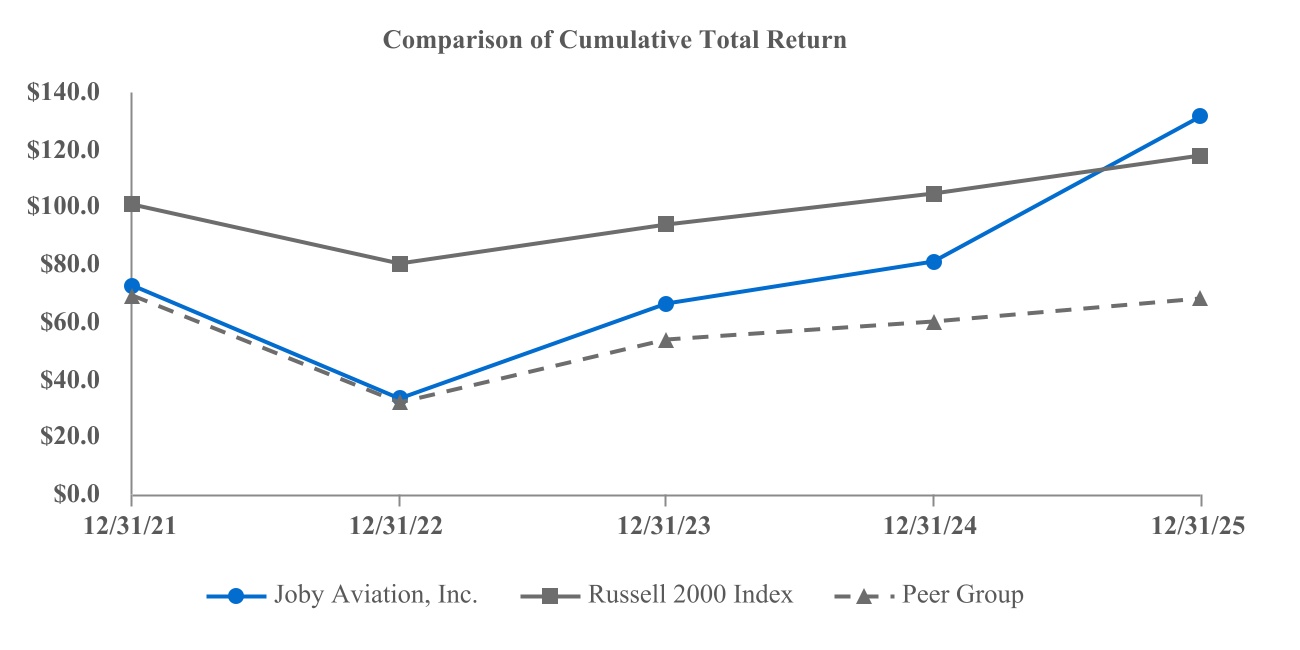
Recent Sale of Unregistered Securities and Use of Proceeds
Recent Sale of Unregistered Securities
None.
Use of Proceeds
None.
Issuer Purchases of Equity Securities
None.
Item 6. [Reserved]
Item 7. Management’s Discussion and Analysis of Financial Condition and Results of Operations
The following discussion and analysis provides information that our management believes is relevant to an assessment and understanding of our consolidated results of operations and financial condition. The discussion should be read together with our consolidated financial statements and related notes appearing elsewhere in this Annual Report. We have elected to omit discussion on the earliest of the three years covered by the consolidated financial statements presented. Refer to Item 7. Management's Discussion and Analysis of Financial Condition and Results of Operations located in our annual report on Form 10-K for the year ended December 31, 2024, filed on February 27, 2025, for reference to discussion of the fiscal year ended December 31, 2023, the earliest of the three fiscal years presented. This discussion and analysis includes forward looking statements that involve risks and uncertainties. Please see the section of this Annual Report titled “Special Note Regarding Forward-Looking Statements.”
Overview
We have spent more than a decade designing and testing a piloted all-electric, vertical take-off and landing (“eVTOL”) air taxi that we intend to operate as part of a fast, quiet and convenient service in cities around the world. The aircraft is quiet when taking off, near silent when flying overhead and is being designed to transport a pilot and up to four passengers - or a targeted payload of up to 1,000 pounds - at speeds of up to 200 mph. The aircraft is optimized for urban routes, with a target range of up to 100 miles on a single charge. According to our modeling, more than 99% of urban routes in cities such as New York City and Los Angeles are significantly shorter than this, enabling higher utilization through faster turnaround times of our aircraft. By combining the freedom of air travel with the efficiency of our aircraft, we expect to deliver journeys that are up to 10 times faster than driving, and it is our goal to steadily drive down end-user pricing in the years following commercial launch to make the service widely accessible. The low noise enabled by the all-electric powertrain will allow the aircraft to operate around dense, urban areas while blending into the background noise of cities. In August 2025, we added another milestone flight to thousands of successful test flights, with our piloted eVTOL flight between two public airports in FAA-controlled airspace, demonstrating operational maturity and integration with existing air traffic. As the first eVTOL aircraft developer to receive a signed, stage 4 G-1 certification basis which was subsequently published in final form in the Federal Register, we believe we are well positioned to be the first eVTOL manufacturer to earn standard airworthiness certification from the Federal Aviation Administration (“FAA”). We have multiple special airworthiness certificates already issued by the FAA for our fleet of pre-type certification aircraft.
We have identified three potential routes to market: (1) Joby owned and operated air taxi service (2) affiliate owned and operated service and (3) direct sales and defense. We plan to manufacture, operate and sell our aircraft, and are building a vertically integrated transportation company to maximize the value of our investments. In addition to building a novel aircraft, we are also building a proprietary operating system that integrates data across aircraft build, operations and maintenance. At the front end, we are developing a convenient app to deliver the first on-demand, aerial ridesharing service. We are targeting carrying our first passengers in 2026. We believe this vertically-integrated business model will generate the greatest economic returns over time, while providing us with end-to-end control and information regarding customer experience to optimize for customer safety, comfort and value.
In August 2025, we acquired Blade Urban Air Mobility, Inc. and its subsidiaries (“Blade”), a technology-powered, global urban air mobility platform. Following the acquisition, Blade continues to operate its air charter broker service as our wholly owned subsidiary. The transaction is expected to unlock immediate market access, including an established customer base, operational expertise, airport relationships and infrastructure across key urban corridors in New York City and Southern Europe and allow us to combine our best-in-class technology with Blade’s experience in delivering premium customer transportation at scale.
Since our inception in 2009, we have been primarily engaged in research and development of eVTOL aircraft. We have incurred net operating losses and negative cash flows from operations in every year since our inception. As of December 31, 2025, we had an accumulated deficit of $2,785.6 million. We have funded our operations primarily with proceeds from the issuance of stock, convertible notes and the proceeds from our merger in August 2021 with Reinvent Technology Partners (“RTP”), a special purpose acquisition company, through which we became a publicly-traded company.
Key Factors Affecting Operating Results
See the section entitled “Risk Factors” for a further discussion of these considerations.
Development of the Global Urban Air Mobility (“UAM”) Market
Our revenue will be directly tied to the continued development of short distance aerial transportation. While we believe the global market for UAM will be large, it remains undeveloped and there is no guarantee of future demand. We delivered our first aircraft for initial service operations with the DOD in September 2023 and are targeting carrying our first passengers in 2026. Our business will require significant investment leading up to launching these services, including, but not limited to, final engineering designs, prototyping and testing, manufacturing, software development, certification, pilot training, infrastructure and commercialization.
We believe one of the primary drivers for adoption of our aerial ridesharing service is the value proposition and time savings offered by aerial mobility relative to traditional ground-based transportation. Additional factors impacting the pace of adoption of our aerial ridesharing service may include but are not limited to: perceptions about eVTOL quality, safety, performance and cost; perceptions about the limited range over which eVTOL may be flown on a single battery charge; volatility in the cost of oil and gasoline; availability of competing forms of transportation, such as ground, air taxi or ride-hailing services; the development of adequate infrastructure; consumers’ perception about the safety, convenience and cost of transportation using eVTOL relative to ground-based alternatives; and increases in fuel efficiency, autonomy, or electrification of cars. In addition, macroeconomic factors could impact demand for UAM services, particularly if end-user pricing is at a premium to ground-based transportation alternatives. We anticipate initial operations in the U.S. under the eIPP to be followed by operations in selected high-density metropolitan areas where traffic congestion is particularly acute and operating conditions are suitable for early eVTOL operations.
Competition
We believe that the primary sources of competition for our service are ground-based mobility solutions, other eVTOL developers/operators and local/regional incumbent aircraft charter services. While we expect to be first to market with an eVTOL facilitated aerial ridesharing service, we expect this industry to be dynamic and increasingly competitive; and our competitors could get to market before us, either generally or in specific markets. Even if we are first to market, we may not receive any competitive advantage or may be overtaken by other competitors. If new or existing companies launch competing solutions in the markets in which we intend to operate or obtain large-scale capital investment, we may face increased competition. Additionally, our competitors may benefit from our efforts in developing consumer and community acceptance for eVTOL aircraft and aerial ridesharing, making it easier for them to obtain the permits and authorizations required to operate an aerial ridesharing service in the markets in which we intend to launch or in other markets. If we do not capture the first mover advantage that we anticipate, it may harm our business, financial condition, operating results and prospects.
Government Certification
We signed a revised, stage 4 “G-1” certification basis for our aircraft with the FAA in July 2022, which was published in final form in the Federal Register in March 2024. This agreement lays out the specific requirements that need to be met by our aircraft for it to be certified for commercial operations. Reaching this milestone marks a key step towards certifying any new aircraft in the U.S. We think of the FAA type certification process in five stages and have made significant progress towards certification. We have completed or substantially completed three of these five stages and are more than halfway through the fourth stage.
In 2022, we received our Part 135 operating certificate, which is required for us to operate an on-demand air service and allows us to operate the service with conventional aircraft. In October 2024, the FAA published the Special Federal Aviation Regulations (“SFARs”), which include operational regulations related to eVTOLs. We will need to comply with these SFARs as we add our aircraft to our Part 135 operating certificate. If the FAA requires further modifications to our existing G-1 certification basis, makes subsequent modifications to the SFARs, or if there are other regulatory changes or revisions, this could delay our ability to obtain type certification, and could delay our ability to launch our commercial passenger service.
We expect the FAA type certificate will be validated in certain international markets pursuant to bilateral agreements between the FAA and its counterpart civil aviation authorities in other countries. In 2022, we applied for aircraft certification in the United Kingdom and Japan. In 2023, we signed an agreement with Road and Transport Authority of Dubai (“RTA”) for Joby to provide air taxi services in Dubai. The RTA agreement includes a roadmap for local approval by the UAE General Civil Aviation Authority that could precede type certification by the FAA. These arrangements provide a means of efficient international expansion as we develop commercial operations around the world.
In addition to certifying our aircraft, we will also need to obtain authorizations and certifications related to the production of our aircraft and the deployment of our aerial ridesharing service. We anticipate being able to meet the requirements of such authorizations and certifications. If we fail to obtain any of the required authorizations or certifications, or do so in a timely manner, or if any of these authorizations or certifications are modified, suspended or revoked after we obtain them, we may be unable to launch our commercial service or do so on the timelines we project, which would have adverse effects on our business, prospects, financial condition and/or results of operations.
U.S. Government Contracts
In December 2020, we became, to our knowledge, the first company to receive airworthiness approval for an eVTOL aircraft for a flight clearance from the USAF to conduct a government test. Our multi-year relationship with the DOD and other U.S. government agencies has provided us with a compelling opportunity to more thoroughly understand the operational capabilities and maintenance profiles of our aircraft in advance of commercial launch.
With growing USAF interest in hybrid powertrains and autonomy in aviation, we leveraged our existing aircraft platform to address these areas. In the summer of 2025, we participated in the USAF’s Resolute Force Pacific (“REFORPAC”) exercise, successfully demonstrating our Superpilot(TM) autonomous flight technology. We continue to work on autonomy programs with the USAF. Additionally, we are working with L3Harris on leveraging our platform to address opportunities to sell aircraft for defense applications. We are actively pursuing additional contracts with the DOD and other government agencies in these areas and believe that our investments in hydrogen-electric and autonomous technology will position us well to capitalize on these opportunities, but we may be unable to secure additional contracts or continue to grow our relationship with the U.S. government and/or DOD.
Vertically-Integrated Business Model
Our primary business model is to serve as a vertically-integrated eVTOL transportation service provider. Present projections indicate that payback periods on aircraft will result in a viable business model over the long-term as production volumes scale and unit economics improve to support sufficient market adoption. As with any new industry and business model, numerous risks and uncertainties exist. Our projections are dependent on certifying and delivering aircraft on time and at a cost that will allow us to offer our service at prices that a sufficient number of customers will be willing to pay for the time and efficiency savings they receive from utilizing our eVTOL services. Our aircraft include parts and manufacturing processes unique to eVTOL aircraft, in general, and our product design, in particular. We have used our best efforts to estimate costs in our planning projections. However, the variable cost associated with assembling our aircraft at scale remains uncertain at this stage of development. Our vertically-integrated business model also relies, in part, on developing and certifying component parts rather than sourcing already certified parts from third-party suppliers. While we believe this model will ultimately result in a more performant aircraft and better operating economics, the increased time and effort required to develop and certify these components may result in delays compared to alternative approaches.
Our vertically-integrated approach is also dependent on recruiting, developing and retaining the right talent at the right time to support engineering, certification, manufacturing, and go-to-market operations. As we progress through the certification process, we will have an increasing need to accelerate hiring in selected areas. If we are unable to add sufficient headcount it could impact our ability to meet our expected timelines for certification and entry into service.
The global economy has recently seen a significant rise in tariffs and other protective trade measures that have applied to a wide range of finished goods and raw materials. While tariffs have not had a material impact on our business, financial condition or results of operations to date due to the limited scale of our prototype manufacturing and focus on certification efforts, over time new tariffs or other restrictions imposed in connection with trade wars or political instability could increase the costs of raw materials and other goods, both for us and our suppliers, particularly as we begin to scale our manufacturing operations and produce aircraft for commercial use. We believe that our high level of vertical integration, coupled with our investments in U.S. manufacturing facilities, give us a competitive advantage with increased flexibility to adapt to future trade policy changes and are actively working to minimize the potential impact of any such tariffs or other restrictions.
The success of our business is also dependent, in part, on the utilization rate of our aircraft, which is the amount of time our aircraft spend in the air carrying passengers. We intend to maintain a high daily aircraft utilization rate, and reductions in utilization will adversely impact our financial performance. High daily aircraft utilization is achieved in part by reducing turnaround times at vertiports. Aircraft utilization is reduced by delays and cancellations from various factors, many of which are beyond our control, including adverse weather conditions, security requirements, air traffic congestion and unscheduled maintenance events.
Components of Results of Operations
Revenue
Revenue consists of passenger revenue and other revenue.
Passenger revenue primarily includes revenue generated from the transportation of passengers via helicopter or fixed wing aircraft, booked through Blade. Flights are typically booked through Blade associates, the Blade app, or third-party channels and paid for principally via credit card transactions, wire transfers, checks, customer credits, and gift cards. Flight payments are typically collected at the time of booking before the performance of the related service, and revenue is recognized when the service is completed.
Other revenue primarily includes revenue from government flight services, customer demonstration and exhibition activities, and engineering services. Government flight services revenue primarily includes consideration for our performance of customer-directed flights and on-base operations for various U.S. Department of Defense (DOD) agencies. The other revenue is recognized (i) over time, as the performance obligations are satisfied, in an amount that reflects the consideration we expect to be entitled to in exchange for those services, typically measured based on flight hours, service hours, milestones, or other relevant metrics; or (ii) at a point in time, upon termination of a contract, if applicable, when we have fulfilled our obligations and no further performance is required.
Operating expenses
Cost of Revenue
Cost of Revenue consist primarily of costs related to operators of aircraft and vehicles, flight support, maintenance personnel, expenses associated with support aircraft such as rent and fuel, depreciation of capitalized ground support equipment, and our aircraft fuel or electricity cost, landing fees, pilot salaries, as directly attributed to our performance of the flight services and customer demonstration and exhibition activities, and costs of providing engineering services. Flight services expenses do not include the costs of manufacturing our aircraft and aircraft parts as such costs are expensed when incurred as Research and Development Expenses (see below).
Research and Development Expenses
Research and development expenses consist primarily of personnel expenses, including salaries, benefits, and stock-based compensation, costs of consulting, equipment and materials, depreciation and amortization and allocations of overhead, including rent, information technology costs and utilities. Research and development expenses are partially offset by payments we received in the form of government grants, including those received under the Agility Prime program.
We expect our research and development expenses to increase as we increase staffing to support aircraft engineering and software development, build aircraft, and continue to explore and develop next generation aircraft and technologies.
Selling, General and Administrative Expenses
Selling, general and administrative expenses consist of personnel expenses, including salaries, benefits, and stock-based compensation, related to executive management, finance, legal, and human resource functions. Other costs include business development, contractor and professional services fees, audit and compliance expenses, insurance costs and general corporate expenses, including allocated depreciation, rent, information technology costs and utilities.
We expect our selling, general and administrative expenses to increase as we hire additional personnel and consultants to support the growth of our operations and comply with applicable regulations.
Loss from changes in Fair Value of Warrants, Earnout Shares and Contingent Consideration
Publicly-traded warrants (“Public Warrants”), private placement warrants issued to Sponsor (“Private Placement Warrants”), warrants issued to Delta Air Lines, Inc. (“Delta Warrants”), shares of common stock owned by Sponsor subject to certain terms on vesting, lock-up and transfer (“Earnout Shares”) and contingent consideration related to Blade acquisition EBITDA Earnout are recorded as liabilities and subject to remeasurement to fair value at each balance sheet date. We expect to incur incremental income (expense) in the consolidated statements of operations for the fair value adjustments for these outstanding liabilities at the end of each reporting period, except for the Private Placement Warrants, which were fully exercised on August 11, 2025 as described in Note 8 of our Consolidated Financial Statements included elsewhere in this Annual Report on Form 10-K.
2025 Acquisition
On August 29, 2025, the Company completed the acquisition of 100% of the outstanding equity of Blade Urban Air Mobility, Inc., a wholly owned subsidiary of Strata Critical Medical, Inc, f/k/a Blade Air Mobility, Inc. (“Seller”). Blade Urban Air Mobility, Inc. and its subsidiaries (“Blade”) operate a technology-powered, global urban air mobility platform through which they provide air charter broker and other services. The transaction is expected to unlock immediate market access and infrastructure across key urban corridors in New York City and Southern Europe and allow the Company to combine its best-in-class technology with Blade’s experience of delivering premium customer transportation at scale.
The Company acquired all assets and assumed liabilities of Blade for total purchase consideration of approximately $92.4 million, consisting of (i) 5,325,585 shares of the Company’s common stock with an aggregate fair value of $74.5 million, calculated net of $1.5 million attributed to the Company’s post-combination compensation expense, (ii) payments contingent upon the achievement of future Earnings Before Interest, Taxes, Depreciation and Amortization (“EBITDA”) targets with a fair value of approximately $7.6 million (“EBITDA Earnout”), (iii) indemnity holdback amount of $10.0 million (“Indemnity Holdback”), and (iv) pre-combination-attributed fair value of substitution RSUs of approximately $0.3 million. The acquisition was accounted for as a business combination in accordance with ASC 805, Business Combinations, which requires that the assets acquired and liabilities assumed in a business combination be recognized at their estimated acquisition-date fair values (see Note 4).
Interest and Other Income, Net
Interest income consists primarily of interest earned on our cash and cash equivalents and investments in marketable securities.
Provision for Income Taxes
Our provision for income taxes consists of an estimate of federal, state, and foreign income taxes based on enacted federal, state, and foreign tax rates, as adjusted for allowable credits, deductions, uncertain tax positions, changes in deferred tax assets and liabilities, and changes in tax law. Due to the level of historical losses, we maintain a valuation allowance against U.S. federal and state deferred tax assets as it has been concluded it is more likely than not that these deferred tax assets will not be realized.
Results of Operations
Comparison of the Year Ended December 31, 2025 to the Year Ended December 31, 2024
The following table summarizes our historical results of operations for the periods indicated (in thousands, except percentage):
| | | | | | | | | | | | | | | | | | | | | | | |
| December 31, | | Change |
| 2025 | | 2024 | | ($) | | (%) |
| Revenue | $ | 53,425 | | | $ | 136 | | | $ | 53,289 | | | n.m * |
| Operating expenses: | | | | | | | |
| Cost of Revenue | 29,328 | | | 67 | | | 29,261 | | | n.m * |
| Research and development | 581,101 | | | 477,156 | | | 103,945 | | | 22 | % |
| Selling, general and administrative | 162,587 | | | 119,667 | | | 42,920 | | | 36 | % |
| Total operating expenses | 773,016 | | | 596,890 | | | 176,126 | | | 30 | % |
| Loss from operations | (719,591) | | | (596,754) | | | (122,837) | | | 21 | % |
| Interest and other income, net | 43,164 | | | 42,822 | | | 342 | | | 1 | % |
| Loss on common stock issuance in private placement | (40,258) | | | — | | | (40,258) | | | 100 % |
Loss from change in fair value of warrants, earnout shares and contingent consideration | (211,850) | | | (53,973) | | | (157,877) | | | 293 | % |
Total other loss, net | (208,944) | | | (11,151) | | | (197,793) | | | n.m * |
| Loss before income taxes | (928,535) | | | (607,905) | | | (320,630) | | | 53 | % |
Income tax expense | 1,307 | | | 129 | | | 1,178 | | | 913 | % |
| Net loss | $ | (929,842) | | | $ | (608,034) | | | $ | (321,808) | | | 53 | % |
n.m* marks changes that are not meaningful.
Revenue
Revenue increased by $53.3 million to $53.4 million during the year ended December 31, 2025 from $0.1 million during the year ended December 31, 2024. The increase was primarily due to the passenger service revenue from our Blade offering after Blade acquisition and higher revenue from on-base operations for a DOD agency, demonstration flights, and engineering services provided to third parties.
Cost of Revenue
Cost of Revenue increased by $29.3 million to $29.3 million during the year ended December 31, 2025 from $0.1 million during the year ended December 31, 2024. The increase was primarily due to the passenger service costs from our Blade offering after Blade acquisition and cost of performing demonstration flights and providing engineering services.
Research and Development Expenses
Research and development expenses increased by $103.9 million, or 22%, to $581.1 million during the year ended December 31, 2025 from $477.2 million during the year ended December 31, 2024. The increase was primarily attributable to increases in personnel to support aircraft engineering, software development, prototype manufacturing, and certification and a decrease in expense reduction due to lower grants earned as part of our government contracts.
Selling, General and Administrative Expenses
Selling, general and administrative expenses increased by $42.9 million, or 36%, to $162.6 million during the year ended December 31, 2025 from $119.7 million during the year ended December 31, 2024. The increase was primarily attributable to Blade acquisition costs and payroll and other indirect operating expenses after the Blade acquisition and increases in legal and marketing spend.
Total Other Loss, Net
Total other loss, net increased by $197.8 million to a loss of $208.9 million during the year ended December 31, 2025 from a loss of $11.2 million during the year ended December 31, 2024. The increase was primarily driven by a $157.9 million increase in loss from changes in fair value of warrants, earnout shares and contingent consideration, and loss on common stock issuance in private placement of $40.3 million.
Liquidity and Capital Resources
Sources of Liquidity
We have incurred net losses and negative operating cash flows from operations since inception, and we expect to continue to incur losses and negative operating cash flows for the foreseeable future until we successfully commence sustainable commercial operations. To date, we have funded our operations primarily with proceeds from the Merger and issuance of stock and convertible notes.
In August 2021, we raised net proceeds of $1,067.9 million from the Merger and $843.3 million from the issuances of Legacy Joby’s redeemable convertible preferred stock and convertible notes prior to the Merger.
In October 2022, we raised net proceeds of $60.0 million from the sale of 11,044,232 shares of our common stock and warrants to Delta Air Lines, Inc.
In May 2023, we raised $180.2 million in net proceeds from our issuance and sale, in a registered direct offering to certain institutional investors of 43,985,681 shares of our common stock.
In June 2023, we raised net proceeds of $99.9 million from our issuance and sale of 15,037,594 shares of our common stock to SKT.
In October 2024, we raised $221.8 million in net proceeds from an underwritten public offering of 46,000,000 shares of our common stock.
In December 2024, we entered into an Equity Distribution Agreement with Morgan Stanley & Co. LLC and Allen & Company LLC, as sales agents (“Equity Distribution Agreement”), through which we may offer and sell, from time to time at our sole discretion, up to an aggregate of $300.0 million of our common stock in an “at-the-market” offering (“ATM Offering”). As of December 31, 2025, 29,950,799 shares of our common stock have been sold pursuant to the Equity
Distribution Agreement for net proceeds of $282.4 million. As of December 31, 2025, $8.1 million remains available for sale under the Equity Distribution Agreement.
In May 2025, we issued 49,701,790 shares at a price per share of $5.03 for net proceeds of $249.9 million pursuant to a stock purchase agreement with Toyota Motor Corporation (“Toyota”) that we entered in October 2024. Pursuant to the agreement, Toyota has committed to invest an additional $250.0 million, subject to certain closing conditions (“Toyota Investment”).
In October 2025, we raised $575.9 million in net proceeds from an underwritten public offering of 35,075,000 shares of our common stock.
As of December 31, 2025, we have received $34.6 million from the exercise of our Public Warrants.
As of December 31, 2025, we had cash, cash equivalents and restricted cash of $241.7 million and short-term investment in marketable securities of $1,167.1 million. Restricted cash, totaling $0.9 million, primarily reflects cash temporarily retained for security deposit on leased facilities. We believe that our cash, cash equivalent and short-term investments will satisfy our working capital and capital requirements for at least the next twelve months.
In January 2026, we have received $70.0 million from the exercise of the first tranche of Delta Warrant (Note 8 ).
In February 2026, we raised net proceeds of approximately $576.0 million from an underwritten public offering of 52,863,437 shares of our common stock (the “February 2026 Equity Offering”), and net proceeds of approximately $670.4 million from an underwritten public offering of $690.0 million principal amount of 0.75% Convertible Senior Notes due 2032 (the “Notes”).
Long-Term Liquidity Requirements
We expect our cash and cash equivalents on hand together with the proceeds of future sales under the ATM Offering, additional proceeds from the Toyota Investment, the proceeds of the February 2026 Equity Offering, the issuance of the Notes, the Overallotment Option, if exercised, and cash we expect to generate from future operations will provide sufficient funding to support us beyond the initial launch of our commercial operations. Until we generate sufficient operating cash flow to fully cover our operating expenses, working capital needs and planned capital expenditures, or if circumstances evolve differently than anticipated, we expect to utilize a combination of equity and debt financing to fund any future remaining capital needs. If we raise funds by issuing equity securities, dilution to stockholders may result. Any equity securities issued may also provide for rights, preferences, or privileges senior to those of holders of common stock. If we raise funds by issuing debt securities, these debt securities would have rights, preferences, and privileges senior to those of preferred and common stockholders. The terms of debt securities or borrowings could impose significant restrictions on our operations. The capital markets have in the past, and may in the future, experience periods of upheaval that could impact the availability and cost of equity and debt financing.
Our principal uses of cash in recent periods were to fund our research and development activities, personnel cost and support services. Near-term cash requirements will also include spending on manufacturing facilities, ramping up production and supporting production certification, scaled manufacturing operations for commercialization, infrastructure and vertiports development, pilot training facilities, software development and production of aircraft. We do not have material cash requirements related to current contractual obligations. As such, our cash requirements are highly dependent upon management’s decisions about the pace and focus of both our short and long-term spending.
Cash requirements can fluctuate based on business decisions that could accelerate or defer spending, including the timing or pace of investments, infrastructure and production of aircraft. Our future capital requirements will depend on many factors, including our revenue growth rate, the timing and the amount of cash received from our customers, the expansion of sales and marketing activities, and the timing and extent of spending to support development efforts. In the future, we may enter into arrangements to acquire or invest in complementary businesses, products, and technologies, which could require us to seek additional equity or debt financing. If we require additional financing we may not be able to raise such financing on acceptable terms or at all. If we are unable to raise additional capital or generate cash flows necessary to continue our research and development and invest in continued innovation, we may not be able to compete successfully, which would harm our business, results of operations, and financial condition. If adequate funds are not available, we may need to reconsider our investments in production operations, the pace of our production ramp-up, infrastructure investments in vertiports, expansion plans or limit our research and development activities, which could have a material adverse impact on our business prospects and results of operations.
Cash Flows
The following tables set forth a summary of our cash flows for the periods indicated (in thousands, except percentage):
| | | | | | | | | | | | | | | | | | | | | | | |
| Year Ended December 31, | | Change |
| 2025 | | 2024 | | ($) | | (%) |
| Net cash (used in) provided by: | | | | | | | |
| Operating activities | $ | (509,893) | | | $ | (436,267) | | | $ | (73,626) | | | 17 | % |
| Investing activities | (475,416) | | | 70,763 | | | (546,179) | | | (772) | % |
| Financing activities | 1,026,643 | | | 361,114 | | | 665,529 | | | 184 | % |
| Net increase (decrease) in cash, cash equivalents, and restricted cash | $ | 41,334 | | | $ | (4,390) | | | $ | 45,724 | | | n.m. |
Net Cash Used in Operating Activities
Net cash used in operating activities for the year ended December 31, 2025 was $509.9 million, consisting primarily of a net loss of $929.8 million, adjusted for non-cash items and statement of operations impact from investing and financing activities which includes $127.9 million in stock-based compensation expense, a $211.9 million loss from change in the fair value of warrants, earnout shares and contingent consideration, $40.2 million in depreciation and amortization expense, $40.3 million loss on common stock issuance in private placement and $7.6 million net decrease in our net working capital, partially offset by $7.8 million net accretion of our investments in marketable securities.
Net cash used in operating activities for the year ended December 31, 2024 was $436.3 million, consisting primarily of a net loss of $608.0 million, adjusted for non-cash items and statement of operations impact from investing and financing activities which includes $104.4 million in stock-based compensation expense, $54.0 million loss from change in the fair value of warrants and earnout shares, $35.6 million in depreciation and amortization expense, partially offset by $15.8 million net accretion of our investments in marketable securities and $6.4 million net increase in our net working capital.
Net Cash Provided by (Used in) Investing Activities
Net cash used in investing activities for the year ended December 31, 2025 of $475.4 million was primarily due to purchases of marketable securities of $1,170.4 million and purchases of property and equipment of $53.9 million, partially offset by proceeds from the sales and maturities of marketable securities of $745.4 million and $3.5 million net cash from the Blade acquisition.
Net cash provided by investing activities for the year ended December 31, 2024 of $70.8 million was primarily due to proceeds from the sales and maturities of marketable securities of $715.2 million, partially offset by purchases of marketable securities of $603.8 million and purchases of property and equipment of $40.6 million.
Net Cash Provided by Financing Activities
Net cash provided by financing activities for the year ended December 31, 2025 of $1,026.6 million was primarily due to net proceeds of $575.9 million from issuance of common stock in underwritten public offering, net proceeds of $249.9 million from issuance of common stock in private placement with Toyota, net proceeds of $153.6 million from issuance of common stock in at-the-market public offering, $36.8 million proceeds from exercise of stock options and issuance of common stock warrants and proceeds from the issuance of common stock under the employee stock purchase plan of $12.1 million, partially offset by $1.6 million repayments of obligation under finance leases and tenant improvement loan.
Net cash provided by financing activities for the year ended December 31, 2024 of $361.1 million was primarily due to net proceeds of $221.8 million from issuance of common stock in underwritten public offering and net proceeds of $128.8 million from issuance of common stock in at-the-market public offering, proceeds from the issuance of common stock under the employee stock purchase plan of $11.2 million and $1.7 million proceeds from exercise of stock options and issuance of common stock warrants, partially offset by $2.4 million repayments of obligations under finance leases and tenant improvement loan.
Critical Accounting Estimates
Management’s discussion and analysis of our financial condition and results of operations is based on our Consolidated Financial Statements, which have been prepared in accordance with U.S. GAAP. The preparation of these Consolidated Financial Statements requires us to make estimates and assumptions for the reported amounts of assets, liabilities, revenue,
expenses and related disclosures. Our estimates are based on our historical experience and on various other factors that we believe are reasonable under the circumstances, the results of which form the basis for making judgments about the carrying value of assets and liabilities that are not readily apparent from other sources. Actual results may differ from these estimates under different assumptions or conditions and any such differences may be material.
The significant accounting policies of the Company are described in more detail in Note 2 to our Consolidated Financial Statements included elsewhere in this Annual Report. We believe the following accounting policies and estimates to be critical to the preparation of our Consolidated Financial Statements.
Stock-Based Compensation
We measure and record the expense related to stock-based payment awards based on the fair value of those awards as determined on the date of grant. When the observable market price or volatility we use to determine grant date fair value does not reflect certain material non-public information known to the Company but unavailable to marketplace participants at the time the market price is observed, we determine whether an adjustment to the observable market price is required. We recognize stock-based compensation expense over the requisite service period of the individual grant, generally equal to the vesting period and use the straight-line method to recognize stock-based compensation, and account for forfeitures as they occur. Some of our awards contain service-based vesting conditions as well as performance-based vesting conditions. We consider the probability of achieving each of the performance goals at the end of each reporting period and recognize expense over the requisite period when achievement of the goal is determined to be probable, and adjust the expense if the probability of achieving the goal later changes. The Company estimates the probabilities based on available information about the progress made towards performance goals at each reporting period. Our performance based awards issued under annual Bonus Plans are classified as equity or, initially, as a liability, depending on the terms of the plan. For liability classified awards, the liability is reclassified to equity when the respective milestones have been met. If it is determined that the milestone cannot be met, the liability is reversed.
We selected the Black-Scholes-Merton (“Black-Scholes”) option-pricing model as the method for determining the estimated fair value for stock options and awards under our ESPP program. The Black-Scholes model requires the use of highly subjective and complex assumptions, which determine the fair value of share-based awards, including the option’s expected term, expected volatility of the underlying stock, risk-free interest rate and expected dividend yield.
Expected volatility - We estimate the expected volatility of our common stock on the date of grant based on the historical stock price volatility of our own common shares within the same length of period as the expected term. Where, in some cases, our common share trading history is shorter than the expected term, and for periods prior to the Merger since we were not a publicly traded company, we estimated the expected volatility for our stock options and awards under our ESPP program by using an average of historical volatilities of selected industry peers deemed to be comparable to our business corresponding to the expected term of the awards.
Risk-free interest rate - The risk-free interest rate is based on the U.S. Treasury yield curve in effect at the time of grant for zero-coupon U.S. Treasury notes with maturities corresponding to the expected term of the awards.
Expected dividend yield - The expected dividend rate is zero as we currently have no history or expectation of declaring dividends on our common stock.
Expected term - The expected term represents the period these stock awards are expected to remain outstanding and is based on historical experience of similar awards, giving consideration to the contractual terms of the stock-based awards, vesting schedules, and expectations of future employee behavior.
Accounting for Long-Lived Assets
In accounting for long-lived assets, we make estimates about the expected useful lives, projected residual values, and the potential for impairment. In estimating useful lives and residual values of our property and equipment, we have relied upon actual industry experience with the same or similar property and equipment types and our anticipated utilization of the property and equipment. Changing market prices of new and used property and equipment, government regulations, and changes in our maintenance program or operations could result in changes to these estimates.
Our long-lived assets are evaluated for impairment as of the end of each reporting period for events and circumstances that indicate the assets may be impaired. Indicators include operating or cash flow losses, significant decreases in market value, or changes in technology.
If we conclude that events and circumstances indicate the assets may be impaired, to determine if impairment exists for our property and equipment used in operations, we group our property and equipment by type (the lowest level for which there are identifiable cash flows) and then estimate their future cash flows based on projections of capacity, asset age,
maintenance requirements, and other relevant conditions. An impairment occurs when the sum of the estimated undiscounted future cash flows are less than the aggregate carrying value of the assets. The impairment loss recognized is the amount by which the assets' carrying value exceeds its estimated fair value. We estimate our property and equipment's fair value using third party valuations which consider the effects of the current market environment, age of the assets, and marketability.
We have not identified any events and circumstances that would indicate that our long-lived assets may be impaired. Accordingly, we have not recorded any impairment charge to our existing property and equipment during the twelve months ended December 31, 2025.
Fair value measurements involving significant estimation uncertainty
We apply fair value measurement guidance in a number of areas of our consolidated financial statements. Some of our fair value measurements involve a significant level of estimation uncertainty, generally because they require valuation models and inputs that are not directly observable in the market or otherwise require significant judgment. These estimates are critical because changes in key assumptions can materially affect the recorded amounts of the related assets and liabilities and, in certain cases, our results of operations. These estimates have had, or are reasonably likely to have, a material impact on our financial condition or results of operations.
Fair value of warrant, earnout, and contingent consideration liabilities
Certain of our financial instruments, including our Earnout Shares Liability, Delta warrant liability, and contingent consideration liabilities such as the EBITDA Earnout, are measured at fair value on a recurring basis and remeasured each reporting period until exercised, settled, or otherwise extinguished. Changes in the fair value of these liabilities are recognized in other income (loss), net, and can cause variability in our results of operations.
Valuation of these liabilities requires significant judgment because certain inputs are not directly observable in the market (“Level 3”). We estimate fair value using valuation techniques that may include quoted market prices for similar instruments and, for Level 3 instruments, option-pricing and Monte Carlo simulation models. Key assumptions can include our common stock price (and the sensitivity of the instruments’ value to changes in our stock price), expected volatility, expected term, and for instruments with milestone or other contingent settlement features, the probability and timing of achieving such milestones. For contingent consideration arrangements such as the EBITDA Earnout, significant unobservable inputs may also include projected adjusted EBITDA, achievement probabilities, and the discount rate used to present value expected payments.
Changes in these assumptions, particularly expected volatility, our stock price, the probability and timing of milestone achievement, forecasted operating results, and discount rates, can have a significant impact on the fair value of these liabilities and the resulting gains or losses recognized in other income (loss), net. Changes in our stock price, volatility assumptions, and milestone or earnout expectations from period to period can drive significant remeasurement gains or losses.
Business combinations and valuation of acquired intangible assets (including the Blade acquisition)
Our accounting for business combinations requires us to estimate the fair value of acquired assets and liabilities, including identifiable intangible assets and contingent consideration, and to recognize goodwill for the excess of purchase consideration over the estimated fair value of net identifiable assets acquired. Determining the fair value of acquired intangible assets requires significant judgment and the use of valuation techniques such as discounted cash flow models and other income and cost approaches.
These valuation techniques rely on assumptions including forecasted revenues and EBITDA, customer demand, expected margins, attrition and royalty rates (as applicable), contributory asset charges, the expected useful lives of the assets, and the selection of an appropriate discount rate. Changes in these assumptions could materially affect the recorded amounts of acquired intangible assets and goodwill, future amortization expense, and, if indicators of impairment arise, the timing and amount of impairment charges.
Accounting for Leases
We determine if an arrangement is a lease, or contains a lease, at inception. We analyze our contractual arrangements to evaluate whether they have any embedded leases. The asset component of our operating leases is recorded as right-of-use assets, and the liability component is recorded as current lease liabilities and long-term lease liabilities in our consolidated balance sheets. Right-of-use assets and lease liabilities are recognized based on the present value of the future minimum lease payments over the lease term at commencement date. Due to significant volume of contractual arrangements we enter, we may not be able to identify all embedded leases arrangements, resulting in understatement of our right-of-use
assets and liabilities. This assessment also includes evaluating whether certain passenger transportation arrangements and service contracts contain embedded leases (including aircraft leases embedded within agreements with third-party aircraft operators).
As most of our leases do not provide an implicit rate, we use incremental borrowing rate (“IBR”) to calculate present value of future minimum lease payments, which is the estimated rate we would be required to pay for fully collateralized borrowing over the period similar to lease terms. Determining IBR requires us to estimate our credit rating for secured borrowing and to identify appropriate interest rates for comparable companies with similar credit rating. If we are not able to correctly estimate IBR, our right-of-use assets and liabilities may be incorrect. Our incremental borrowing rate is an estimate based on an analysis of available market data for debt instruments of companies with credit and financial profiles similar to ours and may be impacted by changes in market conditions.
Our lease terms may include options to extend or terminate the lease when it is reasonably certain that we will exercise that option. Determining that options are reasonably certain to be exercised requires us to make certain assumptions about our future operations and space and assets requirements. Incorrect assumptions may result in our lease term being incorrect, impacting our right-of-use assets and liabilities. Certain arrangements may include renewal or termination options, and judgment is required in determining whether such options are reasonably certain to be exercised, which affects the measurement of right-of-use assets and lease liabilities.
Assumptions made by us at the commencement date are re-evaluated upon occurrence of certain events, including a lease modification. A lease modification results in a separate contract when the modification grants the lessee an additional right of use not included in the original lease and when lease payments increase commensurate with the standalone price for the additional right of use. When a lease modification results in a separate contract, it is accounted for in the same manner as a new lease. If we are not able to re-evaluate lease changes and modifications appropriately, our right-of-use assets and liabilities may be incorrect. In addition, for embedded leases within passenger transportation agreements, we may be required to estimate and allocate the portion of consideration that represents lease components versus non-lease components, which can impact the measurement of the related right-of-use assets and lease liabilities.
Recent Accounting Pronouncements
See Note 2 of our Consolidated Financial Statements included elsewhere in this Annual Report for more information regarding recently issued accounting pronouncements.
Item 7A. Quantitative and Qualitative Disclosures About Market Risk.
Interest Rate Risk
We are exposed to market risk for changes in interest rates applicable to our short-term investments. We had cash, cash equivalents, restricted cash and investments in short-term marketable securities totaling $1,408.8 million as of December 31, 2025. Cash equivalents and short-term investments were invested primarily in money market funds, U.S. treasury bills and government and corporate bonds. Our investment policy is focused on the preservation of capital and supporting our liquidity needs. Under the policy, we invest in highly rated securities, issued by the U.S. government and corporations or liquid money market funds. We do not invest in financial instruments for trading or speculative purposes, nor do we use leveraged financial instruments. We utilize external investment managers who adhere to the guidelines of their investment policies. A hypothetical 10% change in interest rates would not have a material impact on the value of our cash, cash equivalents or short-term investments or our interest income.
Foreign Currency Risk
We are not exposed to significant foreign currency risks related to our operating expenses as our foreign operations are not material to our consolidated financial statements.
Item 8. Financial Statements and Supplementary Data
INDEX TO FINANCIAL STATEMENTS
JOBY AVIATION, INC.
| | | | | |
| Consolidated Financial Statements | |
| |
| |
| |
| |
| |
| |
| |
| |
| |
| |
| |
| |
| |
| |
| |
| |
| |
| |
| |
| |
| |
| |
| |
REPORT OF INDEPENDENT REGISTERED PUBLIC ACCOUNTING FIRM
To the Shareholders and the Board of Directors of Joby Aviation, Inc.
Opinion on the Financial Statements
We have audited the accompanying consolidated balance sheets of Joby Aviation, Inc. and its subsidiaries (the “Company”) as of December 31, 2025 and, 2024, the related consolidated statements of operations, comprehensive loss, stockholders’ equity, and cash flows, for each of the three years in the period ended December 31, 2025, and the related notes (collectively referred to as the “financial statements”). In our opinion, the financial statements present fairly, in all material respects, the financial position of the Company as of December 31, 2025 and, 2024, and the results of its operations and its cash flows for each of the three years in the period ended December 31, 2025, in conformity with accounting principles generally accepted in the United States of America (U.S. GAAP).
We have also audited, in accordance with the standards of the Public Company Accounting Oversight Board (United States) (PCAOB), the Company’s internal control over financial reporting as of December 31, 2025, based on criteria established in Internal Control — Integrated Framework (2013) issued by the Committee of Sponsoring Organizations of the Treadway Commission and our report dated February 26, 2026, expressed an unqualified opinion on the Company's internal control over financial reporting.
Basis for Opinion
These financial statements are the responsibility of the Company’s management. Our responsibility is to express an opinion on the Company’s financial statements based on our audits. We are a public accounting firm registered with the PCAOB and are required to be independent with respect to the Company in accordance with the US federal securities laws and the applicable rules and regulations of the Securities and Exchange Commission and the PCAOB.
We conducted our audits in accordance with the standards of the PCAOB. Those standards require that we plan and perform the audit to obtain reasonable assurance about whether the financial statements are free of material misstatement, whether due to error or fraud. Our audits included performing procedures to assess the risks of material misstatement of the financial statements, whether due to error or fraud, and performing procedures that respond to those risks. Such procedures included examining, on a test basis, evidence regarding the amounts and disclosures in the financial statements. Our audits also included evaluating the accounting principles used and significant estimates made by management, as well as evaluating the overall presentation of the financial statements. We believe that our audits provide a reasonable basis for our opinion.
Critical Audit Matters
The critical audit matters communicated below are matters arising from the current-period audit of the financial statements that were communicated or required to be communicated to the audit committee and that (1) relate to accounts or disclosures that are material to the financial statements and (2) involved our especially challenging, subjective, or complex judgments. The communication of critical audit matters does not alter in any way our opinion on the financial statements, taken as a whole, and we are not, by communicating the critical audit matters below, providing separate opinions on the critical audit matters or on the accounts or disclosures to which they relate.
Valuation of Certain Acquired Intangible Assets - Refer to Notes 2 and 4 to the financial statements
Critical Audit Matter Description
On August 29, 2025, the Company completed the acquisition of 100% of the outstanding equity of Blade Urban Air Mobility, Inc. (“Blade”), for total purchase consideration of approximately $92.4 million. The acquisition was accounted for as a business combination in accordance with Accounting Standards Codification 805, Business Combinations. Accordingly, the purchase consideration was allocated to the assets acquired and liabilities assumed based on their respective fair values, including intangible assets of $17 million. Intangible assets acquired primarily related to exclusive rights to air transportation services and developed technology. Management estimated the fair value of the intangible assets using valuation techniques, which included a discounted cash flow model. The fair value determination of the acquired intangible assets required management to make significant estimates and assumptions, including revenue and Earnings Before Interest, Taxes, Depreciation, and Amortization (EBITDA) forecasts and discount rate.
We identified the valuation of certain acquired intangible assets as a critical audit matter given the level of judgment involved by management in developing certain valuation assumptions, and their use of a specialist to determine the fair values due to high complexity. Our audit procedures required a high degree of auditor judgment and increased extent of effort, including the need to involve our fair value specialists, when performing audit procedures to evaluate the reasonableness of management’s assumptions. The significant assumptions used to estimate the fair value of Blade’s intangible assets relate primarily to revenue and EBITDA forecasts and the discount rate applied to future cash flows.
How the Critical Audit Matter Was Addressed in the Audit
Our audit procedures related to the valuation of acquired intangible assets included the following, among others:
•We tested the design and operating effectiveness of the Company’s internal controls over the valuation of certain acquired intangible assets.
•We assessed the reasonableness of management’s forecasted revenues and EBITDA by comparing the projected growth rates to historical results, certain peer companies, and industry data.
•We evaluated whether the forecasted revenues and EBITDA were consistent with evidence obtained in other areas of the audit.
With the assistance of our fair value specialists, we evaluated management’s valuation of certain acquired intangible assets as follows:
•Evaluated the reasonableness of the valuation models.
•Tested the reasonableness of the valuation assumptions, including discount rate.
Accounting for Stock Purchase Agreement – Refer to Note 9 to the financial statements
Critical Audit Matter Description
On October 1, 2024, the Company entered into a stock purchase agreement (SPA) (as amended and restated on May 22, 2025) providing for the issuance and sale by the Company to Toyota Motor Corporation of up to an aggregate of 99,403,579 shares of common stock at a purchase price of $5.03 per share. The SPA is structured in two equal tranches of $250.0 million each. The closing of each tranche is subject to the satisfaction of certain closing conditions set forth in the SPA, which include the parties negotiating and entering into various agreements and obtaining regulatory approvals. On May 22, 2025, the Company completed the initial closing of the first tranche under the SPA upon the satisfaction of initial closing conditions. The additional closing of the second tranche is subject to the satisfaction of additional conditions including, but not limited to, the execution of a strategic alliance agreement and certain other customary closing conditions.
We identified management’s accounting evaluation and conclusion as to whether the additional closing of the second tranche under the SPA should be recognized for accounting purposes as of December 31, 2025, as a critical audit matter. This required a high degree of auditor judgment and an increased extent of effort, including the evaluation of management’s assertions regarding if the additional closing of the second tranche under the SPA is contractually binding or legally enforceable prior to the satisfaction of the additional closing conditions.
How the Critical Audit Matter Was Addressed in the Audit
Our audit procedures related to management’s accounting evaluation and conclusion as to whether the additional closing of the second tranche under the SPA should be recognized for accounting purposes as of December 31, 2025, included the following, among others:
•We tested the effectiveness of the Company’s internal control over management’s review of complex nonroutine transactions, which included the SPA.
•We evaluated management’s accounting evaluation and conclusion as to whether the additional closing of the second tranche under the SPA is recognized for accounting purposes as of December 31, 2025.
•We evaluated the assertions made by management supporting if the additional closing of the second tranche under the SPA is contractually binding or legally enforceable prior to the satisfaction of the additional closing conditions under the SPA, including inquiries and consideration of evidence from the Company’s legal counsel.
•We evaluated the Company’s disclosures related to the SPA for conformity with the relevant requirements under U.S. GAAP.
/s/ Deloitte & Touche LLP
San Jose, California
February 26, 2026
We have served as the Company’s auditor since 2020.
REPORT OF INDEPENDENT REGISTERED PUBLIC ACCOUNTING FIRM
To the shareholders and the Board of Directors of Joby Aviation, Inc.
Opinion on Internal Control over Financial Reporting
We have audited the internal control over financial reporting of Joby Aviation, Inc. and subsidiaries (the “Company") as of December 31, 2025, based on criteria established in Internal Control —Integrated Framework (2013) issued by the Committee of Sponsoring Organizations of the Treadway Commission (COSO). In our opinion, the Company maintained, in all material respects, effective internal control over financial reporting as of December 31, 2025, based on criteria established in Internal Control — Integrated Framework (2013) issued by COSO.
We have also audited, in accordance with the standards of the Public Company Accounting Oversight Board (United States) (PCAOB), the consolidated financial statements as of and for the year ended December 31, 2025, of the Company and our report dated February 26, 2026, expressed an unqualified opinion on those financial statements.
Basis for Opinion
The Company’s management is responsible for maintaining effective internal control over financial reporting and for its assessment of the effectiveness of internal control over financial reporting, included in the accompanying Management’s
Report on Internal Control over Financial Reporting. Our responsibility is to express an opinion on the Company’s internal control over financial reporting based on our audit. We are a public accounting firm registered with the PCAOB and are required to be independent with respect to the Company in accordance with the U.S. federal securities laws and the applicable rules and regulations of the Securities and Exchange Commission and the PCAOB.
We conducted our audit in accordance with the standards of the PCAOB. Those standards require that we plan and perform the audit to obtain reasonable assurance about whether effective internal control over financial reporting was maintained in all material respects. Our audit included obtaining an understanding of internal control over financial reporting, assessing the risk that a material weakness exists, testing and evaluating the design and operating effectiveness of internal control based on the assessed risk, and performing such other procedures as we considered necessary in the circumstances. We believe that our audit provides a reasonable basis for our opinion.
Definition and Limitations of Internal Control over Financial Reporting
A company’s internal control over financial reporting is a process designed to provide reasonable assurance regarding the reliability of financial reporting and the preparation of financial statements for external purposes in accordance with generally accepted accounting principles. A company's internal control over financial reporting includes those policies and procedures that (1) pertain to the maintenance of records that, in reasonable detail, accurately and fairly reflect the transactions and dispositions of the assets of the company; (2) provide reasonable assurance that transactions are recorded as necessary to permit preparation of financial statements in accordance with generally accepted accounting principles, and that receipts and expenditures of the company are being made only in accordance with authorizations of management and directors of the company; and (3) provide reasonable assurance regarding prevention or timely detection of unauthorized acquisition, use, or disposition of the company’s assets that could have a material effect on the financial statements.
Because of its inherent limitations, internal control over financial reporting may not prevent or detect misstatements. Also, projections of any evaluation of effectiveness to future periods are subject to the risk that controls may become inadequate because of changes in conditions, or that the degree of compliance with the policies or procedures may deteriorate.
/s/ Deloitte & Touche LLP
San Jose, California
February 26, 2026
JOBY AVIATION, INC. AND SUBSIDIARIES
CONSOLIDATED BALANCE SHEETS
(In thousands, except share and per share amounts)
| | | | | | | | | | | |
| December 31, |
| 2025 | | 2024 |
| Assets | | | |
| Current assets: | | | |
| Cash and cash equivalents | $ | 240,810 | | | $ | 199,627 | |
| Short-term investments | 1,167,106 | | | 733,224 | |
| Total cash, cash equivalents and short-term investments | 1,407,916 | | | 932,851 | |
| Restricted cash | 220 | | | — | |
| Other receivables | 7,139 | | | 16,044 | |
| Prepaid expenses and other current assets | 30,479 | | | 20,710 | |
| Total current assets | 1,445,754 | | | 969,605 | |
| Property and equipment, net | 146,571 | | | 120,954 | |
| Operating lease right-of-use assets | 31,837 | | | 28,689 | |
| Restricted cash | 693 | | | 762 | |
| Intangible assets | 18,859 | | | 8,127 | |
| Goodwill | 89,422 | | | 14,322 | |
| Other non-current assets | 61,933 | | | 61,006 | |
| Total assets | $ | 1,795,069 | | | $ | 1,203,465 | |
| Liabilities and stockholders’ equity | | | |
| Current liabilities | | | |
| Accounts payable | $ | 3,604 | | | $ | 4,261 | |
| Operating lease liabilities, current portion | 8,404 | | | 5,031 | |
| Accrued expenses and other current liabilities | 48,018 | | | 38,842 | |
| Total current liabilities | 60,026 | | | 48,134 | |
| Operating lease liabilities, net of current portion | 26,167 | | | 26,178 | |
| Warrant liability | 104,878 | | | 95,410 | |
| Earnout shares liability | 156,692 | | | 117,416 | |
| Other non-current liabilities | 37,593 | | | 3,964 | |
| Total liabilities | 385,356 | | | 291,102 | |
| Commitments and contingencies (Note 7) | | | |
| Stockholders’ equity: | | | |
Preferred stock: $0.0001 par value - 100,000,000 shares authorized at December 31, 2025 and 2024. No shares issued and outstanding at December 31, 2025 and 2024. | — | | | — | |
Common stock: $0.0001 par value - 2,800,000,000 and 1,400,000,000 shares authorized at December 31, 2025 and 2024 respectively, 915,076,698 and 784,176,364 shares issued and outstanding at December 31, 2025 and 2024, respectively | 91 | | | 78 | |
| Additional paid-in capital | 4,193,684 | | | 2,768,605 | |
| Accumulated deficit | (2,785,579) | | | (1,855,737) | |
| Accumulated other comprehensive income (loss) | 1,517 | | | (583) | |
| Total stockholders’ equity | 1,409,713 | | | 912,363 | |
| Total liabilities and stockholders’ equity | $ | 1,795,069 | | | $ | 1,203,465 | |
The accompanying notes are an integral part of these consolidated financial statements.
JOBY AVIATION, INC. AND SUBSIDIARIES
CONSOLIDATED STATEMENTS OF OPERATIONS
(In thousands, except share and per share data)
| | | | | | | | | | | | | | | | | |
| Year Ended December 31, |
| 2025 | | 2024 | | 2023 |
| Revenue | $ | 53,425 | | | $ | 136 | | | $ | 1,032 | |
| Operating expenses: | | | | | |
| Cost of Revenue | 29,328 | | | 67 | | | 200 | |
Research and development | 581,101 | | | 477,156 | | | 367,049 | |
Selling, general and administrative | 162,587 | | | 119,667 | | | 105,877 | |
| Total operating expenses | 773,016 | | | 596,890 | | | 473,126 | |
| Loss from operations | (719,591) | | | (596,754) | | | (472,094) | |
| Interest and other income, net | 43,164 | | | 42,822 | | | 45,561 | |
| Loss on common stock issuance in private placement | (40,258) | | | — | | | — | |
| Loss from change in fair value of warrants, earnout shares and contingent consideration | (211,850) | | | (53,973) | | | (86,378) | |
| Total other loss, net | (208,944) | | | (11,151) | | | (40,817) | |
| Loss before income taxes | (928,535) | | | (607,905) | | | (512,911) | |
| Income tax expense | 1,307 | | | 129 | | | 139 | |
| Net loss | $ | (929,842) | | | $ | (608,034) | | | $ | (513,050) | |
| Net loss per share, basic and diluted | $ | (1.13) | | | $ | (0.87) | | | $ | (0.79) | |
| Weighted-average common shares outstanding, basic and diluted | 826,240,955 | | | 699,794,747 | | | 647,907,598 | |
The accompanying notes are an integral part of these consolidated financial statements.
JOBY AVIATION, INC. AND SUBSIDIARIES
CONSOLIDATED STATEMENTS OF COMPREHENSIVE LOSS
(In thousands)
| | | | | | | | | | | | | | | | | |
| Year Ended December 31, |
| 2025 | | 2024 | | 2023 |
| Net loss | $ | (929,842) | | | $ | (608,034) | | | $ | (513,050) | |
| Other comprehensive gain (loss): | | | | | |
| Unrealized gain on available-for-sale securities | 1,099 | | | 550 | | | 8,240 | |
| Foreign currency translation gain (loss) | 1,001 | | | (653) | | | 126 | |
| Total other comprehensive gain (loss) | 2,100 | | | (103) | | | 8,366 | |
| Comprehensive loss | $ | (927,742) | | | $ | (608,137) | | | $ | (504,684) | |
The accompanying notes are an integral part of these consolidated financial statements.
JOBY AVIATION, INC. AND SUBSIDIARIES
CONSOLIDATED STATEMENTS OF STOCKHOLDERS’ EQUITY
(In thousands, except share data)
| | | | | | | | | | | | | | | | | | | | | | | | | | | | | | | | | | | | | | |
| | Common Stock | | Additional
Paid-In
Capital | | Accumulated
Deficit | | Accumulated
Other
Comprehensive
Income (Loss) | | Total
Stockholders’
Equity |
| | Shares | | Amount | | | | |
| Balance at January 1, 2023 | | 622,602,815 | | | $ | 61 | | | $ | 1,908,179 | | | $ | (734,653) | | | $ | (8,846) | | | $ | 1,164,741 | |
| Net loss | | — | | | — | | | — | | | (513,050) | | | — | | | (513,050) | |
| Other comprehensive loss | | — | | | — | | | — | | | — | | | 8,366 | | | 8,366 | |
| Issuance of common stock upon exercise of stock options | | 2,923,022 | | | 3 | | | 1,907 | | | — | | | — | | | 1,910 | |
| Issuance of common stock upon vesting of restricted stock units | | 11,694,630 | | | — | | | — | | | — | | | — | | | — | |
| Issuance of common stock in private placement | | 59,160,449 | | | 6 | | | 279,893 | | | — | | | — | | | 279,899 | |
| Issuance of common stock under Employee Stock Purchase Plan | | 1,881,109 | | | | | 6,918 | | | | | | | 6,918 | |
| Vesting of early exercised stock options and common stock issued in private placement | | — | | | — | | | 523 | | | — | | | — | | | 523 | |
| Stock-based compensation | | — | | | — | | | 85,055 | | | — | | | — | | | 85,055 | |
| Balance at December 31, 2023 | | 698,262,025 | | | $ | 70 | | | $ | 2,282,475 | | | $ | (1,247,703) | | | $ | (480) | | | $ | 1,034,362 | |
| Net loss | | — | | | — | | | — | | | (608,034) | | | — | | | (608,034) | |
| Other comprehensive loss | | — | | | — | | | — | | | — | | | (103) | | | (103) | |
| Issuance of common stock upon exercise of stock options | | 3,367,232 | | | 1 | | | 1,474 | | | — | | | — | | | 1,475 | |
| Issuance of common stock upon vesting of restricted stock units | | 14,467,566 | | | — | | | — | | | — | | | — | | | — | |
Issuance of common stock in at-the-market public offering, net of issuance cost of $4,183 | | 16,158,784 | | | 2 | | | 128,834 | | | — | | | — | | | 128,836 | |
Issuance of common stock in underwritten public offering, net of issuance cost of $10,446 | | 46,000,000 | | | 5 | | | 221,849 | | | — | | | — | | | 221,854 | |
| Issuance of common stock under Employee Stock Purchase Plan | | 2,600,522 | | | | | 11,200 | | | — | | | — | | | 11,200 | |
| Issuance of common stock in acquisition | | 3,320,235 | | | | | 9,472 | | | — | | | — | | | 9,472 | |
| Vesting of early exercised stock options and common stock issued in private placement | | — | | | — | | | 424 | | | — | | | — | | | 424 | |
| Stock-based compensation | | — | | | — | | | 112,877 | | | — | | | — | | | 112,877 | |
| Balance at December 31, 2024 | | 784,176,364 | | | $ | 78 | | | $ | 2,768,605 | | | $ | (1,855,737) | | | $ | (583) | | | $ | 912,363 | |
| Net loss | | — | | | — | | | — | | | (929,842) | | | — | | | (929,842) | |
| Other comprehensive gain | | — | | | — | | | — | | | — | | | 2,100 | | | 2,100 | |
| Issuance of common stock upon exercise of stock options and vesting of early exercised stock options | | 3,360,948 | | | 2 | | | 2,799 | | | — | | | — | | | 2,801 | |
Issuance of common stock in at-the-market public offering, net of issuance cost of $5,301 | | 13,792,015 | | | 1 | | | 153,566 | | | — | | | — | | | 153,567 | |
Issuance of common stock in underwritten public offering, net of issuance cost of $15,081 | | 35,075,000 | | | 4 | | | 575,931 | | | — | | | — | | | 575,935 | |
| Issuance of common stock upon vesting of restricted stock units | | 14,199,687 | | | — | | | — | | | — | | | — | | | — | |
| Issuance of common stock under Employee Stock Purchase Plan | | 2,308,333 | | | | | 12,073 | | | — | | | — | | | 12,073 | |
Issuance of common stock in private placement, net of issuance cost of $95 | | 49,701,790 | | | 5 | | | 290,158 | | | — | | | — | | | 290,163 | |
| Issuance of common stock upon exercise of private warrants | | 4,128,197 | | | — | | | 70,468 | | | — | | | — | | | 70,468 | |
| Issuance of common stock upon exercise of public warrants | | 3,008,779 | | | — | | | 60,696 | | | — | | | — | | | 60,696 | |
| Vesting of earnout shares | | — | | | — | | | 60,709 | | | — | | | — | | | 60,709 | |
| Issuance of common stock in acquisition | | 5,325,585 | | | 1 | | | 76,202 | | | — | | | — | | | 76,203 | |
| Stock-based compensation | | — | | | — | | | 122,477 | | | — | | | — | | | 122,477 | |
| Balance at December 31, 2025 | | 915,076,698 | | | $ | 91 | | | $ | 4,193,684 | | | $ | (2,785,579) | | | $ | 1,517 | | | $ | 1,409,713 | |
The accompanying notes are an integral part of these consolidated financial statements.
JOBY AVIATION, INC. AND SUBSIDIARIES
CONSOLIDATED STATEMENTS OF CASH FLOWS
(In thousands)
| | | | | | | | | | | | | | | | | |
| Year Ended December 31, |
| 2025 | | 2024 | | 2023 |
| Cash flows from operating activities | | | | | |
| Net loss | $ | (929,842) | | | $ | (608,034) | | | $ | (513,050) | |
| Reconciliation of net loss to net cash used in operating activities: | | | | | |
| Depreciation and amortization expense | 40,158 | | | 35,572 | | | 30,493 | |
| Stock-based compensation expense | 127,887 | | | 104,446 | | | 93,636 | |
| Loss from change in the fair value of warrants, earnout shares and contingent consideration | 211,850 | | | 53,973 | | | 86,378 | |
| Loss on common stock issuance in private placement | 40,258 | | | — | | | — | |
| Net accretion and amortization of investments in marketable debt securities | (7,832) | | | (15,821) | | | (20,202) | |
| Changes in operating assets and liabilities | | | | | |
| Other receivables and prepaid expenses and other current assets | 9,043 | | | (11,803) | | | (573) | |
| Other non-current assets | 1,442 | | | (545) | | | 309 | |
| Accounts payable and accrued expenses and other liabilities | (6,902) | | | 6,116 | | | 6,442 | |
| Non-current liabilities | 4,045 | | | (171) | | | 2,736 | |
| Net cash used in operating activities | (509,893) | | | (436,267) | | | (313,831) | |
| Cash flows from investing activities | | | | | |
| Purchase of marketable securities | (1,170,369) | | | (603,777) | | | (809,978) | |
| Proceeds from sales and maturities of marketable securities | 745,418 | | | 715,157 | | | 920,879 | |
| Purchases of property and equipment | (53,918) | | | (40,617) | | | (30,597) | |
| Acquisitions, net of cash | 3,453 | | | — | | | — | |
| Net cash provided by (used in) investing activities | (475,416) | | | 70,763 | | | 80,304 | |
| Cash flows from financing activities | | | | | |
| Underwritten public offering gross proceeds | 591,016 | | | 232,300 | | | — | |
| Underwritten public offering commission and offering expenses | (15,081) | | | (10,446) | | | — | |
| Proceeds from issuance of common stock in private placement, net | 249,905 | | | — | | | 280,110 | |
| At-the-market public offering gross proceeds | 158,868 | | | 133,019 | | | — | |
| At-the-market public offering commission and offering expenses | (5,301) | | | (4,183) | | | — | |
| Proceeds from the issuance of common stock under the Employee Stock Purchase Plan | 12,073 | | | 11,200 | | | 6,918 | |
| Proceeds from the exercise of stock options and warrants issuance | 36,791 | | | 1,659 | | | 2,055 | |
| Repayments of obligations under finance lease and tenant improvement loan | (1,628) | | | (2,435) | | | (844) | |
| Net cash provided by financing activities | 1,026,643 | | | 361,114 | | | 288,239 | |
| Net change in cash, cash equivalents and restricted cash | 41,334 | | | (4,390) | | | 54,712 | |
| Cash, cash equivalents and restricted cash, at the beginning of the year | 200,389 | | | 204,779 | | | 150,067 | |
| Cash, cash equivalents and restricted cash, at the end of the year | $ | 241,723 | | | $ | 200,389 | | | $ | 204,779 | |
| Reconciliation of cash, cash equivalents and restricted cash to consolidated balance sheets | | | | | |
| Cash and cash equivalents | $ | 240,810 | | | $ | 199,627 | | | $ | 204,017 | |
| Restricted cash | 913 | | | 762 | | | 762 | |
| Cash, cash equivalents and restricted cash in consolidated balance sheets | $ | 241,723 | | | $ | 200,389 | | | $ | 204,779 | |
| Non-cash investing and financing activities | | | | | |
| Cashless exercise of private warrants | $ | 85,159 | | | $ | — | | | $ | — | |
| Acquisitions in exchange for stock issuance | $ | 74,496 | | | $ | — | | | $ | — | |
| Unpaid property and equipment purchases | $ | 2,720 | | | $ | 6,536 | | | $ | 1,769 | |
| Property and equipment purchased through financing leases | $ | 4,424 | | | $ | 2,537 | | | $ | 5,221 | |
| Right-of-use assets acquired through operating leases | $ | 4,215 | | | $ | 5,115 | | | $ | 5,652 | |
| Net non-cash assets acquired | $ | — | | | $ | 9,472 | | | $ | — | |
The accompanying notes are an integral part of these consolidated financial statements.
JOBY AVIATION, INC. AND SUBSIDIARIES
NOTES TO THE CONSOLIDATED FINANCIAL STATEMENTS
Note 1. Company and Nature of Business
Description of Business
Joby Aviation, Inc. (“Joby Aviation” or the “Company”) is a vertically integrated air mobility company that is building a clean, quiet, fully electric vertical take-off and landing (“eVTOL”) aircraft to be used to deliver air transportation as a service. The Company is headquartered in Santa Cruz, California.
Merger with RTP
On August 10, 2021 (“Closing Date”), Reinvent Technology Partners, a Cayman Islands exempted company and special purpose acquisition company (“RTP”), completed the acquisition of Joby Aero, Inc., a Delaware corporation (“Legacy Joby”) pursuant to that certain Agreement and Plan of Merger (“Merger Agreement”), dated as of February 23, 2021, by and among RTP, RTP Merger Sub Inc., a Delaware corporation and wholly-owned subsidiary of RTP, and Legacy Joby. On the Closing Date, RTP was redomesticated as a Delaware corporation and changed its name to Joby Aviation, Inc. and Legacy Joby survived as a wholly-owned subsidiary of RTP (“Merger”).
In connection with the execution of the Merger Agreement, RTP entered into separate subscription agreements with a number of investors (each a “PIPE Investor”), pursuant to which the PIPE Investors agreed to purchase, and RTP agreed to sell to the PIPE Investors, shares of Common Stock, in a private placement (“PIPE Financing”). The PIPE Financing closed substantially concurrently with the consummation of the Merger.
The Merger, together with the other transactions described in the Merger Agreement and the PIPE Financing, are referred to herein as the (“Reverse Recapitalization”). The number of Legacy Joby common shares and redeemable convertible preferred shares for all periods prior to the Closing Date have been retrospectively increased using the exchange ratio that was established in accordance with the Merger Agreement.
Significant Risks and Uncertainties
Management expects losses and negative cash flows to continue for the foreseeable future, primarily as a result of continued research and development efforts. The Company historically funded its research and development efforts through equity and debt issuances. Failure to raise additional funding or generate sufficient positive cash flows from operations in the longer term could have a material adverse effect on the Company’s ability to achieve its intended business objectives.
The Company operates in a dynamic high-technology industry. The Company is subject to a number of risks, including the possibility of the Urban Air Mobility (“UAM”) market not achieving its expected potential; potential competition from ground-based mobility solutions and other eVTOL developers and operators; the Company’s ability to secure adequate infrastructure; the possibility that its aircraft may not meet the required safety and performance standards; the Company’s ability to obtain relevant regulatory approvals for the certification and manufacture of its aircraft and the commercialization of its service in a timely manner or at all; the ability of the U.S. government to modify or terminate existing contracts; the Company’s ability to raise future capital when needed; and risks related to the Company’s vertically-integrated business model.
The Company's foreign operations are subject to risks inherent in operating under different legal systems and various political and economic environments. Among the risks are changes in existing income tax and other laws, possible limitations on foreign investment and income repatriation, government pricing or foreign exchange controls, and restrictions on currency exchange.
Note 2. Summary of Significant Accounting Policies
Basis of Presentation
The consolidated financial statements include accounts of the Company and its wholly-owned subsidiaries. All intercompany balances and transactions have been eliminated in consolidation. The consolidated financial statements have been prepared in conformity with accounting principles generally accepted in the United States of America (“U.S. GAAP”) and include all adjustments necessary for the fair presentation of the Company’s financial position, results of operations, and cash flows for the periods presented.
Foreign Currency
The Company determined that the local currency is the functional currency for its foreign operations. Assets and liabilities of each foreign subsidiary are translated to United States dollars using the current exchange rate at the balance sheet date. Income and expenses are translated using the average exchange rate during the period. Cumulative translation adjustments related to the Company’s foreign subsidiaries are presented within the accumulated other comprehensive loss line on the consolidated balance sheets. Net gains and losses resulting from foreign currency transactions are included in interest and other income, net in the accompanying consolidated statements of operations.
Common Stock Warrants Liabilities
The Company evaluates terms of its common stock warrants to conclude if warrants meet the criteria to be classified within stockholders’ equity. The agreements governing the common stock warrants may include provisions which could result in a different settlement value of the warrants depending on various inputs, for example depending on the registration status of the underlying shares, holder of warrants, or other events. If these inputs are not an input into the pricing of a fixed-for-fixed equity-linked instrument, and are not within the scope of allowed exceptions described in indexation accounting guidance, the common stock warrants are not considered to be indexed to the Company’s own stock. In such cases, the Company records these warrants as liabilities on the consolidated balance sheets at fair value, with subsequent changes in their respective fair values recognized in the consolidated statements of operations at each reporting date.
Earnout Shares Liability
In connection with the Reverse Recapitalization and pursuant to the Sponsor Agreement by and among the Company, Reinvent Sponsor, LLC (“Sponsor”) and RTP (“Sponsor Agreement”), Sponsor agreed to certain terms of vesting, lock-up and transfer with respect to the 17,130,000 common shares held by it (“Earnout Shares”). The terms of the Sponsor Agreement specify that the Earnout Shares will vest upon achieving certain specified Release Events, as further described in Note 8. In accordance with ASC 815-40, the Earnout Shares are not indexed to the Common Stock and therefore are accounted for as a liability (“Earnout Shares Liability”) as of the Closing Date and subsequently remeasured at each reporting date with changes in fair value recorded as a component of other income (loss), net in the consolidated statements of operations.
The estimated fair value of the Earnout Shares Liability was determined using a Monte Carlo simulation using a distribution of potential outcomes on a monthly basis over the Earnout Period (as defined in Note 8) prioritizing the most reliable information available. The assumptions utilized in the calculation are based on the achievement of certain stock price milestones, including the current Company Common Stock price, expected volatility, risk-free rate, expected term and dividend rate.
Determination of the fair value of the Earnout Shares Liability involves certain assumptions requiring significant judgment and actual results may differ from assumed and estimated amounts.
Contingent Consideration
The Company has contingent consideration arrangements under which additional consideration may become payable upon the achievement of specified earnings measures, including EBITDA-based targets. Contingent consideration that is not classified as equity is recorded as a liability at fair value at the acquisition date and remeasured to fair value at each reporting date until settlement. Changes in fair value are recognized in earnings within loss from change in fair value of warrants, earnout shares and contingent consideration in the consolidated statements of operations. Fair value is estimated using valuation techniques such as Monte Carlo simulation and incorporates significant assumptions, which may include projected financial performance, expected volatility, discount rates, and the probability and timing of achieving the applicable targets.
Use of Estimates
The preparation of consolidated financial statements in conformity with U.S. GAAP requires the Company to make estimates and assumptions that affect the reported amounts of assets and liabilities, expenses, and disclosure of contingent assets and liabilities. The most significant estimates are related to the assets and liabilities measured at fair value initially or on recurring basis where unobservable inputs are significant to the measurement of these assets or liabilities fair value, such as common stock warrants liabilities, earnout shares liability, contingent consideration, as well as estimates related to stock-based awards, long-lived assets and leases. These estimates and assumptions are based on current facts, historical experience and various other factors believed to be reasonable under related circumstances. The estimates form the basis for making judgments about the carrying values of assets and liabilities and the recording of expenses that are not readily apparent from other sources. Actual results may differ materially and adversely from these estimates.
Segments
Operating segments are defined as components of an entity where discrete financial information is evaluated regularly by the chief operating decision maker (“CODM”) in deciding how to allocate resources and in assessing performance. The Company determined its reportable segment using the management approach based on how the CODM evaluates the business. The Company operates as one operating segment because its CODM, who is its Chief Executive Officer, reviews Company’s financial information on a consolidated basis for purposes of making decisions regarding allocating resources and assessing performance. The Company has no segment managers who are held accountable by the CODM for operations, operating results, and planning of components below the consolidated level.
Fair Value of Financial Instruments
The Company’s financial instruments consist of cash and cash equivalents, short-term investments, other receivables, accounts payable, accrued liabilities, short-term and long-term debt, common stock warrants, earnout shares liability and EBITDA earnout liability. The carrying amounts of cash and cash equivalents, short-term investments, other receivables, accounts payable, and accrued and other current liabilities approximate their fair values due to the short time to the expected receipt or payment. The carrying amount of the Company’s short-term debt approximates its fair value as the effective interest rate approximates market rates currently available to the Company. Common stock warrants which are initially recorded in equity at the value allocated to them are not subject to remeasurement in subsequent periods. At initial recognition, the Company recorded the common stock warrants liabilities, earnout shares liability and EBITDA earnout liability on the balance sheet at their fair value. The common stock warrants liabilities, earnout shares liability and EBITDA earnout liability are subject to remeasurement at each balance sheet date, with changes in fair value recognized as a component of other income, net in the consolidated statements of operations.
Concentrations of Credit Risk
Financial instruments that subject the Company to credit risk consist primarily of cash, cash equivalents and restricted cash, short-term investments and other receivables. At December 31, 2025 and 2024, cash and cash equivalents consisted of cash deposited with domestic and foreign financial institutions that are of high-credit quality. The Company is exposed to credit risk in the event of default by the domestic financial institutions to the extent that cash and cash equivalent deposits are in excess of amounts insured by the Federal Deposit Insurance Corporation. Foreign cash balances are not insured. The Company has not experienced any losses on its deposits since inception. Short-term investments consist of government and corporate debt securities and corporate asset backed securities that carry high-credit ratings and accordingly, minimal credit risk exists with respect to these balances.
The Company has other receivables due from United States and foreign government agencies under the Company’s government grant contracts. At December 31, 2025 and 2024, those government agencies receivables accounted for 45% and 81% of the Company’s other receivables, respectively. The Company provides for uncollectible amounts on an expected credit loss basis by recording an allowance for doubtful receivables based on historical information, current conditions, and reasonable and supportable forecasts.
Cash, Cash Equivalents, and Restricted Cash
The Company considers all highly liquid investments with remaining original maturity of three months or less from the date of purchase to be cash and cash equivalents. The recorded carrying amount of cash and cash equivalents approximates their fair value. At December 31, 2025 and 2024, restricted cash, primarily related to a security deposit for a lease obligation, was approximately $0.9 million and $0.8 million, respectively.
Marketable Debt Securities
The Company classifies marketable debt securities as available-for-sale at the time of purchase and reevaluates such classification at each balance sheet date. The Company may sell these securities at any time for use in current operations even if they have not yet reached maturity. As a result, the Company classifies its marketable debt securities, including those with maturities beyond twelve months, as current assets in the consolidated balance sheets. These marketable debt securities are carried at fair value and unrealized gains and losses are recorded in the accumulated other comprehensive income (loss), which is reflected as a component of stockholders’ equity (deficit). Realized gains and losses are reported in other income, net in the consolidated statements of operations.
On January 1, 2022, the Company adopted ASU 2016-13, Financial Instruments - Credit Losses (Topic 326): Measurement of Credit Losses on Financial Instruments, as amended, on a modified retrospective basis. At each reporting period, the Company evaluates its marketable debt securities at the individual security level to determine whether there is a decline in the fair value below its amortized cost basis (an impairment). In circumstances where the Company intends to
sell, or are more likely than not required to sell, the security before it recovers its amortized cost basis, the difference between fair value and amortized cost is recognized as a loss in the consolidated statements of operations, with a corresponding write-down of the security’s amortized cost. In circumstances where neither condition exists, the Company then evaluates whether a decline is due to credit-related factors. The factors considered in determining whether a credit loss exists include the extent to which fair value is less than the amortized cost basis, changes in the credit quality of the underlying security issuers, credit ratings actions, as well as other factors.
If the Company concludes that credit loss exists, to determine the portion of a decline in fair value that is credit-related, the Company compares the present value of the expected cash flows of the security discounted at the security’s effective interest rate to the amortized cost basis of the security. A credit-related impairment is limited to the difference between fair value and amortized cost, and recognized as an allowance for credit loss on the consolidated balance sheet with a corresponding adjustment to net income (loss). Any remaining decline in fair value that is non-credit related is recognized in other comprehensive income (loss), net of tax. Improvements in expected cash flows due to improvements in credit are recognized through reversal of the credit loss and corresponding reduction in the allowance for credit loss.
The Company did not record any allowance for credit losses during the year ended December 31, 2025.
Property and Equipment, net
Property and equipment, net is stated at cost less accumulated depreciation and amortization. Depreciation and amortization are primarily recorded using the straight-line method over the estimated useful lives of the assets, generally two years to thirty years. Leasehold improvements and equipment finances under capital leases are amortized over the shorter of the estimated useful life of the asset or the remaining term of the lease.
Asset Acquisitions and Business Combinations
Upon an acquisition, the Company performs an initial test to determine whether substantially all of the fair value of the gross assets transferred is concentrated in a single identifiable asset or a group of similar identifiable assets, such that the acquisition would not represent a business. If that test suggests that the set of assets and activities is a business, the Company then performs a second test to evaluate whether the assets and activities transferred include inputs and substantive processes that together, significantly contribute to the ability to create outputs, which would constitute a business. If the result of the second test suggests that the acquired assets and activities constitute a business, the Company accounts for the transaction as a business combination.
For transactions accounted for as business combinations, the Company allocates the fair value of acquisition consideration to the acquired identifiable assets and liabilities based on their estimated fair values. Acquisition consideration includes the fair value of any promised contingent consideration. The excess of the fair value of acquisition consideration over the fair value of acquired identifiable assets and liabilities is recorded as goodwill. Contingent consideration is remeasured to its fair value each reporting period with changes in the fair value of contingent consideration recorded in general and administrative expenses. Such valuations require management to make significant estimates and assumptions, especially with respect to intangible assets. Management’s estimates of fair value are based upon assumptions believed to be reasonable, but inherently uncertain and unpredictable, and as a result, actual results may differ from estimates. In certain circumstances, the allocations of the excess purchase price are based upon preliminary estimates and assumptions and subject to revision when the Company receives final information, including appraisals and other analyses. During the measurement period, which is one year from the acquisition date, the Company may record adjustments to the assets acquired and liabilities assumed with the corresponding offset to goodwill. Upon the conclusion of the measurement period, any subsequent adjustments are recorded to earnings. Acquisition-related costs are expensed as incurred.
For transactions accounted for as asset acquisitions, the cost, including certain transaction costs, is allocated to the assets acquired on the basis of relative fair values. No goodwill is recognized in asset acquisitions.
Goodwill
Goodwill is recorded when the consideration transferred for a business acquisition exceeds the fair value of net identifiable assets and liabilities acquired. Goodwill is measured and tested for impairment annually on the first business day of the fiscal fourth quarter and whenever events or changes in circumstances indicate the carrying amount of goodwill may exceed its implied fair value. The Company first assesses qualitative factors to determine whether it is more likely than not that the fair value of goodwill’s reporting unit is less than its carrying amount, however the Company may determine to proceed directly to the quantitative impairment test.
If the Company assesses qualitative factors and concludes that it is more likely than not that the fair value of goodwill’s reporting unit is less than its carrying amount or if the Company determines not to use the qualitative assessment, then a
quantitative impairment test is performed. The quantitative impairment test requires comparing the fair value of the reporting unit to its carrying value, including goodwill. The Company has identified that its business operates as a single operating segment which is also a single reporting unit for purposes of testing for goodwill impairment. An impairment exists if the fair value of the reporting unit is lower than its carrying value, and the Company would record a goodwill impairment loss in the fiscal quarter in which the determination is made.
Intangible Assets
Intangible assets include identifiable intangible assets, primarily developed technology and exclusive rights to air transportation services resulting from acquisitions (Note 4). Acquired intangible assets are initially recorded at fair value. The fair value of intangible assets is estimated either on the basis of replacement cost or the discounted cash flow model. Intangible assets are amortized on a straight-line basis over their estimated useful lives, generally three years to ten years. The Company’s estimates of useful lives of intangible assets are based on cash flow forecasts which incorporate various assumptions, including forecasted remaining useful life until technological obsolescence of software.
Contractual Agreement
The Company’s contractual agreement asset (Note 5) is classified as other non-current assets on the consolidated balance sheet. The Company will amortize the contractual agreement asset in proportion to the estimated incremental cash flows earned under the agreement over an estimated period of two years. The Company expects to begin generating incremental cash flows under the contractual agreement asset in 2026.
Impairment of Long-Lived Assets
The Company reviews its long-lived assets for impairment at least annually or whenever events or changes in circumstances indicate the carrying amount of an asset may not be recoverable. Recoverability of assets is measured by comparing the carrying amount of the asset to future net cash flows expected to be generated by the asset. If the Company determines that the carrying value of the asset may not be recoverable, the impairment to be recognized is measured by the amount by which the carrying amount of the assets exceeds the fair value of the assets. Fair value is determined through various valuation techniques, including discounted cash flow models, quoted market values, and third-party independent appraisals, as considered necessary. The Company did not record any impairment of long-lived assets in 2025, 2024 and 2023.
Leases
The Company accounts for leases in accordance with ASC 842. The Company determines whether an arrangement is a lease, or contains a lease, at inception by evaluating whether the contract conveys the right to control the use of an identified asset for a period of time in exchange for consideration. At the commencement date, the Company classifies leases as operating or finance leases. A lease is classified as a finance lease if any of the following criteria are met: (i) the lease transfers ownership of the underlying asset to the Company by the end of the lease term, (ii) the lease grants the Company an option to purchase the underlying asset that the Company is reasonably certain to exercise, (iii) the lease term is for a major part of the remaining economic life of the underlying asset, (iv) the present value of the sum of the lease payments and any residual value guaranteed by the Company equals or exceeds substantially all of the fair value of the underlying asset, or (v) the underlying asset is of such a specialized nature that it is expected to have no alternative use to the lessor at the end of the lease term. Leases not meeting any of these criteria are classified as operating leases.
Leases with an initial term greater than 12 months are recognized on the balance sheet as right-of-use (“ROU”) assets and corresponding lease liabilities. The Company has elected not to recognize ROU assets and lease liabilities for leases with terms of 12 months or less. The lease term includes the non-cancellable period of the lease and renewal options that are reasonably certain to be exercised. The Company evaluates renewal options based on relevant facts and circumstances and reassesses lease term when events or changes in circumstances indicate the Company is reasonably certain to exercise (or not exercise) an option. ROU assets and lease liabilities are measured at commencement date based on the present value of lease payments over the lease term. Because most leases do not provide an implicit rate, the Company uses its incremental borrowing rate (“IBR”), which is the estimated rate the Company would be required to pay for fully collateralized borrowing over a term similar to the lease term, to determine the present value of lease payments.
Lease cost for operating leases is recognized on a straight-line basis over the lease term. Variable lease payments are excluded from the measurement of the lease liability and are recognized in expense as incurred. Lease incentives, including tenant improvement allowances, are reflected in the measurement of the ROU asset and are recognized as a reduction of lease cost over the lease term. The Company’s lease agreements generally do not contain residual value guarantees or material restrictive covenants.
For lease agreements entered into or reassessed, the Company accounts for lease and non-lease components separately and does not combine such components. Certain agreements, such as capacity purchase agreements with third-party aircraft operators, may include embedded leases under ASC 842 when they provide the Company with the right to control the use of an identified aircraft and obtain substantially all of the economic benefits from its use. In those arrangements, the Company allocates consideration between lease and non-lease components and accounts for the lease component in accordance with ASC 842.
Assumptions made at the commencement date are reassessed upon the occurrence of certain events, including a lease modification. A lease modification is accounted for as a separate contract when the modification grants an additional right of use not included in the original lease and the incremental lease payments are commensurate with the stand-alone price of the additional right of use. Modifications that do not result in a separate contract are accounted for as a remeasurement of the existing lease.
Government Grants
The Company receives payments from government entities primarily for research and development deliverables as part of ongoing development of the Company’s technology and future services offering. Under the Company’s accounting policy for government grants received as a payment for research and development services, grants are recognized on a systematic basis over the periods in which these services are provided and are presented as a reduction of research and development expenses in the consolidated statement of operations. A grant that is compensation for expenses or losses already incurred, or for which there are no future related costs, is recognized in the consolidated statement of operations in the period in which it becomes receivable, typically, as a reduction of research and development expenses.
Revenue Recognition
Identifying the customer
The Company receives payments from U.S. and foreign government entities as part of the Company’s research and development and service arrangements with these entities as well as from passengers and other customers in connection with the passenger services business. The Company may also receive payments from commercial entities for customer demonstration and exhibition activities, and engineering services performed under contract. To evaluate if these arrangements are within the scope of ASC Topic 606, Revenue from Contracts with Customers (“ASC 606”), the Company first determines if counterparties meet ASC 606’s definition of a customer in the context of the arrangements (“Customer”).
The arrangement’s counterparty is a Customer if it obtains goods or services that are an output of the Company’s ordinary activities in exchange for consideration. To determine if an arrangement with counterparty represents an exchange transaction, the Company analyses arrangements using the following indicators of an exchange transaction:
•The arrangement represents a reciprocal transfer that results in counterparty acquiring assets or services.
•Both the Company and counterparty agree on the amount of assets transferred in exchange for goods and services that are of commensurate value (versus counterparty having full discretion).
•The funds to be received by the Company allow for performance at a profit (versus partial cost-reimbursement basis).
•The goods or services provided by the Company directly benefit the counterparty or are for counterparty’s own use.
•If there are potential public benefits, they are secondary to the potential direct benefit to the counterparty.
•The counterparty obtains proprietary rights or other privileges and exclusive knowledge of research outcomes.
•Contractual provisions of the arrangement provide for the assessment of penalties beyond the amount of assets transferred if the Company fails to perform (versus limited to delivery of assets/services already provided and the return of unspent funds).
Recognizing revenue
If the Company concludes that the arrangement’s counterparty is not a Customer, the Company accounts for this arrangement as described in Government Grants and Research and Development sections of this footnote. If the Company concludes that counterparty is a Customer and arrangement is not a lease, the Company records revenue in accordance with ASC 606 core principle at the time when counterparty obtains control of promised goods or services in the amount that reflects the consideration expected to be received by the Company in exchange for those goods or services.
Passenger revenue primarily includes revenue generated from the transportation of passengers via helicopter or fixed wing aircraft, booked through the Company’s wholly owned subsidiary, Blade Urban Air Mobility, Inc. and its subsidiaries (“Blade”). Flights are typically booked through Blade associates, the Blade app, or third-party channels and paid for
principally via credit card transactions, wire transfers, checks, customer credits, and gift cards. Flight payments are typically collected at the time of booking before the performance of the related service, and revenue is recognized when the service is completed. Payments received in advance of performance, including advance payments, customer credit balances, and gift card purchases, are recorded as contract liabilities (deferred revenue) and recognized as revenue when the flight is flown. For flight passes, consideration is recognized as revenue ratably over the term of the pass. For itineraries that include more than one flight segment, each segment represents a separate performance obligation and revenue is recognized for each segment as travel occurs. Fees for add-on services and non-refundable seat changes or extensions are considered part of the passenger flight performance obligation and are recognized when the related travel occurs. Certain governmental taxes included in flight prices are collected and remitted to the appropriate governmental agencies and are excluded from revenue.
The Company uses five-step model to recognize the revenue: (1) identify the contract with the Customer; (2) identify performance obligation(s); (3) determine transaction price for the contract; (4) allocate the transaction price to the separate performance obligations in the contract; and (5) recognize revenue when, or as, performance obligations are satisfied.
Practical expedients, alternatives and policy elections
Allocation of transaction price to optional goods or services: When a Customer has a material right to acquire future goods or services and those goods or services are similar to the original goods or services in the contract and are provided in accordance with the terms of the original contract, then the Company, as a practical alternative to estimating the standalone selling price of the option, allocates the transaction price to the optional goods or services by reference to the goods or services expected to be provided and the corresponding expected consideration. A material right exists if the Customer is only able to obtain these future goods or services by entering into the original contract and the option provides the Customer with the ability to obtain the additional goods or services at a discount that is incremental to a discount typically given to that class of customer.
Immaterial promised goods or services: For promised goods or services that are immaterial in the context of the contract with the Customer, the Company does not assess whether these promises are performance obligations. If revenue related to such immaterial promises is recognized before related goods or services are transferred to the Customer, the Company accrues costs related to transfer of these goods or services.
Incremental costs of obtaining a contract: The incremental costs of obtaining a contract are expensed when incurred if the amortization period of the asset that the Company otherwise would have recognized is one year or less.
Financing component adjustment: The promised amount of consideration is not adjusted for the effects of a significant financing component if the Company expects, at contract inception, that the period between when the Company transfers a promised good or service to a Customer and when the Customer pays for that good or service will be one year or less.
Taxes collected on behalf of the customers: The Company made an accounting policy election to exclude from the measurement of the transaction price all taxes assessed by a governmental authorities when these taxes are both imposed on and concurrent with a specific revenue-producing transaction and collected by the Company from a Customer.
Disclosure of remaining performance obligations: The Company does not disclose remaining performance obligations for contracts that have an original expected duration of one year or less.
Cost of Revenue
Cost of Revenue consist primarily of costs related to operators of aircraft and vehicles, flight support, maintenance personnel, expenses associated with support aircraft such as rent and fuel, depreciation of capitalized ground support equipment, and our aircraft fuel or electricity cost, landing fees, pilot salaries, as directly attributed to our performance of the flight services and customer demonstration and exhibition activities, and costs of providing engineering services. Flight services expenses do not include the costs of manufacturing our aircraft and aircraft parts as such costs are expensed when incurred as Research and Development expenses.
Research and Development
The Company expenses research and development costs as incurred. Research and development expenses consist primarily of personnel expenses, including salaries, benefits, and stock-based compensation, costs of consulting, equipment and materials, depreciation and amortization and allocations of overhead, including rent, information technology costs and utilities. Research and development expenses are partially offset by payments the Company received in the form of government grants, including the majority of those received under the U.S. Air Force’s transformative vertical lift program (“Agility Prime”).
Selling, General and Administrative
Selling, general and administrative expenses primarily consist of personnel expenses, including salaries, benefits, and stock-based compensation, related to executive management, finance, legal and human resource functions. Other costs include business development, contractor and professional services fees, audit and compliance expenses, insurance costs and general corporate expenses, including allocated depreciation, rent, information technology costs and utilities.
Advertising Expense
The Company expenses advertising costs as incurred. Advertising expenses for the years ended December 31, 2025, 2024 and 2023 were $0.3 million, $0.2 million and $0.2 million, respectively, included in selling, general and administrative expenses in the consolidated statements of operations.
Concentrations
Major Customers
Two customers accounted for more than 10% or more of the Company’s revenue for the year ended December 31, 2025, Customer A represented approximately 14% of total revenues, while Customer B represented approximately 12% of total revenues. One customer accounted for 10% or more of the Company’s revenue for the years ended 2024 and 2023.
One customer accounted for 12% of the Company’s other receivables as of December 31, 2025. No single customer accounted for 10% of the Company’s other receivables as of December 31, 2024.
Income Taxes
The Company uses the asset and liability method in accounting for income taxes. Deferred tax assets and liabilities are recognized for the estimated future tax consequences attributable to differences between the financial statement carrying amounts of existing assets and liabilities and their respective tax basis. Deferred tax assets and liabilities are measured using enacted tax rates expected to apply to taxable income in the years in which those temporary differences are expected to be recovered or settled. Deferred tax expense or benefit is the result of changes in the deferred tax asset and liability. Valuation allowances are established when necessary to reduce deferred tax assets where it is more likely than not that the deferred tax assets will not be realized.
In evaluating the Company’s ability to recover deferred tax assets, the Company considers all available positive and negative evidence, including historical operating results, ongoing tax planning, and forecasts of future taxable income on a jurisdiction-by-jurisdiction basis. Based on the level of historical losses, the Company has established a full valuation allowance to reduce its net deferred tax assets to the amount that is more likely than not to be realized.
A tax benefit from an uncertain tax position may be recognized when it is more likely than not that the position will be sustained upon examination by the taxing authorities, including resolutions of any related appeals or litigation processes, based on the technical merits of the position.
The Company recognizes interest and penalties related to unrecognized tax benefits within the income tax expense line in the accompanying consolidated statements of operations. Accrued interest and penalties are included within the related liabilities line in the consolidated balance sheets.
Net Loss per Share
Basic net loss per common share is calculated by dividing the net loss attributable to common stockholders by the weighted-average number of shares of common stock outstanding during the period, without consideration of potentially dilutive securities. Diluted net loss per share is computed by dividing the net loss attributable to common stockholders by the weighted-average number of shares of common stock and potentially dilutive securities outstanding for the period. For purposes of the diluted net loss per share calculation, the redeemable convertible preferred stock, common stock warrants, common stock subject to repurchase, stock options and earnout shares are considered to be potentially dilutive securities.
Basic and diluted net loss attributable to common stockholders per share is presented in conformity with the two-class method required for participating securities as the redeemable convertible preferred stock is considered a participating security. The Company’s participating securities do not have a contractual obligation to share in the Company’s losses. As such, the net loss is attributed entirely to common stockholders. Because the Company has reported a net loss for the reporting periods presented, the diluted net loss per common share is the same as basic net loss per common share for those periods.
Comprehensive Loss
Comprehensive loss includes all changes in equity (net assets) during the period from nonowner sources. The Company’s comprehensive loss consists of its net loss, its cumulative translation adjustments, and its unrealized gains or losses on available-for-sale debt securities.
Stock-Based Compensation
The Company measures and records the expense related to stock-based payment awards based on the fair value of those awards as determined on the date of grant. When the observable market price or volatility that the Company uses to determine grant date fair value does not reflect certain material non-public information known to the Company but unavailable to marketplace participants at the time the market price is observed, the Company determines whether an adjustment to the observable market price is required. The Company recognizes stock-based compensation expense over the requisite service period of the individual grant, generally equal to the vesting period and uses the straight-line method to recognize stock-based compensation, and accounts for forfeitures as they occur. The Company accounts for awards containing performance-based vesting condition based on the probability of achieving each of the performance goals at the end of each reporting period and recognizes expense over the requisite period, when achievement of the goal is determined to be probable, and adjusts the expense if the probability of achieving the goal later changes. The Company selected the Black-Scholes-Merton (“Black-Scholes”) option-pricing model as the method for determining the estimated fair value for stock options and employee stock purchase plan awards. The Black-Scholes model requires the use of highly subjective and complex assumptions, which determine the fair value of share-based awards, including the award’s expected term, expected volatility of the underlying stock, risk-free interest rate and expected dividend yield.
Recently Adopted Accounting Pronouncements
In December 2023, the Financial Accounting Standards Board (FASB) issued ASU 2023-09, Income Taxes (Topic 740): Improvements to Income Tax Disclosures, which requires public business entities to disclose in their rate reconciliation table additional categories of information about federal, state and foreign income taxes and to provide more details about the reconciling items in some categories if the items meet a quantitative threshold. The guidance also requires all entities to disclose annually income taxes paid (net of refunds received) disaggregated by federal (national), state and foreign taxes and to disaggregate the information by jurisdiction based on a quantitative threshold. For public business entities, the guidance is effective for annual periods beginning after December 15, 2024. The Company adopted this ASU in the fourth quarter of 2025. The adoption had a disclosure only impact on the Company’s consolidated financial statements (Note 12).
New Accounting Pronouncements Not Yet Adopted
In November 2024, the FASB issued ASU 2024-03, Income Statement—Reporting Comprehensive Income—Expense Disaggregation Disclosures (subtopic 220-40): Disaggregation of Income Statement Expenses, which requires public entities to disclose specified information about certain costs and expenses. In January 2025, the FASB issued ASU 2025-01, Income Statement—Reporting Comprehensive Income—Expense Disaggregation Disclosures (subtopic 220-40):Disaggregation of Income Statement Expenses, Clarifying the Effective Date. ASU 2024-03 applies to all public entities and ASU 2025-01 clarifies that the guidance in ASU 2024-03 is effective for annual reporting periods beginning after December 15, 2026, and interim reporting periods beginning after December 15, 2027. The Company expects the adoption to have a disclosure only impact on its consolidated financial statements.
In May 2025, the FASB issued ASU 2025-03, Business Combinations (Topic 805) and Consolidation (Topic 810) —Determining the Accounting Acquirer in the Acquisition of a Variable Interest Entity, which requires an entity involved in an acquisition transaction effected primarily by exchanging equity interests when the legal acquiree is a VIE that meets the definition of a business to consider the factors in paragraphs 805-10-55-12 through 55-15 to determine which entity is the accounting acquirer. ASU 2025-03 applies to all entities for annual reporting periods beginning after December 15, 2026, and interim reporting periods within those annual reporting periods. The Company is currently evaluating the impact of ASU 2025-03 on its consolidated financial statements.
In May 2025, the FASB issued ASU 2025-04, Compensation—Stock Compensation (Topic 718) and Revenues from Contracts with Customers (Topic 606)—Clarifications to Share-Based Consideration Payable to a Customer. The amendments in this ASU revise the master glossary definition of the term performance condition for share-based consideration payable to a customer. Further, the amendments in this ASU clarify that share-based consideration encompasses the same instruments as share-based payment arrangements but the grantee does not need to be a supplier of goods or services to the grantor. Finally, the amendments in this ASU clarify that a grantor should not apply the guidance in Topic 606 on constraining estimates of variable consideration to share-based consideration payable to a customer. The amendments in this ASU are effective for all entities for annual reporting periods (including interim reporting periods
within annual reporting periods) beginning after December 15, 2026. Early adoption is permitted for all entities. The Company is currently evaluating the impact of ASU 2025-04 on its consolidated financial statements.
In July 2025, the FASB issued ASU 2025-05, Financial Instruments—Credit Losses (Topic 326). The amendments in this ASU provide that in developing reasonable and supportable forecasts as part of estimating expected credit losses, all entities may elect a practical expedient that assumes that current conditions as of the balance sheet date do not change for the remaining life of the asset. The amendments in this ASU are effective for all entities for annual reporting periods beginning after December 15, 2025, and interim reporting periods within those annual reporting periods. The Company is currently evaluating the impact of ASU 2025-05 on its consolidated financial statements.
In September 2025, the FASB issued ASU 2025-06, Intangibles—Goodwill and Other—Internal-Use Software (Subtopic 350-40). The amendments in this ASU remove all references to prescriptive and sequential software development stages (referred to as “project stages”) throughout Subtopic 350-40 and requires an entity to start capitalizing software costs when (i) a company’s management has authorized and committed to funding the software project and (ii) it is probable that the project will be completed and the software will be used to perform the function intended (referred to as the “probable-to-complete recognition threshold”). The amendments in this ASU are effective for all entities for annual reporting periods beginning after December 15, 2027, and interim reporting periods within those annual reporting periods. The Company is currently evaluating the impact of ASU 2025-06 on its consolidated financial statements.
In September 2025, the FASB issued ASU 2025-07, Derivatives and Hedging (Topic 815) and Revenue from Contracts with Customers (Topic 606). The amendments in this ASU (i) exclude from derivative accounting non-exchange-traded contracts with underlyings that are based on operations or activities specific to one of the parties to the contract and (ii) clarify that an entity should apply the guidance in Topic 606, including the guidance on noncash consideration in paragraphs 606-10-32-21 through 32-24, to a contract with share-based noncash consideration (for example, shares, share options, or other equity instruments) from a customer for the transfer of goods or services. The amendments in this ASU are effective for all entities for annual reporting periods beginning after December 15, 2026, and interim reporting periods within those annual reporting periods. The Company is currently evaluating the impact of ASU 2025-07 on its consolidated financial statements.
In December 2025, the FASB issued ASU 2025-10, Government Grants (Topic 832). The amendments in this ASU establish the accounting for a government grant received by a business entity, including guidance for (1) a grant related to an asset and (2) a grant related to income. The amendments in this ASU are effective annual reporting periods beginning after December 15, 2028, and interim reporting periods within those annual reporting periods. Early adoption is permitted. The Company is currently evaluating the impact of ASU 2025-10 on its consolidated financial statements.
Note 3. Fair Value Measurements
Assets and liabilities recorded at fair value on a recurring basis in the consolidated balance sheets are categorized based upon the level of judgment associated with the inputs used to measure their fair values. Fair value represents the price that would be received to sell an asset or paid to transfer a liability in an orderly transaction between market participants at the measurement date. Valuation techniques used to measure fair value must maximize the use of observable inputs and minimize the use of unobservable inputs. The authoritative guidance on fair value measurements establishes a three-tier fair value hierarchy for disclosure of fair value measurements as follows:
•Level 1 - Inputs are unadjusted, quoted prices in active markets for identical assets or liabilities at the measurement date;
•Level 2 - Inputs are observable, unadjusted quoted prices in active markets for similar assets or liabilities, unadjusted quoted prices for identical or similar assets or liabilities in markets that are not active, or other inputs that are observable or can be corroborated by observable market data for substantially the full term of the related assets or liabilities; and
•Level 3 - Unobservable inputs that are significant to the measurement of the fair value of the assets or liabilities that are supported by little or no market data.
A financial instrument’s categorization within the valuation hierarchy is based upon the lowest level of input that is significant to the fair value measurement. The Company’s assessment of the significance of a particular input to the fair value measurement in its entirety requires management to make judgments and consider factors specific to the asset or liability.
The Company’s financial assets consist of Level 1 and 2 assets. The Company classifies its cash equivalents and marketable debt securities within Level 1 or Level 2 because they are valued using either quoted market prices or inputs other than quoted prices which are directly or indirectly observable in the market, including readily-available pricing sources for the identical underlying security which may not be actively traded. The Company’s fixed income available-for-
sale securities consist of high quality, investment grade securities from diverse issuers. The valuation techniques used to measure the fair value of the Company’s marketable debt securities were derived from non-binding market consensus prices that are corroborated by observable market data and quoted market prices for similar instruments.
The Company’s financial liabilities measured at fair value on a recurring basis consist of Level 1, Level 2 and Level 3 liabilities. The Company’s Public Warrants (as defined in Note 8) are classified as Level 1 because they are directly observable in the market. The Company classifies the Private Placement Warrants (as defined in Note 8) within Level 2, because they were valued using inputs other than quoted prices which are directly observable in the market, including readily available pricing for the Company’s Public Warrants. The Company classifies Delta Warrant, Earnout Shares Liability (as defined in Note 8) and EBITDA Earnout liability (as defined in Note 4) within Level 3, because they were valued using unobservable inputs that are significant to the fair value measurement. The Delta Warrant, Earnout Shares Liability and EBITDA Earnout liability are measured at fair value on a recurring basis. Changes in fair value of Level 3 liabilities are recorded in total other income (loss), net, in the consolidated statements of operations.
The following tables set forth the fair value of the Company’s financial assets and liabilities measured on a recurring basis by level within the fair value hierarchy (in thousands):
| | | | | | | | | | | | | | | | | | | | | | | |
| December 31, 2025 |
| Level 1 | | Level 2 | | Level 3 | | Total |
| Assets measured at fair value | | | | | | | |
| Money market funds | $ | 218,080 | | | $ | — | | | $ | — | | | $ | 218,080 | |
| Cash equivalents | $ | 218,080 | | | $ | — | | | $ | — | | | $ | 218,080 | |
| Term deposits | $ | — | | | $ | 30,937 | | | $ | — | | | $ | 30,937 | |
| Asset backed securities | — | | | 94,183 | | | — | | | 94,183 | |
| Government debt securities | — | | | 641,172 | | | — | | | 641,172 | |
| Corporate debt securities | — | | | 400,814 | | | — | | | 400,814 | |
| Available-for-sale investments | — | | | 1,167,106 | | | — | | | 1,167,106 | |
| Total fair value of assets | $ | 218,080 | | | $ | 1,167,106 | | | $ | — | | | $ | 1,385,186 | |
| Liabilities measured at fair value | | | | | | | |
| Common stock warrant liabilities (Public) | $ | 56,392 | | | $ | — | | | $ | — | | | $ | 56,392 | |
| Common stock warrant liabilities (Delta) | — | | | — | | | 48,486 | | | 48,486 | |
| Warrant liability | 56,392 | | | — | | | 48,486 | | | 104,878 | |
| Earnout Shares Liability | — | | | — | | | 156,692 | | | 156,692 | |
| EBITDA Earnout Liability | $ | — | | | $ | — | | | $ | 13,424 | | | $ | 13,424 | |
| Total fair value of liabilities | $ | 56,392 | | | $ | — | | | $ | 218,602 | | | $ | 274,994 | |
| | | | | | | | | | | | | | | | | | | | | | | |
| December 31, 2024 |
| Level 1 | | Level 2 | | Level 3 | | Total |
| Assets measured at fair value | | | | | | | |
| Money market funds | $ | 178,383 | | | $ | — | | | $ | — | | | $ | 178,383 | |
| Cash equivalents | $ | 178,383 | | | $ | — | | | $ | — | | | $ | 178,383 | |
| Term deposits | — | | | 31,179 | | | — | | | 31,179 | |
| Asset backed securities | — | | | 98,412 | | | — | | | 98,412 | |
| Government debt securities | — | | | 206,945 | | | — | | | 206,945 | |
| Corporate debt securities | — | | | 396,688 | | | — | | | 396,688 | |
| Available-for-sale investments | — | | | 733,224 | | | — | | | 733,224 | |
| Total fair value of assets | $ | 178,383 | | | $ | 733,224 | | | $ | — | | | $ | 911,607 | |
| Liabilities measured at fair value | | | | | | | |
| Common stock warrant liabilities (Public) | $ | 34,843 | | | $ | — | | | $ | — | | | $ | 34,843 | |
| Common stock warrant liabilities (Private) | — | | | 23,296 | | | — | | | 23,296 | |
| Common stock warrant liabilities (Delta) | — | | | — | | | 37,271 | | | 37,271 | |
| Warrant liability | 34,843 | | | 23,296 | | | 37,271 | | | 95,410 | |
| Earnout Shares Liability | — | | | — | | | 117,416 | | | 117,416 | |
| Total fair value of liabilities | $ | 34,843 | | | $ | 23,296 | | | $ | 154,687 | | | $ | 212,826 | |
The following is a summary of the Company’s available-for-sale securities (in thousands):
| | | | | | | | | | | | | | | | | | | | | | | | | | | | | |
| December 31, 2025 |
| Cost or Amortized Cost | | Unrealized
Gains | | Unrealized
Losses | | Allowance for credit losses | | Fair value |
| Assets measured at fair value | | | | | | | | | |
| Term deposits | $ | 30,937 | | | $ | — | | | $ | — | | | $ | — | | | $ | 30,937 | |
| Asset backed securities | 93,990 | | | 193 | | | — | | | — | | | 94,183 | |
| Government debt securities | 640,270 | | | 902 | | | — | | | — | | | 641,172 | |
| Corporate debt securities | 400,231 | | | 592 | | | (9) | | | — | | | 400,814 | |
| Total | $ | 1,165,428 | | | $ | 1,687 | | | $ | (9) | | | $ | — | | | $ | 1,167,106 | |
| | | | | | | | | | | | | | | | | | | | | | | | | | | | | |
| December 31, 2024 |
| Cost or Amortized Cost | | Unrealized
Gains | | Unrealized
Losses | | Allowance for credit losses | | Fair Value |
| Term deposits | $ | 31,179 | | | $ | — | | | $ | — | | | $ | — | | | $ | 31,179 | |
| Asset backed securities | 98,277 | | | 135 | | | — | | | — | | | 98,412 | |
| Government debt securities | 206,779 | | | 166 | | | — | | | — | | | 206,945 | |
| Corporate debt securities | 396,410 | | | 352 | | | (74) | | | — | | | 396,688 | |
| Total | $ | 732,645 | | | $ | 653 | | | $ | (74) | | | $ | — | | | $ | 733,224 | |
The weighted-average remaining maturity of the Company’s investment portfolio was less than one year as of the periods presented. No individual security incurred continuous significant unrealized losses for greater than 12 months. There were no transfers between Level 1, Level 2 or Level 3 financial instruments in the years ended December 31, 2025 and 2024.
The following table sets forth a summary of the change in the fair value, which is recognized as a component of total other loss, net within the consolidated statement of operations, of the Company’s Level 3 financial liabilities (in thousands):
| | | | | | | | | | | | | | | | | |
| Earnout Shares Liability | | Common stock warrant liabilities (Delta) | | EBITDA Earnout Liability |
| Fair value as of January 1, 2025 | $ | 117,416 | | | $ | 37,271 | | | $ | — | |
| Issuance (Settlement) of liability | (60,709) | | | — | | | 7,631 | |
| Change in fair value | 99,985 | | | 17,008 | | | 5,793 | |
| Fair value as of December 31 2025 | $ | 156,692 | | | $ | 54,279 | | | $ | 13,424 | |
The fair value of the Earnout Shares Liability and Common stock warrant liabilities (Delta) (see Note 8) and EBITDA Earnout liability (see Note 4) are based on significant unobservable inputs, which represent Level 3 measurements within the fair value hierarchy.
Note 4. Acquisitions
2024 Acquisitions
On May 31, 2024, the Company completed the acquisition of certain assets of an aerospace company that develops modular autonomy technology for aviation in exchange for 1,944,990 shares of the Company’s common stock with an aggregate acquisition date fair value of $9.5 million. The transaction is expected to contribute to development of autonomous capabilities of the Company’s aircraft and to accelerate the execution of the Company’s contract deliverables with the U.S. Department of Defense. The acquisition was accounted for as a business combination as the assets acquired constituted a business in accordance with ASC 805 Business Combinations.
As part of the acquisition, the Company also issued 1,375,245 shares of the Company common stock subject to lock-up period of twelve month following the acquisition date (“Holdback Equity”). The number of shares of Holdback Equity to be released at the end of the lock-up period depends on the continuing employment of selected employees of the aerospace company, whose employment transitioned to the Company as a result of the acquisition, and the weighted volume average price of the Company’s common stock at the end of the lock-up period. The number of shares of Holdback Equity to be released may additionally be reduced to satisfy certain indemnification obligations, if any, of the seller. The Company accounted for the Holdback Equity under ASC 718 Compensation — Stock Compensation as a compensation arrangement separate from the business combination and will recognize $8.7 million as stock-based compensation expense over the lock-up period, commencing on the acquisition date.
The purchase consideration of $9.5 million was preliminarily allocated to $7.4 million of total intangible assets comprising of $6.9 million of acquired developed technology and $0.5 million of contractual assets, $1.6 million of acquired fixed assets comprising of aircraft, related equipment and other long lived assets, $0.3 million of acquired goodwill, and $0.2 million of acquired current assets.
The acquired goodwill is not tax deductible. It represents the excess of the purchase consideration over the aggregate preliminary fair value of identifiable assets acquired at the acquisition date and is primarily attributable to the assembled workforce and expected synergies at the time of the acquisition.
The fair values of the acquired assets are still provisional and subject to change within the measurement period. The Company completed its final determination of the fair values of the acquired assets and liabilities during the measurement period, which ended on May 31, 2025. No measurement-period adjustments were recorded, and the purchase price allocation remained unchanged from the preliminary amounts.
2025 Acquisition
On August 29, 2025, the Company completed the acquisition of 100% of the outstanding equity of Blade Urban Air Mobility, Inc., a wholly owned subsidiary of Strata Critical Medical, Inc, f/k/a Blade Air Mobility, Inc. (“Seller”). Blade Urban Air Mobility, Inc. and its subsidiaries (“Blade”) operate a technology-powered, global urban air mobility platform through which they provide air charter broker and other services. The transaction is expected to unlock immediate market access and infrastructure across key urban corridors in New York City and Southern Europe and allow the Company to combine its best-in-class technology with Blade’s experience of delivering premium customer transportation at scale.
The Company acquired all assets and assumed liabilities of Blade for total purchase consideration of approximately $92.4 million, consisting of (i) 5,325,585 shares of the Company’s common stock with an aggregate fair value of $74.5 million, calculated net of $1.5 million attributed to the Company’s post-combination compensation expense, (ii) payments contingent upon the achievement of future Earnings Before Interest, Taxes, Depreciation and Amortization (“EBITDA”) targets with a fair value of approximately $7.6 million (“EBITDA Earnout”), (iii) indemnity holdback amount of $10.0
million (“Indemnity Holdback”), and (iv) pre-combination-attributed fair value of substitution RSUs of approximately $0.3 million. The acquisition was accounted for as a business combination in accordance with ASC 805, Business Combinations, which requires that the assets acquired and liabilities assumed in a business combination be recognized at their estimated acquisition-date fair values.
In connection with the acquisition, the Company agreed to make payments up to $17.5 million to the Seller, in cash or common stock at the Company’s election, subject to certain adjustments, payable 18 months following the acquisition date if certain key employees of Blade remain employed by the Company (“Retention Earnout”). The Company also issued substitution RSUs with an estimated post-combination-attributed fair value of $2.5 million to certain officers and employees of Blade. The substitution RSUs vest contingent upon each employee’s continued employment with the Company or its subsidiaries, and are recognized as stock-based compensation expense over the RSUs’ vesting terms, commencing on the acquisition date. The Retention Earnout and the substitution RSUs are accounted for as post-combination compensation expense within selling, general and administrative in the Company’s consolidated statements of operations. At December 31, 2025 the Retention Earnout liability amounted to $4.0 million (Note 5).
The Company also entered into a transition services agreement (“TSA”) and Commercial Agreement (“CA”) with the Seller in connection with the acquisition. Under the TSA, the Company and the Seller will provide to each other certain transitional services, including technology support, safety and legal support, business unit and flight operations support, certain administrative services, and access to shared contracts and insurance arrangements. Costs incurred in connection with the TSA will be recognized as expense in the period incurred in the Company’s consolidated statements of operations. Under the CA, the Seller must generally offer the Company the right to provide certain medical transport services before engaging competing providers for a period of eight years from the closing date
The EBITDA Earnout provides for payments of up to $17.5 million contingent upon the achievement of certain EBITDA targets over the first fiscal year following the acquisition date. The fair value of the EBITDA Earnout was calculated by a risk-neutral Monte Carlo simulation, using Geometric Brownian Motion (GBM), which included significant unobservable Level 3 inputs, such as projected adjusted EBITDA and a discount rate of 7.2%. At December 31, 2025 the EBITDA Earnout liability amounted to $13.4 million (Note 5).
As part of the acquisition, $10.0 million was retained by the Company to satisfy the Company’s post-closing indemnification claims, if any, against the seller. The Indemnity Holdback will be released and paid to the seller 18 months following the closing date, subject to reduction to satisfy indemnification obligations of the seller, if any. All or a portion of the Indemnity Holdback or the EBITDA Earnout may be paid, at the Company’s election, in cash or in shares of the Company’s common stock.
The following table summarizes the Company’s preliminary allocation of the purchase consideration to the estimated fair values of the assets acquired and liabilities assumed as of the acquisition date (in thousands):
| | | | | | | | |
| Assets | | |
| Cash and cash equivalents | | $ | 1,070 | |
| Restricted cash | | 813 | |
| Accounts and other receivables | | 4,194 | |
| Prepaid expenses and other current assets | | 7,126 | |
| Property and equipment, net | | 2,111 | |
| Operating lease right-of-use assets | | 4,964 | |
| Intangible assets | | 17,000 | |
| Other non-current assets | | 438 | |
| Goodwill | | 75,100 | |
| Total assets | | $ | 112,816 | |
| Liabilities | | |
| Accounts payable | | $ | 1,600 | |
| Accrued expenses and other current liabilities | | 14,622 | |
| Operating lease liabilities, current portion | | 2,882 | |
| Operating lease liabilities, net of current portion | | 2,240 | |
| Other non-current liabilities | | 336 | |
| Total liabilities | | $ | 21,680 | |
| Total net assets acquired | | $ | 91,136 | |
| | |
The fair values of the acquired assets are still provisional and subject to change within the measurement period. The final determination of the fair values of the acquired assets is expected to be completed as soon as practicable, but no later than one year from the acquisition date. The primary areas that are preliminary relate to net working capital adjustments, the fair values of goodwill, intangible assets, certain tangible assets and liabilities, and income taxes. During the three month period ended December 31, 2025 the Company recorded measurement-period adjustments of $1.3 million, net, consisting of a $1.6 million net working capital adjustment that reduced purchase consideration and net $0.3 million of other measurement-period adjustments that affected the provisional amounts assigned to net assets acquired and goodwill and did not change purchase consideration. Any additional changes to the preliminary estimates of the fair value during the measurement period will be recorded as adjustments to those assets and liabilities with a corresponding adjustment to goodwill.
The following table summarizes the preliminary estimated fair value and useful lives of intangible assets acquired (in thousands):
| | | | | | | | | | | | | | |
| | Estimated Useful Life
(Years) | | Estimated Fair Value |
| Exclusive rights to air transportation services | | 10 | | $ | 8,800 | |
| Developed technology | | 2 | | 6,200 | |
| Customer relationships | | 2 | | 1,000 | |
| Trade name | | 2 | | 1,000 | |
| Total intangible assets | | | | $ | 17,000 | |
Each of the intangible assets acquired fair values were evaluated with the following valuation methodology:
•Exclusive rights to air transportation services agreements were evaluated using the Multi-period Excess Earnings Method, a form of the Income approach. Free cash flows were discounted using a discount rate of 9.5%. Key assumptions include forecasted revenue, EBITDA, income tax rate, contributory asset charges, and discount rate.
•Developed technology was evaluated using the Cost to Recreate Method, a form of the Cost Approach. Key assumptions include direct and indirect developer costs, developer’s profit, and opportunity cost.
•Customer relationships were valued using the With and Without Method, a form of the Income Approach, and then discounted to present value using a discount rate of 9.5%. Key assumptions include forecasted free cash flows with and without the customers in place, income tax rate, and discount rate.
•Trade names were evaluated using the Relief-from Royalty Method, a form of the Income Approach, and then discounted to present value using a discount rate of 9.5%. Key assumptions include forecasted revenue, royalty rate, income tax rate, and discount rate.
In connection with the acquisition, the Company recognized $75.1 million of goodwill, which represents the excess of the purchase price over the fair values of the net assets acquired and liabilities assumed.
The acquired goodwill is tax deductible. It represents the excess of the purchase consideration over the aggregate preliminary fair values of identifiable assets acquired at the acquisition date and is primarily attributable to the assembled workforce and expected synergies at the time of the acquisition.
In connection with the acquisition, the Company recognized $6.0 million of transaction costs, which were related to financial advisory, legal, accounting and other professional fees and were included within selling, general and administrative in the Company’s consolidated statements of operations.
Note 5. Balance Sheet Components
Property and Equipment, Net
Property and equipment, net consists of the following (in thousands):
| | | | | | | | | | | |
| December 31, |
| 2025 | | 2024 |
| Equipment | $ | 126,874 | | | $ | 103,694 | |
| Molds and tooling | 33,077 | | | 22,409 | |
| Buildings | 23,801 | | | 22,186 | |
| Leasehold improvements | 22,831 | | | 20,569 | |
| Computer software | 20,017 | | | 18,072 | |
| Land | 6,270 | | | 6,270 | |
| Vehicles and aircraft | 3,509 | | | 2,486 | |
| Furniture and fixtures | 2,364 | | | 1,110 | |
| Construction in-progress | 36,977 | | | 19,583 | |
| Gross property and equipment | 275,720 | | | 216,379 | |
| Accumulated depreciation and amortization | (129,149) | | | (95,425) | |
| Property and equipment, net | $ | 146,571 | | | $ | 120,954 | |
Depreciation and amortization expense of property and equipment for the years ended December 31, 2025, 2024 and 2023 was $33.5 million, $29.7 million and $24.4 million, respectively. Vehicles and aircraft includes utility automobiles used at the Company's various facilities and purchased aircraft to support the Company's air operations and training.
Intangible Assets, Net
The intangible assets consist of the following (in thousands):
| | | | | | | | | | | |
| December 31, |
| 2025 | | 2024 |
| Developed technology | $ | 13,100 | | | $ | 6,900 | |
| Exclusive rights to air transportation services | 8,800 | | | — | |
| Automation platform software | — | | | 7,200 | |
| System simulation software technology | — | | | 4,600 | |
| Other intangibles | 2,500 | | | 1,485 | |
| Gross intangible assets | 24,400 | | | 20,185 | |
| Accumulated amortization | (5,541) | | | (12,058) | |
| Intangible assets, net | $ | 18,859 | | | $ | 8,127 | |
Amortization expense related to intangible assets for the years ended December 31, 2025, 2024, and 2023, was $6.6 million, $5.9 million, and $6.1 million, respectively. As of December 31, 2025 the weighted-average amortization period of intangible assets was 5.25 years.
The following table presents the estimated future amortization expense of acquired amortizable intangible assets (in thousands):
| | | | | |
| Fiscal Year | December 31, 2025 |
| 2026 | $ | 7,447 | |
| 2027 | 4,641 | |
| 2028 | 880 | |
| 2029 | 880 | |
| 2030 and thereafter | 5,011 | |
| $ | 18,859 | |
Goodwill
The changes in the carrying value of Goodwill are as follows:
| | | | | |
| Goodwill |
| Balance—December 31, 2023 | $ | 14,011 | |
| Additions associated with acquisitions | 311 | |
| Balance—December 31, 2024 | $ | 14,322 | |
Additions associated with acquisitions | 75,100 | |
| Balance—December 31, 2025 | $ | 89,422 | |
Prepaid Expenses and Other Current Assets
Prepaid expenses and other current assets consist of the following (in thousands):
| | | | | | | | | | | |
| December 31, |
| 2025 | | 2024 |
| Prepaid equipment | $ | 2,278 | | | $ | 3,998 | |
| Prepaid software | 9,263 | | | 7,794 | |
| Prepaid taxes | 3,175 | | | 3,183 | |
| Prepaid insurance | 6,151 | | | 3,565 | |
| Prepaid operators | 4,218 | | | — | |
| Other | 5,394 | | | 2,170 | |
| Total | $ | 30,479 | | | $ | 20,710 | |
Other non-current assets
Other non-current assets consist of the following (in thousands):
| | | | | | | | | | | |
| December 31, |
| 2025 | | 2024 |
| Contractual agreement asset | $ | 59,611 | | | $ | 59,611 | |
| Long-term prepaid insurance | 431 | | | 625 | |
| Other non-current assets | 1,891 | | | 770 | |
| Total | $ | 61,933 | | | $ | 61,006 | |
Accrued and other current liabilities
Accrued and other current liabilities consist of the following (in thousands):
| | | | | | | | | | | |
| December 31, |
| 2025 | | 2024 |
| Vendor related accruals | $ | 26,589 | | | $ | 20,026 | |
| Payroll accruals | 5,227 | | | 5,112 | |
| Contract liabilities under contracts with customers | 7,003 | | | 5,161 | |
| Short-term finance lease liability | 2,254 | | | 2,579 | |
| ESPP accrual | 2,062 | | | 1,507 | |
| Deferred research and development credits | — | | | 1,712 | |
| Other accruals and current liabilities | 4,883 | | | 2,745 | |
| Total | $ | 48,018 | | | $ | 38,842 | |
Other non-current liabilities
Other non-current liabilities consist of the following (in thousands):
| | | | | | | | | | | |
| December 31, |
| 2025 | | 2024 |
| Indemnity Holdback liability (Note 4) | $ | 10,000 | | | $ | — | |
| EBITDA Earnout liability (Note 4) | 13,424 | | | — | |
| Finance lease liabilities | 7,447 | | | 3,859 | |
| Retention Earnout liability (Note 4) | 4,006 | | | — | |
| Other non-current liabilities | 2,716 | | | 105 | |
| Total | $ | 37,593 | | | $ | 3,964 | |
Note 6. Leases
The Company leases various office and research and development facilities under operating lease agreements that expire at various dates through October 2073 and generally contain periodic rent increases and various renewal and termination options. Under the terms of the agreements, the Company is responsible for certain insurance, property taxes and maintenance expenses. In fiscal year 2022, the Company adopted ASC 842, recognizing operating lease right-of-use asset and liabilities on the consolidated balance sheet and continuing accreting rent expense on a straight-line basis over the term of the operating leases. Rent expense for 2025, 2024 and 2023 was $9.8 million, $7.7 million and $7.0 million, respectively.
Supplemental balance sheet information related to leases was as follows (in thousands, except lease term and discount rate):
| | | | | | | | | | | |
| December 31, 2025 | | December 31, 2024 |
| Operating leases | | | |
| Assets | | | |
| Operating lease right-of-use assets | $ | 31,837 | | | $ | 28,689 | |
| Liabilities | | | |
| Operating lease liabilities, current | $ | 8,404 | | | $ | 5,031 | |
| Operating lease liabilities, non-current | 26,167 | | | 26,178 | |
| Total operating lease liabilities | $ | 34,571 | | | $ | 31,209 | |
| | | |
| Finance leases | | | |
| Assets | | | |
| Financing lease right-of-use assets | $ | 15,809 | | | $ | 11,351 | |
| Accumulated amortization | (5,680) | | | (3,860) | |
| Financing lease right-of-use assets, net | $ | 10,129 | | | $ | 7,491 | |
| Liabilities | | | |
| Finance lease liabilities, current | $ | 2,254 | | | $ | 2,579 | |
| Finance lease liabilities, non-current | 7,447 | | | 3,859 | |
| Total finance lease liabilities | $ | 9,701 | | | $ | 6,438 | |
| | | | | | | | |
| December 31, 2025 | December 31, 2024 |
| Weighted-average remaining lease term (years) | | |
| Operating leases | 10.8 years | 9.5 years |
| Finance leases | 2.9 years | 3.4 years |
| | |
| Weighted-average discount rate | | |
| Operating leases | 6.9 | % | 6.6 | % |
| Finance leases | 5.2 | % | 7.5 | % |
| | |
Interest rates for the finance leases have ranged from 4.0% to 15.0% per annum.
Maturities of lease liabilities were as follows:
| | | | | | | | | | | |
| December 31, 2025 |
| Operating Leases | | Finance Leases |
| 2026 | $ | 10,909 | | | $ | 2,362 | |
| 2027 | 8,961 | | | 3,957 | |
| 2028 | 7,067 | | | 3,359 | |
| 2029 | 3,725 | | | 98 | |
| 2030 | 2,468 | | | — | |
| 2031 and thereafter | 18,384 | | | — | |
| Total undiscounted lease payments | $ | 51,514 | | | $ | 9,776 | |
| Less: imputed interest | (16,943) | | | (75) | |
| Total lease liabilities | $ | 34,571 | | | $ | 9,701 | |
Lease Costs
The table below presents certain information related to the lease costs:
| | | | | | | | | | | | | | | | | |
| Year Ended December 31, |
| 2025 | | 2024 | | 2023 |
| Operating lease cost | $ | 8,506 | | | $ | 6,613 | | | $ | 5,760 | |
| | | | | |
| Finance Leases | | | | | |
| Amortization of right-of-use assets | 1,820 | | | 1,787 | | | 1,063 | |
| Interest on lease liabilities | 396 | | | 389 | | | 243 | |
| | | | | |
| Other Lease Costs | | | | | |
| Short-term lease cost | 2,548 | | | 2,583 | | | 2,342 | |
Variable lease cost(1) | 3,411 | | | 2,579 | | | 2,414 | |
| Total lease cost | $ | 16,681 | | | $ | 13,951 | | | $ | 11,822 | |
(1) Consist primarily of common-area maintenance, taxes and utilities | | | | | |
The table below presents certain supplemental information related to the cash flows for operating and finance leases recorded on the consolidated statements of cash flows:
| | | | | | | | | | | |
| Year Ended December 31, |
| 2025 | | 2024 |
| Cash paid for amounts included in the measurement of lease liabilities | | | |
| Operating cash flows used for operating leases | $ | (8,528) | | | $ | (6,446) | |
| Operating cash flows used for finance leases | $ | (396) | | | $ | (389) | |
| Finance cash flows used for finance leases | $ | (1,486) | | | $ | (2,156) | |
| | | |
| Right-of-use assets obtained in exchange for lease obligations: | | | |
| Operating lease liabilities | $ | 4,215 | | | $ | 5,115 | |
| Finance lease liabilities | $ | 4,424 | | | $ | 2,537 | |
Note 7. Commitments and Contingencies
Contingencies
As of December 31, 2025, the Company had $11.8 million of unconditional purchase obligations with remaining terms in excess of one year. These obligations primarily relate to the Company’s purchase agreements for certain aircraft parts through 2028.
In December 2023, Blade entered into a technology service agreement with a vendor for cloud computing services where Blade is committed to the remaining spend of $1.6 million for the year ending December 31, 2026.
The Company has contractual relationships with various aircraft operators to provide aircraft service for the Blade chartered flights. Under these capacity purchase agreements (“CPAs”), the Company pays the operator contractually agreed fees (carrier costs) for operating these flights. The fees are generally based on fixed hourly rates for flight time multiplied by hours flown. Under these CPAs, the Company is also responsible for landing fees and other costs, which are either passed through by the operator to the Company without any markup or directly incurred by the Company.
As of December 31, 2025, the Company has remaining unfulfilled obligations under agreements with various aircraft operators to provide aircraft service. The remaining unfulfilled obligation includes amounts within operating lease liability related to aircraft leases embedded within its capacity purchase agreements as included in the operating right-of-use asset and lease liability.
These future unfulfilled obligations were as follows:
| | | | | | | | |
| For the Year Ending December 31, | | Total Unfulfilled Obligation |
| 2026 | | 3,214 | |
| 2027 | | 2,596 | |
The Company is subject to claims and assessments from time to time in the ordinary course of business. Accruals for litigation and contingencies are reflected in the Consolidated Financial Statements based on management’s assessment, including the advice of legal counsel, of the expected outcome of litigation or other dispute resolution proceedings and/or the expected resolution of contingencies. Liabilities for estimated losses are accrued if the potential losses from any claims or legal proceedings are considered probable and the amounts can be reasonably estimated. Significant judgment is required in both the determination of probability of loss and the determination as to whether the amount can be reasonably estimated. Accruals are based only on information available at the time of the assessment due to the uncertain nature of such matters. As additional information becomes available, management reassesses potential liabilities related to pending claims and litigation and may revise its previous estimates, which could materially affect the Company’s consolidated results of operations in a given period. As of December 31, 2025, and 2024, the Company was not involved in any material legal proceedings.
Indemnifications
In the normal course of business, the Company enters into contracts and agreements that contain a variety of representations and warranties and provide for general indemnifications. The Company’s exposure under these agreements is unknown because it involves claims that may be made against the Company in the future, but that have not yet been made. To date, the Company has not paid any claims or been required to defend any action related to its indemnification obligations. However, the Company may record charges in the future as a result of these indemnification obligations.
The Company has indemnified its Board of Directors and officers, to the extent legally permissible, against all liabilities reasonably incurred in connection with any action in which such individual may be involved by reason of such individual being or having been a director or officer, other than liabilities arising from willful misconduct of the individual. The Company currently has directors’ and officers’ insurance. The Company believes the estimated fair value of these obligations is minimal. The Company did not record any liabilities in connection with these possible obligations as of December 31, 2025 and 2024.
Note 8. Stock Warrants, Earnout Shares and Contingent Consideration
Private Placement and Public Warrants
In connection with the Merger, each of the 17,250,000 publicly-traded warrants (“Public Warrants”) and 11,533,333 private placement warrants (“Private Placement Warrants” and, together with the Public Warrants, the “Common Stock Warrants”) issued to Reinvent Sponsor, LLC (“Sponsor”) in connection with RTP’s initial public offering and subsequent
overallotment were converted into an equal number of warrants that entitle the holder to purchase one share of the Company’s Common stock, par value $0.0001 (“Common Stock”) at an exercise price of $11.50 per share, subject to adjustments, and will expire five years after the completion of the Merger or earlier upon redemption or the Company’s liquidation. The Company may redeem the outstanding Common Stock Warrants subject to certain Common Stock price and other conditions as defined in the Warrant Agreement between RTP and Continental Stock Transfer & Trust Company (“Warrant Agreement”) and the Sponsor Agreement by and among the Company, Sponsor and RTP (“Sponsor Agreement”).
The Private Placement Warrants were initially recognized as a liability on August 10, 2021, at a fair value of $21.9 million. On August 11, 2025, the Private Placement Warrants were fully exercised on cashless basis and 4,128,197 shares of common stock were issued upon this cashless exercise of 11,533,333 private placement warrants.The Private Warrant liability was remeasured to fair value during the years ended December 31, 2025, 2024 and 2023, resulting in loss of $47.2 million,$9.2 million and $8.5 million, respectively, which is included within the loss from change in the fair value of warrants, earnout shares and contingent consideration in the consolidated statements of operations.
The Public Warrants were initially recognized as a liability on August 10, 2021 at a fair value of $32.8 million. The public warrant liability was remeasured to fair value based upon the market price as of December 31, 2025, 2024 and 2023, resulting in a loss of $47.6 million, $13.7 million and $12.8 million, respectively, which is included within the loss from change in the fair value of warrants, earnout shares and contingent consideration in the consolidated statements of operations. During the year ended December 31, 2025, 3,008,779 Public Warrants were exercised.
Earnout Shares Liability
In connection with the Reverse Recapitalization and pursuant to the Sponsor Agreement, Sponsor agreed to certain terms of vesting, lock-up and transfer with respect to the 17,130,000 common shares held by it (“Earnout Shares”). The terms of the Sponsor Agreement specify that the Earnout Shares will vest upon achieving certain specified release events. In accordance with ASC 815 Derivatives and Hedging, the Earnout Shares are not indexed to the Common Stock and therefore are accounted for as a liability (“Earnout Shares Liability”) as of the Closing Date and subsequently remeasured at each reporting date with changes in fair value recorded as a component of total other income (loss), net in the consolidated statements of operations.
Under the vesting schedule, 20% of the Earnout Shares vest in tranches when the volume-weighted average price of the Company's common stock quoted on the NYSE is greater than each of $12.00, $18.00, $24.00, $32.00 and $50.00 for any 20 trading days within a period of 30 trading days (each such occurrence a “Triggering Event”). After ten years following the consummation of the Merger (“Earnout Period”), any Earnout Shares which have not yet vested are forfeited. On July 17, 2025, the first Triggering Event occurred when the volume-weighted average price of the Company’s common stock quoted on the NYSE exceeded $12.00 for 20 trading days within a period of 30 consecutive trading days resulting in vesting of 3,426,000 Earnout Shares.
Earnout Shares Liability at the closing of the Merger on August 10, 2021 was $149.9 million based on a Monte Carlo simulation valuation model using a distribution of potential outcomes on a monthly basis over the Earnout Period using the most reliable information available. During the years ended December 31, 2025, 2024 and 2023, the Company recognized a loss related to the change in the fair value of the Earnout Shares Liability of $100.0 million, $21.4 million and $51.9 million, respectively, which is included within the loss from change in the fair value of warrants, earnout shares and contingent consideration in the consolidated statement of operations.
Assumptions used in the valuation are as follows:
| | | | | | | | | | | | | | | | | |
| December 31, | | August 10, |
| 2025 | | 2024 | | 2021 |
| Expected volatility | 76.10 | % | | 74.80 | % | | 62.20 | % |
| Risk-free interest rate | 3.79 | % | | 4.46 | % | | 1.36 | % |
| Dividend rate | 0.00 | % | | 0.00 | % | | 0.00 | % |
| Expected term (in years) | 5.61 | | 6.61 | | 10.00 |
Delta Warrant
In connection with the umbrella agreement that the Company entered with Delta Air Lines, Inc. (“Delta”) on October 7, 2022, the Company sold and issued to Delta, in private placement, 11,044,232 shares of the Company’s Common Stock, at the per-share purchase price of $5.4327, for an aggregate cash consideration of $60.0 million. In addition, the Company
issued a warrant for Delta to purchase up to 12,833,333 shares of the Company's common stock in two tranches, subject to certain milestone achievement conditions (“Delta Warrant”).
The first and the second tranches of the warrant permit Delta to purchase up to 7,000,000 and 5,833,333 shares of Common Stock at exercise prices of $10 and $12, respectively, with each tranche becoming exercisable upon satisfaction of its applicable milestone and expiring on the ten year anniversary of the warrant issuance date. The number of shares and exercise price for both tranches is subject to value cap adjustment if the 30 day volume weighted average price per share of the Company’s stock exceeds 150% of each respective tranche’s exercise price, but disregarding any price increases occurring within 10 business days after a public announcement of the achievement of an applicable milestone, if any. On January 12, 2026, following satisfaction of the applicable milestone on November 10, 2025, Delta exercised the first tranche of the Delta Warrant for 7,000,000 shares.
The Company concluded that no assets or liabilities were transferred by either party beyond the Company’s issuance of common stock and warrants in exchange for the total cash consideration from Delta, that the umbrella agreement does not constitute a funded research and development agreement in the scope of ASC 730 Research and Development or a collaborative agreement in the scope of ASC 808 Collaborative Agreements, and that the Delta Warrant is a freestanding financial instrument not indexed to the Company’s own stock. Accordingly, the Company recognized the issuance of Common Stock as equity in additional paid-in capital on consolidated balance sheets and the Delta Warrant as liability on the consolidated balance sheets at fair value.
The Delta Warrant issuance was initially recognized as a liability on October 7, 2022, at a fair value of $16.1 million based on a Monte Carlo simulation valuation model using the most reliable information available. The Delta Warrant’s liability was remeasured to fair value as of December 31, 2025, 2024 and 2023 resulting in a loss of $11.2 million, $9.5 million and $12.8 million, respectively, which is included within the loss from change in the fair value of warrants, earnout shares and contingent consideration in the consolidated statements of operations.
Assumptions used in the valuation of Delta Warrants are as follows:
| | | | | | | | | | | | | | | | | |
| December 31, | | October 7, |
| 2025 | | 2024 | | 2022 |
| Expected volatility | 76.10 | % | | 74.80 | % | | 72.20 | % |
| Risk-free interest rate | 3.92 | % | | 4.51 | % | | 3.89 | % |
| Dividend rate | 0.00 | % | | 0.00 | % | | 0.00 | % |
| Expected term (in years) | 6.80 | | 7.80 | | 10.00 |
EBITDA Earnout Liability
In connection with the Company’s acquisition of Blade (Note 4), the Company recorded contingent consideration related to EBITDA Earnout. The EBITDA Earnout Liability at the closing of the acquisition on August 29, 2025 was $7.6 million based on a Monte Carlo simulation valuation model using the most reliable information available. During the three month period ended December 31, 2025, the Company recognized a loss related to the change in the fair value of the EBITDA Earnout Liability of $5.8 million which is included within loss from change in fair value of warrants, earnout shares and contingent consideration in the consolidated statements of operations.
Assumptions used in the valuation are as follows:
| | | | | |
| December 31, 2025 |
| Expected volatility | 35.70 | % |
| Risk-free interest rate | 3.41 | % |
| Dividend rate | 0.00 | % |
| Expected term (in years) | 0.66 |
Note 9. Stockholders' Equity
The Company’s Common Stock and Public Warrants trade on the NYSE under the symbol “JOBY” and “JOBY WS”, respectively. Pursuant to the terms of the Amended and Restated Certificate of Incorporation, the Company is authorized to issue the following shares and classes of capital stock, each with a par value of $0.0001 per share: (i) 2,800,000,000 shares of common stock; and (ii) 100,000,000 shares of preferred stock.
Preferred stock may be issued at the discretion of the Company’s Board of Directors, as may be permitted by the General Corporation Law of the State of Delaware, and without further stockholder action. The shares of preferred stock would be issuable for any proper corporate purpose, including, among other things, future acquisitions, capital raising transactions consisting of equity or convertible debt, stock dividends or issuances under current and any future stock incentive plans, pursuant to which the Company may provide equity incentives to employees, officers and directors, and in certain instances may be used as an antitakeover defense. As of December 31, 2025 and 2024, there were no preferred stock issued and outstanding.
The holders of common stock are entitled to one vote for each share held of record on all matters submitted to a vote of the stockholders. The holders of common stock are not entitled to cumulative voting rights with respect to the election of directors, and as a consequence, minority stockholders are not able to elect directors on the basis of their votes alone. As of December 31, 2025 and 2024, no dividends have been declared to date.
The Company had reserved common stock, on an as-converted basis, for future issuance as follows:
| | | | | |
| December 31, 2025 |
| Stock options outstanding under 2016 Stock Plan | 6,462,574 | |
| Unvested RSU's under 2016 Stock Plan | 1,513,837 | |
| Unvested RSU's under 2021 Stock Plan | 42,068,294 | |
| Remaining shares available for future issuance under the 2021 plan | 99,197,579 | |
| Common stock warrants | 21,240,957 | |
| Shares available for issuance under the 2021 ESPP plan | 13,409,644 | |
| Total common stock reserved | 183,892,885 | |
| | | | | |
| December 31, 2024 |
| Stock options outstanding under 2016 Stock Plan | 9,887,462 | |
| Unvested RSU's under 2016 Stock Plan | 3,056,014 | |
| Unvested RSU's under 2021 Stock Plan | 37,332,726 | |
| Remaining shares available for future issuance under the 2021 plan | 85,140,199 | |
| Common stock warrants | 28,783,069 | |
| Total common stock reserved | 164,199,470 | |
Stock Offerings
On May 5, 2023, the Company issued 43,985,681 shares of common stock at a price of $4.10 per share in a registered direct offering to certain institutional investors for net proceeds of $180.2 million, after deducting offering expenses payable by the Company of $0.2 million.
On June 29, 2023, the Company issued 15,037,594 shares of common stock at a price of $6.65 per share in a private placement to SKT for net proceeds of $99.9 million, after deducting offering expenses payable by the Company of $0.1 million. In connection with the investment, the Company entered into an agreement with SKT (the “Registration Rights Agreement”) with respect to the issued shares (the “Registrable Securities”) under which, subject to certain requirements and customary conditions, SKT may require the Company to register the Registrable Securities as described in the Registration Rights Agreement. The Registration Rights Agreement contains additional customary covenants between the Company and SKT and certain restrictions on transfer of the Registrable Securities. The registration rights will terminate at such time as Rule 144 is available for the sale of all of the Registrable Securities without limitation during a three-month period without registration and in certain events related to a change of control.
On October 28, 2024, the Company issued 46,000,000 shares of common stock at a price of $5.05 per share in a underwritten public offering for net proceeds of $221.8 million, after deducting commission and offering expenses payable by the Company of $10.4 million.
In December 2024, the Company entered into an Equity Distribution Agreement with Morgan Stanley & Co. LLC and Allen & Company LLC, under which the Company may offer and sell, from time to time at its sole discretion, up to an aggregate of $300.0 million of its common stock in an “at-the-market” offering (the “ATM Offering”).As of December 31, 2025, 29,950,799 shares of our common stock have been sold pursuant to the Equity Distribution Agreement for net
proceeds of $282.4 million. As of December 31, 2025, $8.1 million remains available for sale under the Equity Distribution Agreement
On October 9, 2025, the Company issued 35,075,000 shares of common stock at a price of $16.85 per share in a underwritten public offering for net proceeds of $575.9 million, after deducting commission and offering expenses payable by the Company of $15.1 million
On October 1, 2024, the Company entered into a stock purchase agreement (as amended and restated on May 22, 2025,
the “Stock Purchase Agreement”) by and between the Company and Toyota Motor Corporation (the “Toyota”) providing for the issuance and sale by the Company to Toyota in a private placement of up to an aggregate of 99,403,579 shares of common stock, par value $0.0001 per share, at a purchase price of $5.03 per share, upon the terms and conditions set forth in the Stock Purchase Agreement (the “Toyota Private Placement”).
The Toyota Private Placement is structured in two equal tranches of $250.0 million each. The closing of each tranche is subject to the satisfaction of certain closing conditions set forth in the Stock Purchase Agreement. The first tranche closing occurred on May 22, 2025. The second tranche is subject to conditions including, but not limited to: the execution of a strategic alliance agreement relating to, among other things, manufacturing arrangements, by the Company and Toyota (“Strategic Alliance Agreement”) and certain other customary closing conditions. The agreements to be entered into in connection with such conditions are subject to the receipt of regulatory approvals, the parties negotiating and entering into definitive agreements and the conditions included within the applicable definitive documents.
The Company evaluated the terms of the Stock Purchase Agreement and concluded that it does not represent a financial instrument, as defined under U.S. GAAP, until the Restated Collaboration Agreement for the first tranche and the Strategic Alliance Agreement for the second tranche are executed by the Company and Toyota. The execution of the Strategic Alliance Agreement, which is subject to negotiation and finalization between the Company and Toyota, did not occur as of December 31, 2025.
Note 10. Revenue Recognition
Disaggregated Revenue
Disaggregated revenue was as follows (in thousands):
| | | | | | | | | | | | | | | | | | | | |
| | Year Ended December 31, |
| | 2025 | | 2024 | | 2023 |
| Passenger | | $ | 34,822 | | | $ | — | | | $ | — | |
| Other | | 18,603 | | | 136 | | | 1,032 | |
| Total Revenue | | $ | 53,425 | | | $ | 136 | | | $ | 1,032 | |
Passenger revenue primarily includes revenue generated from the transportation of passengers via helicopter or fixed wing aircraft, booked through the Company’s wholly owned subsidiary, Blade Urban Air Mobility, Inc. and its subsidiaries (“Blade”), which operates as an air charter broker. Flights are typically booked through Blade associates, the Blade app, or third-party channels and paid for principally via credit card transactions, wire transfers, checks, customer credits, and gift cards. Flight payments are typically collected at the time of booking before the performance of the related service, and revenue is recognized when the service is completed.
Other revenue primarily includes revenue from government flight services, customer demonstration and exhibition activities, and engineering services. Government flight services revenue primarily includes consideration for the Company’s performance of customer-directed flights and on-base operations for various U.S. Department of Defense (DOD) agencies. Demo activities revenue primarily includes consideration for the Company’s performance of customer-directed demonstration and exhibition activities using its aircraft, which may include demonstration flights and related support services performed for counterparties for their benefit. The other revenue is recognized (i) over time, as the performance obligations are satisfied, in an amount that reflects the consideration the Company expects to be entitled to in exchange for those services, typically measured based on flight hours, service hours, milestones, or other relevant metrics;
or (ii) at a point in time, upon termination of a contract, if applicable, when the Company has fulfilled its obligations and no further performance is required.
Contract Liabilities
Contract liabilities are defined as entity’s obligation to transfer goods or services to a customer for which the entity has received consideration (or the amount is due) from the customer. As of December 31, 2025 and 2024, the Company’s contract liability balance is $7.0 million and $5.2 million respectively, classified within accrued and other current liabilities in the condensed consolidated balance sheets. These balances consist of payments from Blade customers and payments for government flight services received in advance of the actual flight, prepaid monthly and annual flight passes, customer credits for flight reservations that were cancelled for good reason by the customer, and prepaid gift card obligations. Customers have one year to use the credit as payment for a future flight with the Company. Revenue recognized out of the beginning balance of contract liability was $5.2 million and $0.1 million for the year ended December 31, 2025 and 2024, respectively. Addition to contract liability as a result of acquisition (see Note 4) was $7.4 million for the year December 31, 2025.
Note 11. Stock-based Compensation
Equity Compensation Plans
In November 2016, the Company’s Board of Directors adopted the 2016 Stock Option and Grant Plan (“2016 Plan”) under which officers, employees, directors, consultants and other key persons of the Company or its affiliates may be granted incentive stock options, nonstatutory stock options, stock appreciation rights, restricted stock and restricted stock units. On August 10, 2021, the Company’s Board of Directors amended the 2016 Plan to provide that no new awards could be granted under the 2016 Plan.
Under the 2016 Plan, stock options were generally granted with an exercise price equal to the estimated fair value of the Company’s common stock, as determined by the Company’s Board of Directors on the date of grant. Options generally have contractual terms of ten years.
Outstanding options generally vest over six years, contain a one year cliff, are exercisable immediately and, upon early exercise, are subject to repurchase by the Company at the original exercise price. If an incentive stock option (“ISO”) is granted to an optionee who, at the time of grant, owns more than 10% of the voting power of all classes of capital stock, the term of the ISO is five years. Options issued under the 2016 Plan must be priced at no less than the fair value of the shares on the date of the grant provided, however, that the exercise price of an option granted to a 10% stockholder is not less than 110% of the fair value of the shares on the date of grant. The Board of Directors determines the exercisability provisions of a stock option agreement at its sole discretion.
The fair value of the RSU’s granted under the 2016 Plan was determined by the Company’s Board of Directors on the date of grant. Generally, RSUs granted under the 2016 Plan have a six year vesting period.
On August 10, 2021, the Company adopted the 2021 Equity Incentive Plan (“2021 Plan”). Under the 2021 Plan, the Company can grant incentive stock options, nonstatutory stock options, stock appreciation rights, restricted stock, restricted stock units and performance awards to employees, directors and consultants. The number of shares available for issuance under the 2021 Plan will be increased on the first day of each fiscal year, beginning on January 1, 2022, in an amount equal to the lesser of (i) a number of shares equal to four percent (4%) of the total number of shares of all classes of common stock of the Company outstanding on the last day of the immediately preceding fiscal year, or (ii) such number of shares determined by the Company’s Board of Directors. Generally, RSUs granted under the 2021 Plan have a three-year or four-year vesting period. On December 31, 2025, the number of shares available for issuance under 2021 Plan was 99,197,579. On January 1, 2026, the number of shares available for issuance under 2021 plan increased by 36,603,068 shares.
Stock Options Activity
The summary of stock option activity is as follows:
| | | | | | | | | | | | | | | | | | | | | | | | | | |
| |
| Stock Option Activity | | Number of
Options | | Weighted-
Average
Exercise
Price Per
Share | | Weighted-
Average
Remaining
Contractual
Term
(in years) | | Aggregate
Intrinsic
Value
(in thousands) |
| Balances—December 31, 2024 | | 9,887,462 | | | $ | 0.75 | | | 5.09 | | $ | 72,936 | |
| Options canceled and forfeited | | (81,330) | | | $ | 0.96 | | | | | |
| Options exercised | | (3,379,622) | | | $ | 0.74 | | | | | |
| Balances—December 31, 2025 | | 6,426,510 | | | $ | 0.76 | | | 4.19 | | $ | 79,949 | |
| Vested and expected to vest | | 6,426,510 | | | $ | 0.76 | | | 4.19 | | $ | 79,949 | |
| Options exercisable | | 5,609,242 | | | $ | 0.69 | | | 4.10 | | $ | 70,165 | |
No options were granted in the years ended December 31, 2025, 2024 and 2023. The total intrinsic value of options exercised was $33.7 million, $18.0 million and $15.2 million respectively, during the years ended December 31, 2025, 2024 and 2023.
Restricted Stock Units
A summary of RSU activity is as follows: (in thousands, except per share data):
| | | | | | | | | | | | | | | | | | | | |
| | Number of Shares | | Weighted-Average Grant Date Fair Value Per
Share | | Aggregate Intrinsic Value (in thousands) |
| Balances—December 31, 2024 | | 40,388,740 | | | $ | 5.94 | | | $ | 328,360 | |
| Granted | | 24,703,532 | | | $ | 10.03 | | | |
| Vested | | (14,199,687) | | | $ | 6.00 | | | |
| Forfeited | | (7,288,035) | | | $ | 6.49 | | | |
| Balances—December 31, 2025 | | 43,604,550 | | | $ | 8.14 | | | $ | 575,580 | |
The total fair value of RSUs vested for the years ended December 31, 2025, 2024 and 2023 was $85.2 million, $90.9 million and $60.6 million, respectively.
On February 27, 2023, the Company’s Compensation Committee of the Board of Directors (“Compensation Committee”) approved a performance-based bonus program under which RSUs were awarded in connection with the achievement of specified goals in 2023 (“2023 Bonus Plan”). The RSU awards were granted when the achievement of each goal was approved by the Compensation Committee in 2023, and the RSUs vested in equal installments in each of January, February, March and April 2024 provided the employee or consultant continued to be a service provider through the relevant vesting dates. The target bonus opportunity was equal to 30% of the employee’s base salary as of the applicable grant date, with stretch bonus goals that were one-third higher than the target amounts unless otherwise established by the Compensation Committee. In accordance with ASC 718 Compensation - Stock Compensation, awards under 2023 Bonus Plan were classified as a liability until such time that the respective milestones were met, at which point the liability was reclassified to equity. If it was determined that a milestone could not be met, the liability was reversed.
On February 12, 2024, the Compensation Committee approved a performance-based program under which RSUs are awarded. Each RSU represents the right to receive, upon vesting, up to 1.25 shares of the Company’s common stock, based on the achievement of certain specified objectives tied to five goals during 2024 (“2024 Bonus Plan”). Each goal had criteria for achievement of a minimum, target or maximum achievement level, expressed as a percentage, and vesting percentage was determined by summing the actual achievement percentages as of December 31, 2024. Under the 2024 Bonus Plan, the maximum possible vesting percentage was 125%. Achievement at exactly the minimum or target levels would result in 45% or 100% vesting , respectively. The RSUs awarded under the 2024 Bonus Plan vested in equal installments on each of January 14, 2025, February 10, 2025, March 4, 2025 and April 7, 2025. In accordance with ASC 718 Compensation - Stock Compensation, the Company determined that the 2024 Bonus Plan awards were equity awards with a performance condition, and classified them as equity.
On February 4, 2025, the Compensation Committee approved a performance-based program under which RSUs are awarded. Each RSU represents the right to receive, upon vesting, up to 1.25 shares of the Company’s common stock, based on the achievement of certain specified elements tied to five goals during the first half of calendar year 2025 (“H1 2025 Bonus Plan”). Each goal has criteria for achievement of a minimum, target or maximum achievement level, expressed as a percentage, and the amount of the awards that will vest is calculated by summing the actual achievement percentages as of June 30, 2025. The maximum possible amount that will vest is 125%. If exactly the minimum or target levels are achieved,
50% and 100% of the awards, respectively, will vest. The RSUs awarded under the H1 2025 Bonus Plan will vest in equal installments on each of January 12, 2026, February 9, 2026 and March 9, 2026, subject in each case to the participant’s continued status as a service provider through the respective vesting date. In accordance with ASC 718 Compensation - Stock Compensation, the Company has determined that the H1 2025 Bonus Plan awards are equity awards with a performance condition, and has classified them as equity.
On July 28, 2025, the Compensation Committee approved a performance-based program under which RSUs are awarded. Each RSU represents the right to receive, upon vesting, up to 2 shares of the Company’s common stock, based on the achievement of certain specified elements tied to six goals during the period from July 1, 2025 to February 18, 2026 (“H2 2025 Bonus Plan”). Each goal has criteria for achievement of a target or maximum achievement level, expressed as a percentage, and the amount of the awards that will vest is calculated by summing the actual achievement percentages as of February 18, 2026. The maximum possible amount that will vest is 200%. If exactly the target levels are achieved, 100% of the awards will vest. For five of the six goals, the achievement percentage shall be equal to the target achievement percentage of 100% if the goal is achieved on the target date of December 31, 2025 (“Target Date”). If the goal is achieved earlier or later than the Target Date, the achievement percentage shall be increased or decreased on a pro rated basis for each day, up to 200% if the goal is achieved on or before November 11, 2025, or 0% if the goal is achieved on or after February 19, 2026, respectively. For the sixth goal, achievement is determined by the number of elements achieved on or before December 31, 2025. The RSUs awarded under the H2 2025 Bonus Plan will vest in equal installments on each of March 9, 2026 and April 7, 2026, subject in each case to the participant’s continued status as a service provider through the respective vesting date. In accordance with ASC 718 Compensation - Stock Compensation, the Company has determined that the H2 2025 Bonus Plan awards are equity awards with performance condition, and classified them as equity.
On June 21, 2023, the Compensation Committee approved long-term incentive performance-based RSU awards (“LTI Awards”) to certain employees of the Company. The LTI Awards vest in a single installment on June 21, 2026, provided that (i) certain performance conditions are met on or prior to that date and (ii) the employee continues to be a service provider through the vesting date. The Company considers the probability of achieving each of the performance goals at the end of each reporting period and recognizes expense over the requisite service period when achievement of the goal is determined to be probable, and adjusts the expense if the probability of achieving the goal later changes.
On June 2, 2025, the Compensation Committee approved long-term incentive performance-based RSU awards (“2025 LTI Awards”) to certain employees of the Company. The 2025 LTI Awards vest provided that (i) certain performance conditions are met on or prior to the dates stated in the 2025 LTI Awards agreements and (ii) the employee continues to be a service provider through the achievement of such performance conditions. The Company considers the probability of achieving each of the performance goals at the end of each reporting period and recognizes expense over the requisite service period when achievement of the goal is determined to be probable, and adjusts the expense if the probability of achieving the goal later changes.
On February 12, 2024, the Compensation Committee approved a long-term performance-based RSU awards (“LPA Awards”) to certain employees of the Company. The LPA Awards have the same performance conditions as the awards granted under the 2024 Bonus Plan and will vest in three equal annual installments on the anniversary of the grant date, provided that performance conditions are satisfied and the employee continues to be a service provider through the respective vesting dates. In accordance with ASC 718 Compensation - Stock Compensation, Management has determined that these LPA Awards are equity awards with performance and service conditions, and classified them as equity.
The Company recorded stock-based compensation expense in relation to its Bonus Plans and LTI awards of $20.6 million, $18.1 million and $31.3 million for the years ended December 31, 2025, 2024 and 2023, respectively.
Employee Stock Purchase Plan
On August 10, 2021, the Company adopted the 2021 Employee Stock Purchase Plan (“2021 ESPP”). Under the 2021 ESPP, participating employees may be offered the option to purchase shares of the Company’s Common Stock at a purchase price which equals 85% of the fair market value of the Company’s common stock on the enrollment date or on the exercise date, whichever is lower. Under the terms of 2021 ESPP, if the closing price of the Company’s shares on the exercise date falls below the closing price of the Company’s shares on the enrollment date for an ongoing offering, the ongoing offering will terminate immediately following the purchase of ESPP shares on the exercise date and participants in
the terminated offering will automatically be enrolled in the new offering (“ESPP Reset”), potentially resulting in an additional modification to stock-based compensation expense to be recognized over the new offering period.
Due to the changes in the Company’s stock price, an ESPP Reset occurred on May 15, 2024, resulting in incremental stock-based compensation expense recognized over the offering period that ended on May 15, 2025.
The number of shares of common stock available for issuance under the 2021 ESPP will be increased on the first day of each fiscal year beginning on January 1, 2022, in an amount equal to the lesser of (i) a number of shares of common stock equal to half percent (0.5%) of the total number of shares of all classes of common stock of the Company on the last day of the immediately preceding fiscal year, or (ii) such number of shares determined by the Company’s Board of Directors. On December 31, 2025, the number of shares available for issuance under 2021 ESPP was 13,409,644. On January 1, 2026, the number of shares available for issuance under 2021 ESPP increased by 4,575,383 shares. During the year ended December 31, 2025, the Company issued 2,308,333 shares under the 2021 ESPP. The stock-based compensation expense recognized for the 2021 ESPP was $6.4 million, $6.5 million and $3.7 million for the year ended December 31, 2025, 2024 and 2023, respectively.
The assumptions in the Black-Scholes option-pricing models used to determine the fair value of 2021 ESPP awards granted were as follows:
| | | | | | | | |
| Year Ended December 31, |
| 2025 | 2024 |
| Expected volatility | 78.7% - 91.8% | 56.1% - 77.0% |
| Expected dividend yield | — | % | — | % |
| Expected term (in years) | 0.5 - 1.0 | 0.5 - 1.0 |
| Risk-free interest rate | 3.7% - 4.3% | 4.3% - 5.4% |
Expected volatility - We estimate the expected volatility of our common stock on the date of grant based on the historical stock price volatility of our own common shares within the same length of period as the expected term.
Risk-free interest rate - The risk-free interest rate is based on the U.S. Treasury yield curve in effect at the time of grant for zero-coupon U.S. Treasury notes with maturities corresponding to the expected term of the awards.
Expected dividend yield - The expected dividend rate is zero as the Company currently has no history or expectation of declaring dividends on its common stock.
Expected term - The expected term represents the period these stock awards are expected to remain outstanding and is based on historical experience of similar awards, giving consideration to the contractual terms of the stock-based awards, vesting schedules, and expectations of future employee behavior.
Stock-based compensation expense
The following sets forth the total stock-based compensation expense for the Company’s stock options included in the Company’s consolidated statements of operations (in thousands):
| | | | | | | | | | | | | | | | | |
| Year Ended December 31, |
| 2025 | | 2024 | | 2023 |
| Research and development expenses | $ | 96,180 | | | $ | 83,063 | | | $ | 73,160 | |
| Selling, general and administrative expenses | 31,707 | | | 21,383 | | | 20,476 | |
| Total stock-based compensation expense | $ | 127,887 | | | $ | 104,446 | | | $ | 93,636 | |
As of December 31, 2025, total unrecognized compensation cost related to stock awards was $302.0 million to be recognized over a weighted average remaining requisite service period of approximately 2.5 years.
Shares Subject to Repurchase
The Company allows certain option holders to exercise unvested options to purchase shares of common stock. Common shares received from such early exercises are subject to a right of repurchase at the original issuance price. The Company’s repurchase right with respect to these shares lapses as the shares vest. These awards are typically subject to a vesting period of six years. As of December 31, 2025 and 2024, 708,731 and 1,154,146 shares, respectively, were subject to repurchase at
a weighted average price of $0.04 per share and $0.05 per share, respectively, and $0.0 million and $0.1 million, respectively, was recorded within the other non-current liabilities on the Company’s consolidated balance sheets.
In addition, upon completion of the Reverse Recapitalization 2,677,200 shares of Legacy Joby preferred stock which were subject to time-based vesting conditions were converted to shares of restricted common stock. As of December 31, 2025 and 2024, the number of such shares that were subject to repurchase was 668,384 and 1,114,380.
Note 12. Income Taxes
The components of loss before taxes are as follows (in thousands):
| | | | | | | | | | | | | | | | | |
| Year Ended December 31, |
| 2025 | | 2024 | | 2023 |
| United States | $ | (910,122) | | | $ | (597,424) | | | $ | (506,243) | |
| International | (18,413) | | | (10,481) | | | (6,668) | |
| Loss before income taxes | $ | (928,535) | | | $ | (607,905) | | | $ | (512,911) | |
The provision for income taxes is as follows (in thousands):
| | | | | | | | | | | | | | | | | |
| Year Ended December 31, |
| 2025 | | 2024 | | 2023 |
| Current | | | | | |
| Federal | $ | — | | | $ | — | | | $ | — | |
| State | — | | | 14 | | | 6 | |
| Foreign | 1,307 | | | 115 | | | 133 | |
| Total current provision | $ | 1,307 | | | $ | 129 | | | $ | 139 | |
| Deferred | | | | | |
| Federal | — | | | — | | | — | |
| State | — | | | — | | | — | |
| Total deferred benefit | — | | | — | | | — | |
| Total provision (benefit) | $ | 1,307 | | | $ | 129 | | | $ | 139 | |
A reconciliation of the provision for income taxes to the amount computed by applying the 21% statutory U.S. federal income tax rate to income before income taxes after the adoption of ASU 2023-09 is as follows:
| | | | | | | | | | | |
| Year Ended December 31, |
| 2025 |
| (in thousands) | | % |
| Tax at U.S. Statutory Rate | $ | (194,992) | | | 21.0 | % |
| State and Local Income Taxes | (2) | | | — | % |
| Foreign Tax Effects | | | |
| Effect of Foreign Operations | 4,096 | | | (0.4) | % |
| Tax Credits | | | |
| Research and development tax credits | (31,180) | | | 3.4 | % |
| Changes in Valuation Allowances | 177,069 | | | (19.2) | % |
| Nontaxable and Nondeductible items | | | |
Share-based compensation, net (1) | (11,839) | | | 1.3 | % |
| Other Adjustments | 12,499 | | | (1.3) | % |
| Change in Fair Value of Derivative | 44,488 | | | (4.8) | % |
| Changes in Unrecognized Tax Benefits | 1,168 | | | (0.1) | % |
| Effective Tax Rate | $ | 1,307 | | | (0.1) | % |
(1) Includes amounts related to non-deductible stock-based compensation, including non-deductible executive compensation, in addition to excess tax benefits or shortfalls from stock-based compensation. Our tax provision includes $13 million of excess tax benefits for 2025.
A reconciliation of the provision for income taxes to the amount computed by applying the 21% statutory U.S. federal income tax rate to income before income taxes for years prior to the adoption of ASU 2023-09 is as follows:
| | | | | | | | | | | |
| Year Ended December 31, |
| 2024 | | 2023 |
| % | | % |
| Tax at federal statutory rate | (21.0) | % | | (21.0) | % |
| State taxes, net of federal benefit | — | % | | (1.6) | % |
| Permanent differences | 3.5 | % | | 16.8 | % |
| Change in valuation allowance | 22.4 | % | | 9.0 | % |
| Tax credits | (4.9) | % | | (3.2) | % |
| Effective income tax rate | 0.0 | % | | 0.0 | % |
Significant components of the Company’s net deferred tax assets (in thousands):
| | | | | | | | | | | | | | | | | |
| December 31, |
| 2025 | | 2024 | | 2023 |
| Deferred tax assets: | | | | | |
| Net operating loss carryforwards | $ | 403,606 | | | $ | 190,451 | | | $ | 138,735 | |
| Research and development credits | 165,103 | | | 115,651 | | | 55,492 | |
| Accruals and reserves | — | | | 567 | | | 2,479 | |
| Property and equipment | 3,277 | | | 2,892 | | | 3,110 | |
| Stock-based compensation | 14,075 | | | 6,094 | | | 16,396 | |
| Goodwill | 3,921 | | | 2,965 | | | 4,311 | |
| Intangibles | 207 | | | 2,769 | | | 2,234 | |
| Lease Liability | 642 | | | 515 | | | 664 | |
| Capitalized R&D | 160,300 | | | 173,217 | | | 88,985 | |
| Other | 12 | | | — | | | — | |
| Total deferred tax assets | 751,143 | | | 495,121 | | | 312,406 | |
| Valuation allowance | (736,003) | | | (481,760) | | | (295,740) | |
| Net deferred tax assets | $ | 15,140 | | | $ | 13,361 | | | $ | 16,666 | |
| Deferred tax liabilities | | | | | |
| Contractual agreement | (15,479) | | | (13,361) | | | (16,666) | |
| Total deferred tax liabilities | (15,479) | | | (13,361) | | | (16,666) | |
| Net deferred tax assets | $ | (339) | | | $ | — | | | $ | — | |
The following shows the changes in the gross amount of unrecognized tax benefits as follows (in thousands):
| | | | | | | | | | | | | | | | | |
| Year Ended December 31, |
| 2025 | | 2024 | | 2023 |
| Unrecognized tax benefits, beginning of the year | $ | 42,045 | | | $ | 20,241 | | | $ | 14,571 | |
| Increases related to prior year tax positions | 563 | | | 6,925 | | | 684 | |
| Decreases related to prior year tax positions | — | | | — | | | (1,037) | |
| Increases related to current year tax positions | 16,335 | | | 14,879 | | | 6,023 | |
| Unrecognized tax benefits, end of year | $ | 58,943 | | | $ | 42,045 | | | $ | 20,241 | |
The Company has adopted the accounting policy that interest and penalties recognized are classified as part of its income taxes. As of December 31, 2025 and 2024 , the Company has accrued $0.4 million and $0.0 million interest and penalties, respectively. As of each of December 31, 2025 and 2024, the Company has unrecognized tax benefits that, if recognized, would impact its effective tax rate by $0.8 million and $0.0 million, respectively.
In assessing the realizability of deferred income tax assets, management considers whether it is more likely than not that some portion or all of the deferred tax assets will not be realized. The ultimate realization of deferred income tax assets is dependent upon the generation of future taxable income during the periods in which those temporary differences become deductible. Due to the uncertainty of the business in which the Company operates, projections of future profitability are difficult and past operating results are not necessarily indicative of future profitability. Management does not believe it is more likely than not that the deferred income tax assets will be realized; accordingly, a full valuation allowance has been established on net deferred income tax assets. The valuation allowance increased by $254.2 million during the year ended December 31, 2025, and by $186.0 million during the year ended December 31, 2024.
As of December 31, 2025, the Company had federal net operating loss carryforwards (“NOLs”) of $1,662.0 million, of which approximately $15.8 million will begin to expire in 2036 and the remainder do not expire. As of December 31, 2024, the Company had federal net operating loss carryforwards (“NOLs”) of $817.6 million of which approximately $1.3 million will begin to expire in 2036 and the remainder do not expire. As of December 31, 2025 and 2024, the Company had state NOLs of $601.0 million and $156.2 million, respectively, that will begin to expire in 2032. In addition, the Company had foreign NOLs of $58.4 million and $28.0 million as of December 31, 2025 and 2024, respectively.
At December 31, 2025, the Company had federal research and development credits of $105.1 million and California research and development credits of $60.0 million. The federal credits will expire beginning 2036, while California credits have no expiration. At December 31, 2024, the Company had federal research and development credits of $101.6 million and California research and development credits of $66.6 million. The federal credits will expire beginning 2036, while California credits have no expiration.
The realizability of the deferred tax assets is primarily dependent on our ability to generate sufficient taxable income in future periods. The need for a valuation allowance requires an assessment of both positive and negative evidence when determining whether it is more-likely-than-not that deferred tax assets are recoverable. Such assessment is required on a jurisdiction-by-jurisdiction basis. In making such assessment, significant weight is given to evidence that can be objectively verified. Based on cumulative taxable income, projections for future taxable income, and the timing of reversal of deferred tax liabilities, the Company has recorded a valuation allowance against certain deferred tax assets.
Note 13. Related Party Transactions
The Company’s Chief Executive Officer and founder has ownership interests in certain vendors that provide services to the Company. Services purchased from these vendors include rent of office space and certain utilities and maintenance services related to the property on which the rented premises are located, and an aircraft charter. Expenses and related payments to these vendors totaled $0.7 million, $0.6 million and $0.6 million during the years ended December 31, 2025, 2024 and 2023, respectively. The Company owed these vendors $0.0 million and $0.0 million as of December 31, 2025 and 2024, respectively.
Toyota Motor Corporation (“Toyota”) is a beneficial owner of more than 10% of the voting interests of the Company and has the right to designate a director for election to the Company’s Board of Directors. Toyota is developing prototypes and supplying parts and materials for some of the Company’s manufactured subassembly components. The Company made payments to Toyota for these parts and materials totaling $1.1 million, $0.7 million and $1.3 million during the years ended December 31, 2025, 2024 and 2023, respectively. In addition, the Company recognized revenue from Toyota related to demonstration flights and related support services amounting to $6.3 million during the three month period ended December 31, 2025. Additionally, the Company identified an embedded finance lease within the Company’s purchase and sale agreement with Toyota for subassembly components in the amount of $7.2 million, $4.1 million and 3.8 million as of December 31, 2025, 2024 and 2023, respectively. The Company owed Toyota $0.1 million and $0.0 million as of December 31, 2025 and 2024, respectively.
In October 2024, the Company and Toyota signed a stock purchase agreement pursuant to which Toyota committed to invest up to an additional $500 million, subject to the satisfaction of certain closing conditions. In May 2025, the Company completed initial closing under this stock purchase agreement and issued 49,701,790 shares at the per share purchase price of $5.03, for an aggregate purchase price of 250,000,000 (“Initial Closing”). The Company recorded a noncash loss of $40.3 million in relation to the Initial Closing to account for the difference between the amount of aggregated purchase price and the fair value of shares issued as of the date of issuance. The fair value of the stock as of the date of issuance was determined based on the market price of the Company’s shares adjusted for a lack of marketability discount, as issued
shares were not registered with the SEC. The loss was presented in the loss on common stock issuance in private placement line within other loss, net, in the consolidated statements of operations during the year ended December 31, 2025.
Note 14. Net Loss per Share Attributable to Common Stockholders
Basic net loss per share is computed by dividing the net loss by the weighted-average number of common shares outstanding for the period. Because the Company reported a net loss for 2025, 2024 and 2023, the number of shares used to calculate diluted net loss per common share is the same as the number of shares used to calculate basic net loss per common share for those periods presented because the potentially dilutive shares would have been antidilutive if included in the calculation.
The following table sets forth the computation of basic and diluted net loss per share attributable to common stockholders (in thousands, except share and per share data):
| | | | | | | | | | | | | | | | | |
| Year Ended December 31, |
| 2025 | | 2024 | | 2023 |
| Numerator: | | | | | |
| Net loss attributable to common stockholders | $ | (929,842) | | | $ | (608,034) | | | $ | (513,050) | |
| Denominator: | | | | | |
| Weighted-average shares outstanding | 826,240,955 | | | 699,794,747 | | | 647,907,598 | |
| Net loss per share attributable to common stockholders, basic and diluted | $ | (1.13) | | | $ | (0.87) | | | $ | (0.79) | |
The following outstanding shares of potentially dilutive securities were excluded from the computation of diluted net loss per share attributable to common stockholders for the periods presented because including them would have been antidilutive:
| | | | | | | | | | | | | | | | | |
| Year Ended December 31, |
| 2025 | | 2024 | | 2023 |
| Common stock warrants | 21,240,957 | | | 28,783,069 | | | 28,783,333 | |
| Unvested restricted stock awards | 668,384 | | | 1,114,380 | | | 1,561,599 | |
| Unvested restricted stock units | 43,582,131 | | | 40,388,740 | | | 31,076,699 | |
| Unvested early exercised common stock options | 708,731 | | | 1,154,146 | | | 1,988,511 | |
| Options to purchase common stock | 6,462,574 | | | 9,887,462 | | | 13,574,585 | |
| Total | 72,662,777 | | | 81,327,797 | | | 76,984,727 | |
Note 15. Segment Reporting
The Company has one operating and reportable segment, air transportation and related services (“Services”). The Services segment includes research and development and related activities to research, develop, test, and manufacture the Company’s eVTOL aircraft and supporting systems, which are managed and evaluated on a consolidated basis. The Services revenue primarily includes consideration received for (i) facilitation of passenger transportation via helicopter or fixed wing aircraft primarily in the Northeast United States and Southern Europe, (ii) performance of customer-directed flights and on-base operations for various DOD agencies, and (iii) other services related to the Company’s core operations. The accounting policies of the services segment are the same as those described in the summary of significant accounting policies.
As the Company has a single reportable segment and is managed on a consolidated basis, the measure of segment profit or loss is consolidated net loss as reported in the consolidated statement of operations. The measure of segment assets is the total assets as reported in the consolidated balance sheet. The Company does not have intra-entity sales or transfers.
The following table presents the segment disclosures required under U.S. GAAP (in thousands):
| | | | | | | | | | | |
| Services segment |
| Year Ended December 31, 2025 | | Year Ended December 31, 2024 |
| Revenue: | $ | 53,425 | | | $ | 136 | |
| Operating expenses: | | | |
| People related costs, excluding stock based compensation expense | (371,130) | | | (316,485) | |
| Loss from change in fair value of warrants, earnout shares, and contingent consideration | (211,850) | | | (53,973) | |
| Stock-based compensation expense | (127,887) | | | (104,446) | |
Other segment items (1) | (272,400) | | | (133,266) | |
| Net loss | $ | (929,842) | | | $ | (608,034) | |
(1) Other segment items comprise primarily of depreciation and amortization, materials used in research & development activities, government grants (presented as a reduction of research and development expenses), professional services, other overhead expenses, and interest and other income, net.
Geographic Information
Revenue by geography is based on the location where the underlying services are provided. Long-lived assets, net includes property and equipment, net and operating right-of-use assets.
Summary financial data attributable to various geographic regions for the periods indicated is as follows (in thousands):
| | | | | | | | | | | | | | | | | | | | |
| | Year Ended December 31, |
| | 2025 | | 2024 | | 2023 |
| Revenue | | | | | | |
| United States | | $ | 35,751 | | | $ | 136 | | | $ | 1,032 | |
| Japan | | 8,134 | | | — | | | — | |
| Europe | | 6,768 | | | — | | | — | |
| Other | | 2,772 | | | — | | | — | |
| | $ | 53,425 | | | $ | 136 | | | $ | 1,032 | |
| | | | | | | | | | | | | | |
| | December 31, |
| | 2025 | | 2024 |
| Long-lived assets | | | | |
| United States | | $ | 160,299 | | | $ | 135,597 | |
| Other | | 18,109 | | | 14,046 | |
| | $ | 178,408 | | | $ | 149,643 | |
Note 16. Subsequent Events
On January 12, 2026, Delta exercised the first tranche of the Delta Warrant (described in Note 8) to purchase 7,000,000 shares of common stock at $10 per share for $70.0 million in cash proceeds, following achievement of the applicable milestone.
On January 28, 2026, the Company entered into an underwriting agreement to issue and sell 52,863,437 shares of common stock at a public offering price of $11.35 per share and granted the underwriters a 30‑day option to purchase up to an additional 7,929,515 shares of common stock. The issuance of the 52,863,437 shares was completed on February 2, 2026, and the Company received net proceeds of approximately $576.0 million, after deducting underwriting discounts and commissions and estimated offering expenses. On January 28, 2026, the Company also entered into a separate underwriting agreement relating to the offer and sale (including short sales) of up to 5,286,343 shares of the Company’s common stock in connection with market activities relating to the Company’s 0.75% convertible senior notes due 2032. These transactions involved existing shares of the Company’s common stock.
On February 2, 2026, the Company issued $690.0 million aggregate principal amount of 0.75% convertible senior notes due 2032 (the “2032 Notes”), including the full exercise of the initial purchasers’ option to purchase an additional $90.0
million principal amount. The Company received net proceeds of approximately $670.4 million, after deducting underwriting discounts and commissions and estimated offering expenses. The 2032 Notes are senior, unsecured obligations and bear interest at 0.75% per year, payable semiannually in arrears on February 15 and August 15 (beginning August 15, 2026), and mature on February 15, 2032, unless earlier repurchased, redeemed or converted. The 2032 Notes are convertible into cash, shares of common stock or a combination of cash and shares, at the Company’s election, subject to customary conversion conditions, including based on stock price and trading price triggers, upon certain corporate events, or during the final conversion period beginning November 17, 2031. The Company may redeem the notes for cash on or after February 20, 2029, subject to specified conditions. The initial conversion rate is 70.4846 shares per $1,000 principal amount (initial conversion price is approximately $14.19 per share), subject to customary anti-dilution adjustments and potential increases upon certain make-whole events. If a fundamental change occurs, holders may require the Company to repurchase the notes for cash at 100% of principal plus accrued interest. The indenture contains customary covenants and events of default. In connection with the issuance of the 2032 Notes, the Company entered into privately negotiated capped call transactions with certain financial institutions at an aggregate cost of approximately $63.3 million. The capped call transactions are expected to reduce potential dilution from conversion of the 2032 Notes and/or offset certain cash payments the Company would be required to make in excess of the principal amount upon conversion. The capped call transactions initially have a strike price of approximately $14.19 per share and an initial cap price of $22.70 per share (each subject to customary adjustments). The capped call transactions provide for net share settlement as the default settlement method, with cash settlement applicable only if elected under the terms of the confirmations.
Item 9. Changes in and Disagreements With Accountants on Accounting and Financial Disclosures
None.
Item 9A. Controls and Procedures
Management’s Evaluation of Disclosure Controls and Procedures
We maintain “disclosure controls and procedures,” as defined in Rules 13a-15(e) and 15d-15(e) under the Exchange Act, that are designed to ensure that information required to be disclosed in the reports that we file or submit under the Exchange Act is (1) recorded, processed, summarized and reported within the time periods specified in the Securities and Exchange Commission’s rules and forms and (2) accumulated and communicated to our management, including our principal executive and principal financial officer, as appropriate to allow timely decisions regarding required disclosure. Our management recognizes that any controls and procedures, no matter how well designed and operated, can provide only reasonable assurance of achieving their objectives and our management necessarily applies its judgment in evaluating the cost-benefit relationship of possible controls and procedures. Our disclosure controls and procedures are designed to provide reasonable assurance of achieving their control objectives.
Our management, under the supervision and with the participation of our principal executive officer and principal financial officer, evaluated the effectiveness of our disclosure controls and procedures at the end of the period covered by this Annual Report. Based upon this evaluation, our principal executive officer and principal financial officer concluded that as of the end of the period covered by this Report, the design and operation of our disclosure controls and procedures were effective at the reasonable assurance level as of December 31, 2025.
Management’s Report on Internal Control over Financial Reporting
Management, under the supervision of our principal executive and principal financial officers, is responsible for establishing and maintaining adequate internal control over our financial reporting as required by the Sarbanes-Oxley Act of 2002 and as defined in Rules 13a-15(f) and 15d-15(f) under the Exchange Act.
As part of management’s evaluation of internal control over financial reporting, the internal control over financial reporting of Blade, acquired in August 2025, was included in our assessment as of December 31, 2025.
Our management evaluated the design and operating effectiveness of our internal control over financial reporting based on the criteria established in the Internal Control-Integrated Framework (2013) issued by the Committee of Sponsoring Organizations of the Treadway Commission. Based on this evaluation, management concluded that the Company’s internal control over financial reporting was effective as of December 31, 2025.
Our independent registered public accounting firm, Deloitte & Touche LLP, has audited the effectiveness of our internal control over financial reporting as of December 31, 2025, as stated in their report, which appears herein.
Changes in Internal Control over Financial Reporting
Other than changes implemented to integrate the acquisition of Blade into our internal control over financial reporting, there were no other changes in our internal control over financial reporting identified in connection with the evaluation required by Rule 13a-15(d) and 15d15(d) of the Exchange Act that occurred during the quarter ended December 31, 2025 that have materially affected, or is reasonably likely to materially affect, our internal control over financial reporting.
Item 9B. Other Information
Trading Plans
On October 9, 2025, Paul Sciarra, Chairman of the Company’s Board of Directors, adopted a trading plan intended to satisfy Rule 10b5-1(c) to sell, subject to certain conditions, up to 1,500,000 shares of Company common stock held by Sciarra Asset Management, beginning February 7, 2026 and ending June 30, 2026.
On October 10, 2025, JoeBen Bevirt, the Company’s Chief Executive Officer, adopted a trading plan intended to satisfy Rule 10b5-1(c) to sell, subject to certain conditions, up to 103,599 shares of Company common stock held by Mr. Bevirt, up to 2,416,401 shares held by the Joby Trust and up to 440,000 held by the JoeBen Bevirt 2020 Descendants Trust, beginning February 8, 2026 and ending June 30, 2026. Mr. Bevirt is the trustee of the Joby Trust and the JoeBen Bevirt 2020 Descendants Trust and may be deemed to be the beneficial owner of such shares.
On December 30, 2025, Eric Allison, the Company’s Chief Product Officer, adopted a trading plan intended to satisfy Rule 10b5-1(c) of the Exchange Act to sell, subject to certain conditions, up to 183,578 shares of Company common stock
beginning March 31, 2026 and ending March 26, 2027. This includes up to 51,578 shares to be issued upon the vesting of RSUs granted to Mr. Allison. The actual number of shares that may be sold under the Rule 10b5-1 trading arrangement will be net of the number of shares sold by the Company to satisfy tax withholding obligations arising from the vesting of the RSUs awarded to Mr. Allison and is not yet determinable.
Item 9C. Disclosure Regarding Foreign Jurisdictions that Prevent Inspections
Not applicable.
Part III
Item 10. Directors, Executive Officers and Corporate Governance
Insider Trading Policy
We have adopted an Insider Trading Policy that applies to our directors, officers and employees that we believe is reasonably designed to promote compliance with insider trading laws, rules and regulations, and any listing standards which are applicable to us. A copy of our Insider Trading Policy has been filed as an Exhibit to this Annual Report. Further, the company will not transact in any of its own securities unless in compliance with U.S. securities laws.
Other Information
The information required by this item, including information about our Executive Officers, Non-Employee Directors and Corporate Governance matters, is incorporated by reference to the definitive Proxy Statement for our 2026 Annual Meeting of Stockholders, which will be filed with the SEC, no later than 120 days after December 31, 2025.
Item 11. Executive Compensation
The information required by this item is incorporated by reference to the definitive Proxy Statement for our 2026 Annual Meeting of Stockholders, which will be filed with the SEC no later than 120 days after December 31, 2025.
Item 12. Security Ownership of Certain Beneficial Owner and Management and Related Stockholder Matters
The information required by this item is incorporated by reference to the definitive Proxy Statement for our 2026 Annual Meeting of Stockholders, which will be filed with the SEC no later than 120 days after December 31, 2025.
Item 13. Certain Relationships and Related Transactions, and Director Independence
The information required by this item is incorporated by reference to the definitive Proxy Statement for our 2026 Annual Meeting of Stockholders, which will be filed with the SEC no later than 120 days after December 31, 2025.
Item 14. Principal Accounting Fees and Services
The information required by this item is incorporated by reference to the definitive Proxy Statement for our 2026 Annual Meeting of Stockholders, which will be filed with the SEC no later than 120 days after December 31, 2025.
Part IV
Item 15. Exhibits, Financial Statement Schedules
Consolidated Financial Statements
Our consolidated financial statements are listed in the “Index to Financial Statements” under Part II, Item 8 of this Annual Report.
Financial Statement Schedules
All financial statement schedules have been omitted because they are not applicable, not material or the required information is shown in Part II, Item 8 of this Annual Report.
Exhibits
The exhibits listed below are filed as part of this Annual Report or are incorporated herein by reference, in each case as indicated below.
| | | | | | | | | | | | | | | | | | | | | | | | | | |
| | | | Incorporation by Reference | | |
Exhibit Number | | Description | | Form | Exhibit | Filing Date | | Filed Herewith |
| 2.1† | | | | S-4 | 2.1 | 7/6/2021 | | |
2.2† | | Equity Purchase Agreement, dated August 1, 2025, by and among Joby Aviation, Inc., Joby Aero, Inc., Blade Air Mobility, Inc., Trinity Medical Intermediate II, Inc., and Blade Urban Air Mobility, Inc. | | 8-K | 2.1 | 8/4/2025 | | |
2.3#† | | | | 8-K | 10.1 | 1/7/2026 | | |
| 3.1 | | | | S-3 | 3.1 | 9/6/2024 | | |
3.2 | | | | 8-K | 3.1 | 6/12/2025 | | |
3.3 | | | | 8-K | 3.1 | 1/24/2025 | | |
| 4.1 | | | | 8-K | 4.1 | 9/21/2020 | | |
| 4.1(a) | | | | S-4 | 4.5 | 7/6/2021 | | |
| 4.2 | | | | 8-K | 4.1 | 9/21/2020 | | |
4.3 | | | | 8-K | 4.1 | 2/2/2026 | | |
4.4 | | | | 8-K | 4.2 | 2/2/2026 | | |
4.5 | | | | 8-K | 4.3 | 2/2/2026 | | |
4.6 | | | | | | | | X |
| 10.1 | | | | S-4 | 10.2 | 7/6/2021 | | |
| 10.2 | | | | S-4 | 10.3 | 7/6/2021 | | |
| 10.3† | | | | S-4 | 10.4 | 7/6/2021 | | |
| 10.4 | | | | S-4 | 10.5 | 7/6/2021 | | |
| 10.5 | | | | S-1 | 10.11 | 8/17/2021 | | |
| 10.6+ | | | | S-1 | 10.12 | 8/17/2021 | | |
| 10.7+ | | | | S-1 | 10.13 | 8/17/2021 | | |
| 10.8+ | | | | S-8 | 99.3 | 12/17/2021 | | |
| 10.9+ | | | | S-1 | 10.15 | 8/17/2021 | | |
| 10.10# | | | | S-4 | 10.23 | 7/6/2021 | | |
| 10.11# | | | | 10-Q | 10.2 | 11/4/2022 | | |
| | | | | | | | | | | | | | | | | | | | | | | | | | |
| | | | Incorporation by Reference | | |
Exhibit Number | | Description | | Form | Exhibit | Filing Date | | Filed Herewith |
| 10.12# | | | | 8-K | 10.22 | 5/27/2025 | | |
| 10.13+ | | | |
|
|
| | X |
10.14+ | | | | 10-K | 10.17 | 3/28/2022 | | |
10.15# | | | | 8-K | 10.1 | 10/11/2022 | | |
10.16 | | | | 8-K | 10.2 | 10/11/2022 | | |
10.17 | | | | 8-K | 10.3 | 10/11/2022 | | |
10.18 | | | | 8-K | 10.4 | 10/11/2022 | | |
10.19# | | | | 10-Q | 10.1 | 8/4/2023 | | |
10.20#+ | | | | 10-Q | 10.1 | 5/8/2025 | | |
10.21 | | | | 10-Q | 10.2 | 11/6/2025 | | |
10.22 | | | | 8-K | 10.1 | 5/27/2025 | | |
10.23 | | | | 8-K | 1.1 | 12/10/2024 | | |
10.24+ | | | | 10-K | 10.27 | 2/27/2025 | | |
10.25+ | | | | 10-K | 10.28 | 2/27/2025 | | |
10.26+ | | | | 10-K | 10.29 | 2/27/2025 | | |
10.27+ | | | | 10-K | 10.30 | 2/27/2025 | | |
10.28+ | | | | 10-K | 10.31 | 2/27/2025 | | |
10.29+ | | | | 8-K | 10.1 | 5/7/2025 | | |
19.1 | | | | 10-K | 19.1 | 2/27/2025 | |
|
| 21.1 | | | | | | | | X |
23.1 | | | | | | | | X |
| 24.1 | | | | | | | | X |
| 31.1 | | | | | | | | X |
| 31.2 | | | | | | | | X |
| 32.1* | | | | | | | | X |
| 32.2* | | | | | | | | X |
97.1 | | | | 10-K | 97.1 | 2/27/2025 | |
|
| 101.INS | | Inline XBRL Instance Document – the instance document does not appear in the Interactive Data File because XBRL tags are embedded within the Inline XBRL document. | | | | | | |
| 101.SCH | | Inline XBRL Taxonomy Extension Schema Document | | | | | | |
| 101.CAL | | Inline XBRL Taxonomy Extension Calculation Linkbase Document | | | | | | |
| 101.DEF | | Inline XBRL Taxonomy Extension Definition Linkbase Document | | | | | | |
| 101.LAB | | Inline XBRL Taxonomy Extension Label Linkbase Document | | | | | | |
| 101.PRE | | Inline XBRL Taxonomy Extension Presentation Linkbase Document | | | | | | |
| 104 | | Cover Page Interactive Data File (embedded within the Inline XBRL document) | | | | | | |
________________
† The annexes, schedules, and certain exhibits to this Exhibit have been omitted pursuant to Item 601(b)(2) of Regulation S-K. The Registrant hereby agrees to furnish supplementally a copy of any omitted annex, schedule or exhibit to the SEC upon request.
+ Indicates a management contract or compensatory plan.
# Certain portions of this exhibit (indicated by “[***]”) have been omitted pursuant to Regulation #S-K, Item 601(b)(10).
* These certifications are furnished to the SEC pursuant to Section 906 of the Sarbanes-Oxley Act of 2002 and are deemed not filed for purposes of Section 18 of the Securities Exchange Act of 1934, as amended, nor shall they be deemed incorporated by reference in any filing under the Securities Act of 1933, except as shall be expressly set forth by specific reference in such filing.
Item 16. Form 10-K Summary
None.
SIGNATURES
Pursuant to the requirements of Section 13 or 15(d) of the Exchange Act, the registrant has duly caused this report to be signed on its behalf by the undersigned, thereunto duly authorized, in the City of Santa Cruz, State of California, on February 26, 2026.
| | | | | | | | |
| Joby Aviation, Inc. |
| By: | /s/ Rodrigo Brumana |
| Name: | Rodrigo Brumana |
| Title: | Chief Financial Officer |
POWER OF ATTORNEY
Each person whose signature appears below constitutes and appoints each of JoeBen Bevirt and Rodrigo Brumana, acting alone or together with another attorney-in-fact, as his or her true and lawful attorney-in-fact and agent, with full power of substitution and re-substitution, for such person and in his or her name, place and stead, in any and all capacities, to sign any or all further amendments to this Annual Report and all further amendments, and to file the same, with all exhibits thereto, and other documents in connection therewith, with the Securities and Exchange Commission, granting unto said attorneys-in-fact and agents, and each of them, full power and authority to do and perform each and every act and thing requisite and necessary to be done in and about the premises, as fully to all intents and purposes as he might or could do in person, hereby ratifying and confirming all that said attorney-in-fact and agent, or his or her substitute or substitutes, may lawfully do or cause to be done by virtue hereof.
Pursuant to the requirements of the Securities Exchange Act of 1934, as amended, this Annual Report has been signed below by the following persons on behalf of the Registrant in the capacities indicated and on February 26, 2026.
| | | | | | | | |
| Signature | | Title |
| | |
| /s/ JoeBen Bevirt | | Chief Executive Officer and Director |
| JoeBen Bevirt | | (Principal Executive Officer) |
| | |
/s/ Rodrigo Brumana | | Chief Financial Officer |
Rodrigo Brumana | | (Principal Financial Officer and Principal Accounting Officer) |
| | |
| /s/ Aicha Evans | | Director |
| Aicha Evans | | |
| | |
| /s/ Halimah DeLaine Prado | | Director |
| Halimah DeLaine Prado | | |
| | |
| | |
/s/ Michael Huerta | | Director |
Michael Huerta | | |
| | |
/s/ Tetsuo Ogawa | | Director |
Tetsuo Ogawa | | |
| | |
| /s/ Dipender Saluja | | Director |
| Dipender Saluja | | |
| | |
| /s/ Paul Sciarra | | Director |
| Paul Sciarra | | |
| | |
/s/ Michael Thompson | | Director |
Michael Thompson | | |
| | |
| /s/ Laura Wright | | Director |
| Laura Wright | | |